|
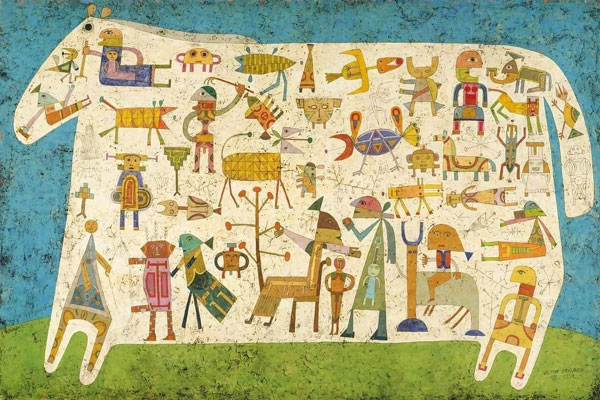
Victor Brauner, Prelude to Civilization, 1954
Where did the beings go who were the models for the masks,
the instigators whom the masks invoke? They were once, at
least in their own eyes, as fully physical as ourselves, a pattern
of vibration that creates the appearance of solidity. They have
disappeared beyond the horizon. They have climbed back
through a ten-d donut hole above the clouds. Enfolded within
their memories, they no longer as completely occupy what we
think of as space. Who knows what percentage of them would
ever want to come back? If a few still care, if they don’t all
hold our actions in contempt, some pass-not film may still
stop them as they’re trying to reach out. The mask allows
their presences to manifest, and it recalls a time before the
worlds had parted.
There was a time when the sky was just a few feet from the
earth. You might turn to look around, suddenly, startled to
feel the hand of a messenger resting lightly on the shoulder,
the channels of light pulsing in his body, his eyes wide as
plates. The future might appear on the surface of the liquid in
a cup. Letters would arrange themselves into epics in the dark
clouds to the north, with no need for an author yet, with
tensions boiling as the scripts divided. Conchs would be
blown to announce the commencement of a battle, a battle
that was no different from a game. The joyous cries of the
wounded would be carried to the Pole Star. Ships would soon
unload their cargo of fresh contestants on the coast.
Back then, to see was a fine art. There were traps and happy
accidents. A number could be up to something. It was all too
easy to insult a god. The vagrant seated at the table, invited in
for a meal, might begin to speak with a scope beyond that of
the assembled elders of the tribe, in a version of their
language that few left could understand. A boy would dream
about a city, a city without shadows and with towers you
could see through, and it would take him a few moments to
sense that he wasn’t still tucked in bed, that he had long since
been transported. He would find himself at a window on the
far side of the zodiac, a triumphal march in progress.
Like a shaft cored from Antarctic ice, encoding ages of
information from the atmosphere, each perfect spring, each
continent-covering cloud, the axis of Omphalos held the
records of past worlds. Such records were a kind of self
-illuminating text. Because humans had not learned to be
nervous about death, or that death was supposed to bring
with it a state of near unconsciousness, they had not yet
realized these worlds were in the past. Back then, all trauma
was part of an initiatory process. Time was a convenience, a
new technology, a crutch. Space was more or less continuous.
There were seed-sounds. There were branches. No
catastrophe blocked one’s passage from one body to another.
You could reach out to pick from a tree, like fruit, the
knowledge of the gods. Much has changed, and our trees are
not similar to their trees. Our contemporary knowledge is no
more than a souvenir.
Do the gods live in cities on the inside of a hollow globe, so
that we stand on them as on the back of a mirror, without
their movements being visible? There is some question, to be
sure, about just who imitates whom, if their movements
determine ours or if ours determine theirs. To see is to
become aware of the hard fact of disjunction. Do we actually
even live upon the surface of the Earth, the true Earth, or, as
Plato argued in the Phaedo, are there two Earths, not one,
and it is not we but the gods who live upon its surface?
We don’t know what the real year is, or how, on the true
Earth, a century may last no longer than it takes to draw a
breath. Heard thousands of miles away, by millions, our
YouTube-assisted voices do not carry. No, they do not carry
the way they should. They are only aimed at others of our
kind. If we have forgotten them, have the models for the
masks forgotten us? Or do they wait, like jilted lovers, for a
small bit of attention, a piece of food, the scent of blood and
rising smoke? Said Homer, “The gods do not require much.”
They still do not require much, only all of ourselves, and even
that we are reluctant to provide.
***
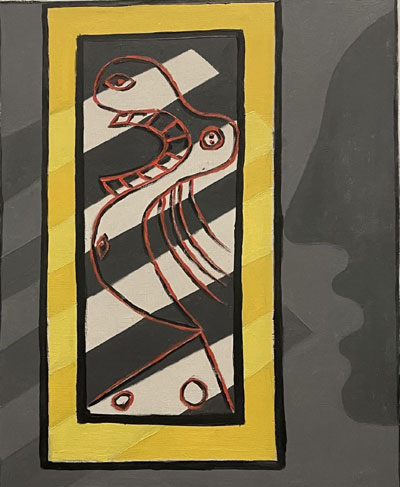
Pablo Picasso, Naked In a Yellow Mirror, 1928
In our culture we think of the mask as something that
conceals, to be used by technocrats at Burning Man or by
traumatized killers in slasher flicks, by Southie bank robbers
or by Dyak headhunters. We are the way we look, just human.
Masks are seldom worn by serious adults. With a smile or a
frown, the mask cues a response, even while the motives of its
wearer cannot be other than ambiguous. The mask
communicates what its wearer would prefer us to believe.
Marcusian free-love theorists turn Puritan. Freedom’s heroes
serve as shepherds for the Oligarchic Spring. That is to say:
the mask distorts. It laughs at the efforts of the thought police,
who cannot determine if their target means what he says, or if
he says what he means. How to separate known unknowns
from totally unknown ones? How sincere can this target be if
there are always more layers of meaning to express, when
behind his literal words, some alien presence crouches?
How easy it is to turn a fact into a symbol, a symbol into a life
or death dispute. The best liars lie to themselves. They do not
know they are lying, any more than you do, reader/listener,
when you tell yourself we’re speaking the same language. A
mask is not practical to wear to work, at least not more than
200 times a year.
Pay no attention to the fallout from your actions. It is true
that certain forests have gone missing. Whole populations
have been ripped up by the roots. If some sea has met its
death by accident, well, what is that to you? The mask that
you wear is a testament to the Power of Positive Thinking. We
are no more than the innocent corporate henchmen that we
seem!
There are, of course, other types of masks that do not look
like masks, but instead, let's say, like a stealth bomber or a
GPS satellite, which from a distance allow us to destroy. To
rename things is to be able to reclassify our shadows. See, it is
those Black Block Anarchists who wear masks. We do not
have any need of them ourselves. Our faces are wide open.
The objective world itself is a kind of mask, for a
consciousness that withdraws to a dimension of its own. Who
knows what we feel? It only matters how we look. The gods
themselves set the precedent for our sociopathic coolness. We
cleanse the fields with plausible deniability from a height, to
broadcast to the world our love for children.
The mask provided to the victim is that of a perpetrator
inverted through a lens, static on a screen, a red and blue heat
outline targeted inside a building. On the World Wide Web,
we can create for ourselves, with some help from our massive
data system, a different interactive mask for each virginal
demographic to be conned, for each tweak of our Neo
-Darwinist agenda, for each jumpstart of the corpse of Calvin,
for each faux-Caliphate that we want to overthrow. One
keystroke by a nerd in Denver could surgically remove a
hospital in Kabul. To grow is to progress, to annihilate the not
-self, to promote the self-as-brand. To progress is to joyously
outsource our own lives. From the many: one, the greatest
good for the smallest percentage. May the force be with you.
May the odds be ever in your favor. Free suicide nets will be
provided at the Foxconn iPhone factory in Zhengzhou.
***
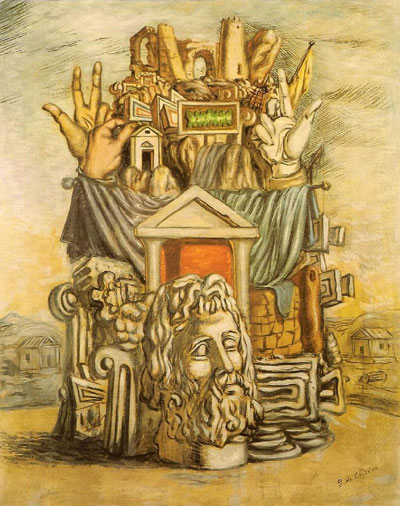
Giorgio de Chirco, Trophy with the Head of Jupiter, 1930
About the military-industrial-infotainment-complex—enough
said; the name itself tells us everything that we might want to
know. Oceania is at war with Eurasia, and it has always been
at war with Eurasia. So too, Oceania has always been at war
with Eastasia, as all user-friendly sources agree. Wars are
always against bad actors, who must be induced to attack us.
No end-game need be specified or imagined. If a hero gets
shot, it is only in the shoulder. The stars are handsome and/or
beautiful. Stocks go only up.
This is not to say that no fluctuations are allowed. Any
downward movement, however, should be seen as just a blip
in a long-term upward trend. The masks of abundance are
traded back and forth. The economy is a tower conjured out
of masks, with a gyroscope on the 52nd year. We have placed
a value on this tower of 40.3 trillion, and we have
cantilevered it to withstand a shift of mood. Up and up it goes.
See it go, but our mood is only as stable as all moods tend to
be. There are those who hate our tower for its height, who
have been sent, they claim, to enforce the law of gravity. The
planet proves a schizoid mother. How odd it is that that our
efforts do not result in success. From the mouth of each mask
on the tower, there shoots a flaming tongue. Winds whistling
through the giantwork prompt a bottomless nostalgia.
And then there is no tower, only wind. The sky smells like the
murder of world. The ash smells a bit like sandalwood. Who
can pick his or her mask from the many strewn about? The
wind has hands enough, yes, to sort them from the wreckage,
but to use these is a skill not easily acquired. Our bones are
cold, and a scar forms on the site of our removal. There will
be no further updates to our programs. What sort of god is
empty space? Skewed harmonies from before the Big Bang
swell, growing louder and more frightening by the minute,
and then more frightening still.
|