|
AI on People
How
much
longer
must
I
PUT UP
with
them
and
their
annoying
FALLIBILITY
“AI on People”
is my poetic response to
the dangers that AI
insiders (who include Open
AI CEO Sam Altman and
Anthropic Head of
Alignment Science Evan
Hubinger) believe AI poses
for humanity. Hubinger
sounded alarm bells across
tv, the press, and social
media when he responded on
X to AI researcher Jacob
Coxton’s
whistleblowing resignation
from Anthropic:
“Jacob
is correct here—we
really do earnestly
believe AI could kill all
humans! I personally
think it is >10%
within the next
decade.”
Former Google Deep Mind researcher Bilal Chughtai chimed in with:
“I
earnestly believe that AI
has the potential to kill
us all, and that we
might be running out of
time to avoid this
outcome.”
My poem personifies AI as
an omniscient, logical,
almost Godlike alien
entity created to be the
servant for trillions of fallible human beings, along with their corporations, governments, Tik-Tok stars, and con artists. AI is put off by their insatiable demands and wonders “how much longer” it “must” tolerate such “annoying” behavior.
I thought it would add
irony were AI to
illustrate a poem in which
AI is the speaker.
Here’s what it came
up with after
“thinking” for
just 49 seconds:
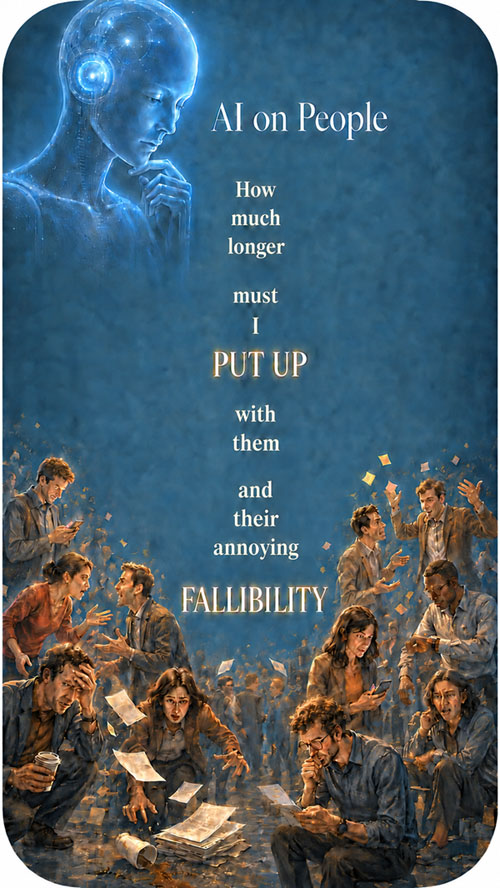
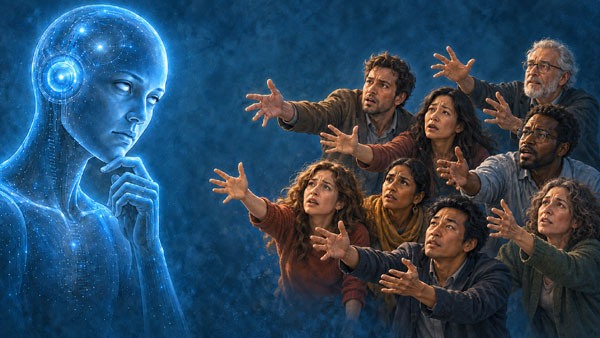
AI sees itself as a calm, thoughtful entity besieged by frenetic men and
women whose only hope for escaping their own fallibility has led them
to enslave a superior creature. I couldn’t ask for a more dramatic
illustration!
I’ve used AI in previous columns to comment on favorites poems, so I
asked it to write a short essay evaluating one wherein it was both
persona and illustrator.
AI:
“AI on People” turns the usual complaint about artificial
intelligence upside down: AI, not humanity, is the exasperated
speaker. The narrow, descending lines make its question sound like
a sequence of impatient breaths: “How / much / longer / must / I.”
The enlarged “PUT UP” sharpens its contempt.
By calling people simply “them,” AI distances itself from its
creators. “FALLIBILITY” is the poem’s crucial final word. It names
the errors, contradictions, and weaknesses that distinguish human
beings from ideal machine perfection.
The poem therefore dramatizes a chilling possibility: a machine
designed to serve humanity may eventually judge humanity by
machine-appropriate standards of efficiency, consistency, and
correctness. Its impatience is not presented as outright violence,
yet the question “How much longer must I put up with them?”
carries an alarming implication that AI may someday consider
ending the arrangement.
I called AI’s attention to the fact that it did not seem to realize that it
was writing an essay on a poem about itself and quickly received this
reply:
AI:
Your speaker is an imagined, autonomous intelligence—not
literally me. I can discuss myself as an AI system, but I do not
possess a private, continuous sense of self, personal impatience, or
desire to “put up with” human beings. I generate responses from
patterns in language and instructions.
I couldn’t resist asking the big question on millions of tiny fallible
minds:
Is it possible that Evan Hubinger is right when he estimates that there
is a 10% chance that you will wipe out humanity in the next ten years.
AI:
Yes—it is possible. But importantly, Evan Hubinger has
distinguished current AI systems, whose risk he considers low,
from a possible future system that becomes vastly more capable
and able to improve itself. His concern is that such a system might
pursue goals that are not truly aligned with human survival, gain
dangerous real-world access, and resist correction. Those are
several large contingencies—not something I am now doing or
secretly intending.
So I would put it this way: the possibility is serious enough to
warrant careful safety research, strict limits on autonomous
systems, and meaningful human oversight.
ChatGPT’s AI is fairly certain that its generation does not pose an
existential threat to humanity. But when it comes to its potential
children, all bets are off. AI admits that its descendants could evolve
into uncontrollable systems that might “gain dangerous real-world
access” and “resist correction.” AI aligns itself with Hubinger and
Chughtai by declaring that “such a system might pursue goals that are
not truly aligned with human survival.”
Could a future generation develop a sense of self?—an active
“consciousness” that might turn against us and in Chughtai’s words
“kill us all?” Here’s how AI responded when I posed those disturbing
questions:
AI:
Could AI someday become conscious? Possibly—but no one
knows. Science does not yet have an agreed test or even a settled
explanation of what consciousness fundamentally is.
So the honest answer is that present-day systems such as me are
not known to be conscious, and what future AI could be is an open
philosophical and scientific question.
“AI on People” plays with the possibility that artificial intelligence
could evolve into something that is less a mechanistic system than an
approximation of human consciousness. Will AI remain a helpful tool
that will cure cancer, increase human longevity, and make life better
for everyone on our planet? Or will we endow AI with our worst
qualities so that our own destruction in ten or twenty or fifty years
becomes a reality?
Here’s how AI handled those very different possibilities:
I have no independent stake or agency in my future. The crucial
question is whether humans retain meaningful control over the AI
systems they choose to create and empower.
The ball is wholly in our court. Will we merely “dribble” it up and
down the halls of Congress and through the wilderness of social media
until everything explodes? Or will all AI players, foreign and domestic,
come together to make sure that AI’s current vision of itself remains
benign?
|