|
The
prolific, early
Modernist writer
Gertrude Stein broke so
many literary and
lifestyle conventions
that it can be hard to
appreciate the extent
and reach of her
creativity both in
writing and living.
Deborah Levy attempts
to illuminate Stein and
her work in My Year
in Paris with Gertrude
Stein: A Fiction.
In the Steiny Road
Poet’s opinion,
Levy’s
“fiction”
is a fascinating
cross-genre work that
combines elements of
two or more established
genres. In the case of
Levy’s book, it
combines fiction
(novel) and nonfiction
(biography and
current-day journal).
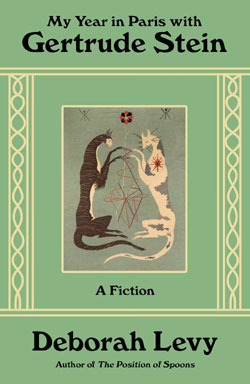
Levy calls My Year in Paris with Gertrude Stein “a fiction” as
it is the story of an unnamed British woman, possibly Levy,
trying to write an essay about Gertrude Stein while engaging
in “current moment” friendships with two women: the French
Franny who has several women lovers and the Danish Eva
who is working on a graphic novel in Paris while her husband
Hamish is in Seattle, Washington, working on a film.
Eva has lost her cat named It. While Franny tries to tame the
mystery of the cat’s name by renaming it Bob, the narrator, in
a Steinian manner, addresses problem after problem that
involves an expression of it. In Chapter 12, Levy introduces a
discussion of it with the English idiom that describes weather:
“It felt like winter had arrived in Paris.” However, what Levy
is after has bigger stakes:
I met Eva for a walk. I thought she might want to talk
about Hamish in Seattle on this day of all days, his plans,
her plans, what he thought about it all. By ‘it all’ did I
mean fascism or authoritarianism or something near it?
Chapter 19 has a rather comic instance of the It problem that
starts with Fanny telling the narrator she is concerned about
how much futile time is being spent on typing out Stein’s
sentences.
She [Franny] thinks Gertrude Stein is depressing me. It’s
true that Gertrude transmits some sort of misery to me.
The exhaustion of reading her prose. The never getting to
the it of it.
The narrator then declares she likes reading books that she
doesn’t understand. To this Franny says, “Why not have some
sex you don’t understand?” Hmm, is Franny offering the
narrator a same-sex experience?
As in a journal, ordinary events of the day are commented on
without necessarily advancing the throughline story. for
example: Chapter 2 opens:
Meanwhile, bombs are falling through the twenty-first
century upon the living and the soon-to-be dead. They all
have names and surnames in our own century, in the
month of November. We are on our screens all the time,
scrolling, scrolling, scrolling through the various wars in
the twenty-fourth year of the twenty-first century.
The short novel of 227 pages is also a stream of consciousness
biography of the hard-to-understand Gertrude Stein framed
in a ping-pong context of her own writings and that of other
writers, such as Sigmond Freud, Gaston Bachelard, Jacques
Derrida, Jack Kerouac, Walt Whitman, and so on.
Characteristic of experimental works that include cross-genre
pieces, Levy attributes quotations with on-the-spot mention
of the publication title, but no further details and never a
footnote or end notes.
Another interesting aspect of Levy’s hard-to-pigeon-hole book
is its feminist features that play off the expectation of
heterosexual relationships. In Chapter 15, Levy provides her
take on the role Alice Toklas played in Stein’s life as her
“angel at the gate,” the guardian who fended off people who
would interfere with either Stein’s work, the relationship
between Gertrude and Alice, or Stein’s identification as a
male. The latter interference involved Alice corralling the
wives and girlfriends of the male writers who came to see
Stein. Levy comments: “I am not sure the wives of the male
writers fared so well as Alice B.” Then Levy drives home this
comment about women suffering discrimination with: “Zelda
Fitzgerald and Vivien Eliot both died in mental asylums.”
The feature of Levy’s book most engaging to this reader is her
use of film-like jump cuts. For example, in Chapter 3, Levy
describes Stein stylishly dressed “wearing a blouse with large
puffed sleeves and a bell-shaped skirt stiffened at the hem
with a lining of horsehair” and peering into a microscope at
Johns Hopkins. This image, in the same paragraph, then
jumps to “She will eventually stare at modern art instead and
try to work out how it is put together. She had no idea how to
put herself together.” Thus, Levy jumps from the portrait of a
well-dressed Stein studying at a prominent establishment of
learning to Stein the discerning collector of modern art to
Stein, a woman who broke all the fashion rules of her time.
Later Levy will talk about Stein eliminating the corset that
girded her fat into curves and how Stein had her partner Alice
Toklas cut her hair short to attain a more mannish look.
These jump cuts possibly suggest a film treatment, yet
another type of genre.
Some readers will assume that Levy is providing well
researched (and therefore correct) information about
Gertrude Stein. While this is the case some of the time, Steiny
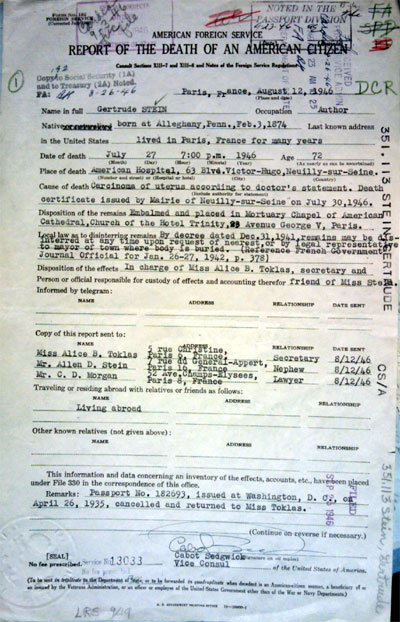
noted several inaccuracies. Levy states in Chapter 4 that Stein
died of stomach cancer. Few Stein scholars have bothered to
look up her death certificate which clearly states Stein’s cause
of death in 1946 was “carcinoma of uterus.” Most likely
Stein’s mother also died of uterine cancer, a condition which,
at the time of Amelia Stein’s death in 1888, was unnamed and
labeled as a female disorder.
In Chapter 13, Levy discusses Stein’s study of bottom
character, a phrase Stein never used. Bottom nature was the
term Stein coined and used prolifically starting in 1898 in her Harvard Psychology Experiment Report and into a string of
her creative works: Q.E.D. (1903); Three Lives, “Melanctha”
(1905-1906) and The Making of Americans (1911-1925). Stein
believed each person had an underlying pattern of behavior
that was a changing mix of repetition, language, human
interactions, and timing. Even as these elements changed, the
individual remained the same person. Levy asserts
interestingly that Picasso got stuck in painting Stein’s portrait
because “he had reached for her ‘bottom character’ and
discovered it was masked.” The odd thing is that, in chapter
31 of My Year in Paris, Levy quotes “The Gradual Making of The Making of Americans” in Stein’s Lectures in America
which uses the phrase bottom nature.
I then began again to think about the bottom nature in
people, I began to get enormously interested in hearing
how everybody said the same thing over and over again
with infinite variations but over and over again until
finally if you listened with great intensity you could hear
it rise and fall and tell all there was inside them, not so
much by the actual words they said or the thoughts they
had but the movement of their thoughts and words
endlessly the same and endlessly different.
There is no mistaking that Levy meant bottom nature in
Chapter 13 and cannot justify changing the term.
Also in Chapter 31, Levy is content to make a remark about
“Alice B.’s recipe for hashish fudge.” By now, most Stein
aficionados know that the recipe came from the Moroccan
-based friend Brion Gysin. They also know that Alice’s
cookbook was late to her publisher and she therefore did not
take the time to test the recipe and discover, oh! cannabis, an
illegal substance!
Levy also mistakenly asserts in Chapter 31 that Stein
delivered medical supplies in both World War I and World
War II. Yes, she drove medical supplies in WWI but no, she
did not drive medical supplies in the second world war. As a
lesbian and a Jew, she was in much more danger in WWII
and in 1939 when that war started, Stein was already 65 years
old.
The final words of My Year in Paris with Gertrude Stein
prove to be circular in the tradition of Gertrude Stein’s
writing. They are said by Eva who has finished her graphic
novel and plans to move to Seattle to live with her husband.
Since the narrator has been unable to complete her essay on
Stein, Eva says she will write the essay for the narrator and
call it My Year in Paris with Gertrude Stein; she suggests it
could also be called The Making of an American. Her
concluding remark is, “Gertrude Stein was a big presence, but
I don’t think anyone can ever get to the bottom of it.”
|



 Writings