|
Two
recent entertainments
share a basic premise:
an acerbic, controlling
woman who has risen to
the top of her
profession and a
younger, more
idealistic woman who is
climbing the career
ladder are forced to
work together.
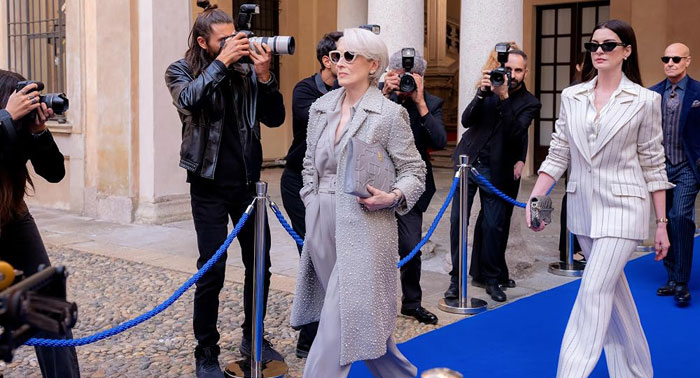
David Frankel’s The
Devil Wears Prada 2, a
sequel to his 2006
film, tells how haughty
fashion editor Miranda
Priestly (Meryl Streep)
and journalist Andrea
“Andy”
Sachs (Anne Hathaway)
are thrown together
again after two
decades. Hacks,the
comedy by Lucia
Aniello, Paul W. Downs
and Jen Statsky that
just ended its
five-season run on HBO
Max, concerns the
fraught collaboration
between hard-charging
standup comedienne
Deborah Vance (Jean
Smart) and quirky
comedy writer Ava
Daniels (Hannah
Einbinder).
In its combined celebration and evisceration of the fashion world, The Devil Wears Prada has
been a cultural
touchstone since Lauren
Weisberger published
the original novel in
2003. Weisberger,
who worked as an
assistant to Vogue editor
Anna Wintour, presented
the hothouse atmosphere
at Runway magazine, the Bible of haute couture, which
was run with icy zeal
by Miranda with Andy as
her much put-upon
factotum. At the
end of the first movie,
Andy leaves Runwayfor
a newspaper career,
while Miranda has
routed tough opposition
to maintain her
position as
editor-in-chief—in
the process
backstabbing her loyal
second-in-command,
Nigel Kipling (Stanley
Tucci).
At the beginning of the
new film, Andy has had
a triumphant two-decade
run as an investigative
reporter. She and
her colleagues are at a
banquet receiving
awards when the news
comes in via text:
they’re all fired.
Miranda, meanwhile, has her own disaster: Runway is
facing enormous public
backlash for running a
puff piece about a
clothing manufacturer
that employs sweatshop
labor. Irv Raditz
(Tibor Feldman), owner
of the company that
publishes Runway, has
a brilliant idea: bring
Andy back to become the
magazine’s
features editor and
lead the damage control.
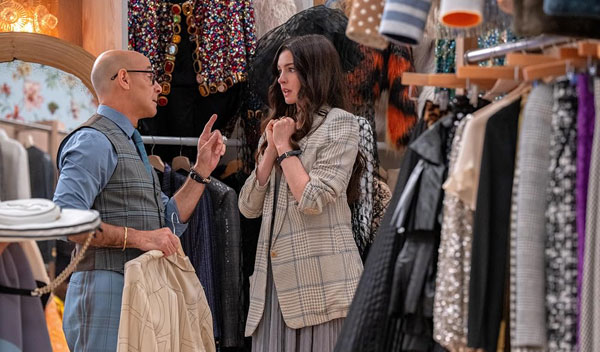
Miranda, who claims not to remember Andy, is openly
contemptuous of her and tells her to her face that she will fail.
Both Andy and Miranda face imminent failure when they must
grovel before a senior executive at Dior who turns out to be Emily
Charlton (Emily Blunt). Things did not go well for
Emily—formerly Miranda’s top assistant—in the first movie, and
after two decades she still bears a grudge against both Miranda
and Andy.
Exactly how Emily exacts her revenge comprises much of The
Devil Wears Prada 2. This plot is tied in with the general theme
of the damage wrought by billionaires, two in particular: Irv’s
oafish son Jay (B.J. Novak) and Bezos-like Benji Barnes (Justin
Theroux). The cost-cutting instituted by Jay provides some
amusement, such as Miranda being forced to fly coach to Milan
Fashion Week. But it would give too much away to say what
Benji has cooked up, and what it has to do with Emily.
In any case, The Devil Wears Prada 2 is a worthy continuation of
the franchise. It’s a frothy confection, filled with glamor, eye
-popping gowns and squads of fashionista celebrity cameos (Lady
Gaga, Donatella Versace, Heidi Klum, Naomi Campbell). Andy is
just as sympathetic and relatable as she was in the first movie;
Miranda and Emily soften just enough at film’s end; and Nigel is
still the slightly prickly but essentially lovable facilitator he’s
always been. Add some actors new to the franchise—such as
Kenneth Branagh as Miranda’s latest husband—and The Devil
Wears Prada 2, like its predecessor, presents as pure fun.
Hacks is also fun, but so much more than that. As an
unrestrained show-biz satire, Hacks is even more hilarious than
Seth Rogen’s The Studio, which is saying a lot. (Rogen has one of
the dozens of celebrity cameos in Hacks, playing strip poker on
TV with Deborah. He loses.) But its outrageousness serves as
backdrop to the deeper story of two women, and how destiny
brings them together, tears them apart, and brings them together
again. The tale of Deborah and Ava has much to say about how
show business warps human perspective, and even more about
how women must hang together to defend themselves against
powerful men.
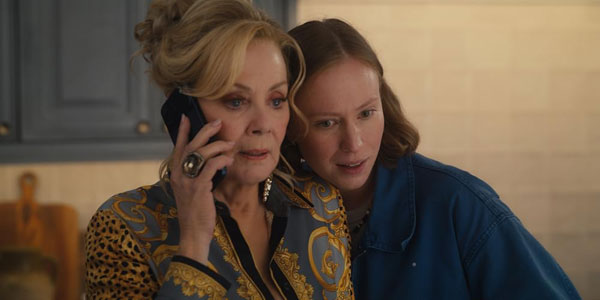
Hacks begins with Deborah finishing one of her residency shows
at a Las Vegas casino. She boards her private jet to Los Angeles,
tapes a segment for her merchandise program on QVC, and flies
back to her mansion in Vegas, where she is greeted by her only
close friends—her two corgis.
Deborah’s act shows signs of being shopworn, and soon casino
CEO Marty Ghilain (Christopher McDonald) tells her that her
residency is in danger. Meanwhile, Ava, a sitcom writer, is out of
a job and unemployable because of a joke involving a gay-baiting
senator that went viral. Jimmy LuSaque Jr. (Downs), manager to
both Deborah and Ava, has a brilliant idea: Ava should work with
Deborah to freshen her material and save her residency.
Neither woman reacts well to Jimmy’s suggestion. “The QVC
muumuu lady?” Ava says. “Didn’t she burn her husband’s house
down?” Deborah has always written her own material and is
offended that anyone thinks she needs help to be funny. “I was
just wondering why you’re dressed like Rachel Maddow’s
mechanic,” Deborah tells Ava at their first meeting.
Deborah suggests that Ava is on drugs. “Do you want me to pee
in a cup?” Ava asks. “Or maybe I’ll just leave a stool sample on
your lawn.”
Ava drives off in her minibox; Deborah comes roaring after her in
her Rolls and cuts her off. She springs out of the driver’s seat and
starts spewing new versions of the joke that got Ava blacklisted.
Ava responds with further one-liners, and their partnership—if
not necessarily their friendship—is set.
Hacks is a delight from beginning to end, although it is unlikely
to attract much of a fanbase from MAGA. Its basic theme is the
overriding, hothouse self-regard endemic to show business,
infecting everyone within it and even some outside of it.
(Deborah’s fan club members, her “Little Debbies,” are monsters
of selfishness who turn on her for every fancied slight.) Deborah
herself does not have a thought that is not related to career
advancement; this has significant impacts on her relationship
with Ava, as it did with her sister Kathy (J. Smith-Cameron) and
daughter D.J. (Kaitlin Olson). To be fair, Deborah has every
reason to hate Kathy, who long ago stole her husband. With D.J.,
a recovering drug addict trying to make it as a jewelry designer,
the situation is more complicated, as everything tends to be on Hacks. The ins and outs of their relationship are too convoluted
to describe here; it’s enough to say that it culminates in mother
and daughter dancing in clown suits on a Mexican stage.
The above paragraph should demonstrate that Hacks is
extremely difficult to summarize. There is simply too much going
on throughout its five seasons, and too many fascinating
characters. I could write a whole column on Jimmy, who makes
Charlie Brown look like Superman, and his ebullient assistant
Kayla (Megan Stelter). Kayla is the managerial equivalent of a
bull in a china shop, with the difference that more often that not
she breaks the right things. In Season 4 Kayla gets her own
wisecracking assistant, Randi (Robby Hoffman). Together they
play not Lucy, but Peppermint Patty and Marcie, to Jimmy’s
Charlie Brown.
And then there is Ava, about whom a series of novels could be
written. An extremely lapsed Catholic with a ditsy mother (Jane
Adams) and a checkered bisexual love life, Ava is no stranger to
careerism, and—without going into detail—she learns some
lessons from Deborah on how to be ruthless. But she is also
optimistic and idealistic, and—again without going into
detail—she becomes the conduit for Deborah slowly but surely
becoming a better person.
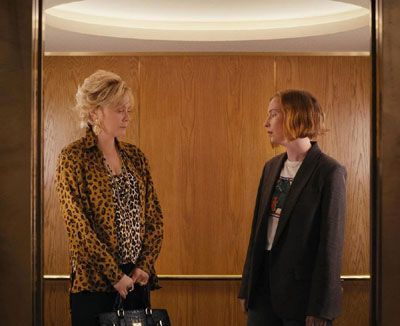
Deborah and Ava’s relationship zigzags throughout the show
between affection and animosity, but by the end they are
BFFs. Some critics have blasted the final episode of Hacks as too
sentimental, and it is certain that the final episode of The Studio won’t be so sweet. But to end Hacks on a cynical note would have
been unbearable. Deborah and Ava have been through too much
together, thanks largely to the billionaires in their lives. Bob
Lipka (Tony Goldwyn), the entertainment mogul who owns the
network that airs Deborah’s talk show, is an amalgam of
everything egregious about American business and everything
sexist about American society.
There are so many great characters in Hacks that I feel like a jerk
not naming them all. I must mention Marcus (Carl Clemons
-Hopkins), beleaguered COO of Deborah’s merchandising
business, his boyfriend Wilson (Johnny Sibilly), his mom Robin
(Angela E. Gibbs) and Robin’s best friend Miss Loretta (Luenell).
There are also Deborah’s housekeeper Josefina (Rose Abdoo), her
personal assistant Damien (Mark Indelicato), her personal
blackjack dealer Kiki (Poppy Liu), tour manager Weed (Laurie
Metcalf), and fellow comedienne and sworn enemy Kelly
Kirkpatrick (Cherry Jones). There are many, many more, but
trust me, they’re all terrific—especially Smart and Einbinder, who
have won multiple awards and deserved every one of them.
A few months ago, as a joke, I posted on Facebook, “Miranda
Priestly vs. Deborah Vance—Who Would Win?” About twenty of
my friends voted, and it was unanimous for Deborah. This is as it
should be. Miranda rules her fiefdom; Deborah, with her
multicolored costumes and bawdy jokes, rules the world.
|