|
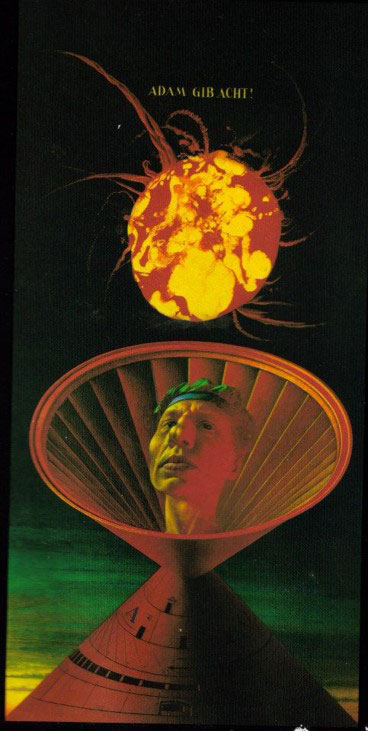
Rudolf Hausner, Adam, Be Careful, 1966
Many previous imperial technocracies have existed, both in
this world and in others, the great majority of which have left
evidence of no more value than a Rorschach blot. There is no
way to count them. There is no way, that is, if we want these
cultures to stay put, if we plan to get the same number two
times in a row. Each functioned according to the physics of its
period. The laws of nature are set as bait for the unwary. We
see what is put before us; we do not see what is there.
It is 1976, let’s say. The spacecraft Viking One transmits
photographs from Mars. Top experts at Cape Canaveral do not
recognize the Pharaoh's mask, staring back at them from the
bare plains of Cydonia, as an artwork made by humans like
themselves. Later photographs, taken by the MGS spacecraft in
1998, are shot from a much different angle, with blurred
details and few shadows. It is feared that the release of sharper
photographs would not put an end to the controversy. They are
then processed through two filters by the JPL staff at NASA,
further flattening out what is left and thus nipping all
conspiracy theories in the bud. Is the Face on Mars a
monument? Is it actually even a face, or no more than a digital
artifact, seen one way in 1976 and another in 1998? It is, at the
least, a clear test of our motives. There are a great many things
that we do not want to know.
Seeing is believing, yes, but true vision is quite different from
belief. We must think in terms of a front and a back, as in a
mirror and its mercury, as in a god’s face and the darkness
underneath. In the same breath, we must think in terms of the
fragile and illusory surface that divides them. Holy terrors slip
from one side to the other. We are ambushed by some violent
form of enlightenment from behind. We see in one direction,
only, or at least in one at a time. We no longer see from each
and all of the 360 degrees of a circle.
Our bodies are the masks for vast energies that we cannot hope
to investigate, not most of us at least, and that we can, even
with the right help, just barely learn to control. We would
prefer to mask these energies. How easy it is to pretend they
never did exist, these energies that turned an egg into a fetus
into a person in nine months. And should we once more start
to feel them bubbling up, we may still tell ourselves that there
is not much going on, that such energies are ours to do with
what we will, at least until we are called to set aside our habits.
Minutes, days, or years may then go by, not that there is really
any difference. All at once, we are seized by the hair. The sky
opens like a camera’s aperture, and then sticks open. A tiny
bird from the preexistent light steps forward with an
outstretched hand, upon which is a talking stone. He has come
to serve as substitute teacher, as a guide. If we dare, we are
free to formulate a question, and the stone will either answer
or destroy us.
We find that obscure glyphs have been tattooed on our chests.
Our science is flawed. Our arts are superficial. We reek of
genocides. We have much to answer for. We do not know if the
light will reciprocate our advances. We are hesitant to
approach it too directly. And yet, how absurd we are. Our
mistake is in thinking that we have some way to hide, that
there is no cost to ambivalence, that the gods have lost all
interest in our actions, that the light would ever allow us to say
“no.” In spite of our reluctance, we find that we have travelled
much farther than we should.
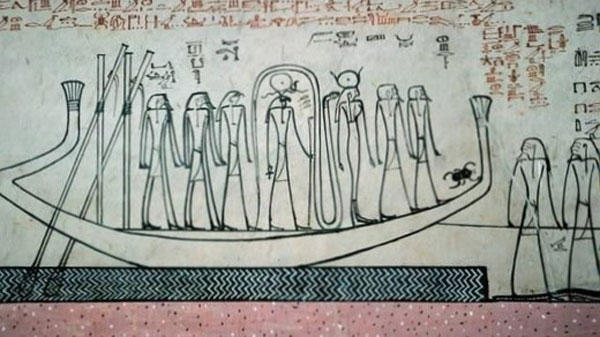
The Solar Barge in the Duat, Tomb of Thutmose III
Our ears ring. Coasts collapse beneath us. In the distance, we
can see the pulse of the derelict reactors, and we find that we
have travelled much further than we should. As we glance up
from our feet, we can see the stairs that stretch to a megalithic
platform, the top and smallest one of five, with its 80-ton
blocks, scorched with flame, heaped with treasures from where
an ocean has withdrawn. There, we confront the Holders of
Our Breath, the Fearsome Catalysts, the Nine, whose eyes are
blank. They have come from the depths to invite us to a
contest, a contest that is always just about to start.
Should we take part, or refuse? To refuse is to decide that the
Earth is far beneath us, that our only goal is joy. To refuse is to
leap beyond space altogether, and there stay, in a realm of
guarded light, to gain knowledge but lose the capacity to act.
To accept is to be swept in a circuit towards Orion, to fight
terrifying battles, to know an even greater joy, only to find that
we must subtly return, to something like our human form, to
the labyrinth of mirrors, to share what we have learned. In the
end, perhaps, there are not two paths but one. Should we
shrink from or yearn for what coils in the abyss? Should we
fear or laugh? Should we cling to light or take part in the
Games? The mask in our hands will inform us of its answer.
What occurs when we climb the steps to the fifth platform,
when we dare to confront the Holders of Our Breath, our
Fearsome Catalysts, the Nine? We are not there an “I,” nor are
we quite a “We.” We are the reenactment of a half
-remembered promise. We are they who must complete the
story that we told. There may not, after all, be tens of millions
of competitors. There may be no more than a fraction of a
fraction, a few to the one side, a few more to the other. These
have come, like the Nine, to start the Games again. In their
museum crates and hypogaea, noseless statues start to breathe.
Our wounds just barely hurt. How wonderful it is to once more
see in all directions. From the depths, the cries of the
dismembered swell, as the waves even now begin to lap the
platform’s edge. The horizon is cold. A red glow kisses it. The
Games darken almost as soon as they’ve begun. Few rules
won’t be broken. A fascist youth stokes the Olympic flame.
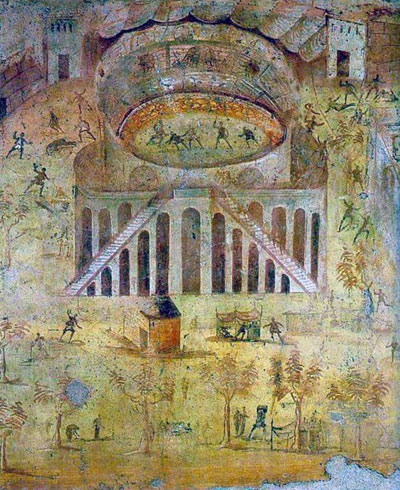
Roman Mural, 3rd century A.D.
Are the masks in the Museum of Interstellar History? No. They
are not in the Museum of Interstellar History, or in the
Museum of Racial Flux, or in the Museum of Atlantic Fog.
Tribes, the rumors of whose deaths have been exaggerated,
have returned from books to take them from the walls. Smoke
pours from the miles of burning oil rigs in Sumer, as the U.S.,
heir to Carthage, dreams of bombing Greenland. Russia, the
Fifth Rome, plots to expand to Dublin in the west, to Cairo in
the south. Luminous orbs appear, for no good reason, by the
thousands. China bars all access to the pyramids on the
Guanzhong plains of Shaanxi.
Why isn’t the Global South content to pay homage to
Ophiuchus, why must they trespass north? Such questions
have been asked not once but many times. Forced migrations
will rename all cultures in their paths. Cars will be swept from
their overpasses. Tornadoes will tell secrets to those with ears
to hear. The Holders of Our Breath, the Fearsome Catalysts,
the Nine, have no real interest in the outcome of the Games,
none that we, in our media bubbles, are now prepared to
understand. A war has been declared on hard technologies, on
the state, on structures that cannot be folded up. The masks
are works of art in progress. Rising up from the cold sea, they
live.
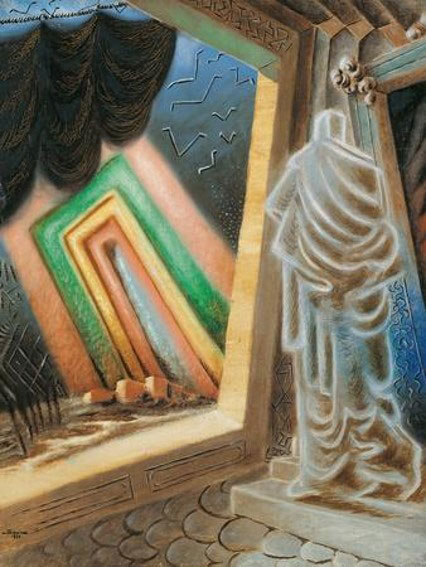
Alberto Savinio, The night of King Solomon 1939
To say to a visitor exiting the museum: “Excuse me, sir or madam, but a mask appears to have attached itself to your
face. It is not yours; please take it off. You look dead. You have
had, for one incarnation, perhaps enough excitement. Here are
your complementary dark glasses. A German Shepherd will be
provided to lead you to a star. Beyond that is the lightning
void.”
|