|
During
my annual jaunt to
London to enjoy the
theatrical riches of
the city, I was struck
by a trend in the West
End to mimic Broadway
in producing ever more
lavish spectacles
reliant on high tech
bells and whistles that
wow audiences. Two of
the shows I saw this
year included ta
dramatization of the Hunger Games at the new state-of-the-art Canary Wharf Theatre and Come Alive – The Greatest Showman at the Empress Museum. Both use immersive techniques and rely on startling and thrilling their audiences with special effects. While one can admire the amount of money London is prepared to spend on new venues (in both these cases purpose-built, temporary structures) to lure audiences, the classicist in me yearns for the West End theatrescape that boasted quirky new plays, masterworks of world drama, Shakespeare, and London’s own original take on American musicals. Thus, it was no wonder that the performance highlights of my trip this year were two iconic classics: Noel Coward’s Hay Fever at the beautiful Wyndham Theatre and Shakespeare’s As You Like It at Stratford-upon-Avon.
Written in 1924, Hay Fever has been dubbed “a comedy of abominable manners.” It is a subtle satire of an English family with Bohemian leanings, who wreaks havoc on the notion of an elegant weekend in the country. At the center of this dysfunctional family is the matriarch, retired diva of the London stage, Judith Bliss, whose real life talent for melodrama quite possibly outshines her stage prowess. Her household is made up of two adult children, Simon and Sorel, who delight in flirtatious games with guests, her reclusive novelist husband David, and her former dresser, now surly maid Clara. Add to this mix the guests each family member invites without consulting the others, and the recipe for social disaster is complete.
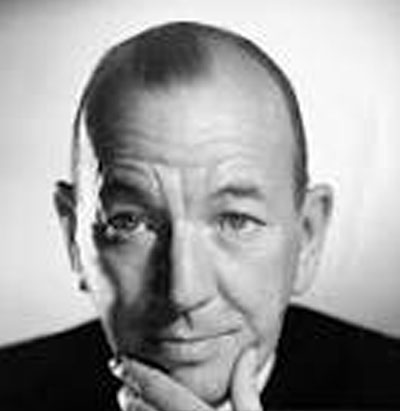
Coward takes us through the mishaps of the weekend with
achingly subtle humor. Every sentence is perfectly calibrated,
brimming with understatement, and loaded with inuendo.
The dialogue is as heady as vintage champagne – which, by
the way, the Wyndham Theatre amply supplies to VIP ticket
holders. The laughs are quiet, but constant, and the entire
two-hour romp is sheer delight.
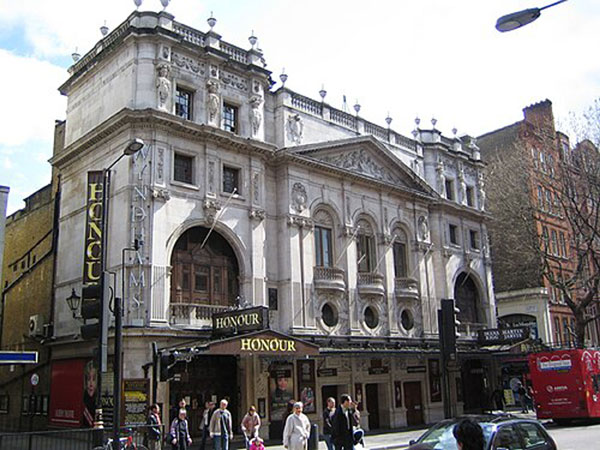
All of this is facilitated by the setting of the gorgeous Gilded
Age Wyndham’s Theatre with its ornate carvings, multiple
boxes and air of aristocratic elegance. The décor by Frankie
Bradshaw with lighting by Oliver Fenwick seems like
beautifully painted watercolors in frothy pastels and gilded
accents. A fire curtain with the tongue-in-cheek image of star
Christine Baranski as a Victorian angel in flight sets the
mischievous tone. The Roaring Twenties costumes are lavish
and at times outlandish adding sparkle to the work.
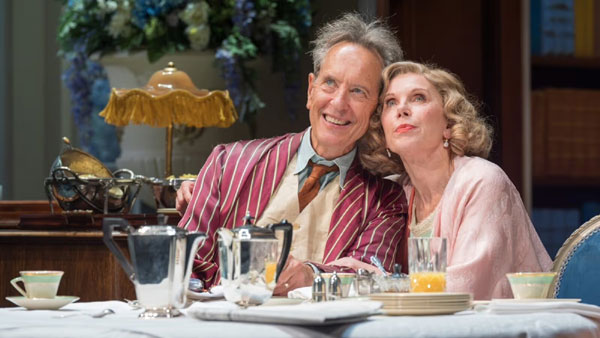
Emily Burns directs with a light and knowing touch and
draws perfectly tuned ensemble performances from the
entire cast. Christine Baranski takes on the iconic role of
Judith Bliss and brings to it a seamlessness with her British
colleagues. Her Judith has the innate zaniness, intimidating
grandeur, and hyperbolic histrionics of a diva, yet somehow,
she manages to retain a core of vulnerability and self
-deprecating humor. As her milquetoast husband, David,
Richard E. Grant cuts a traditional figure who is capable of a
few curve balls himself. Will Close and Ophelia Lovibund as
Simon and Sorel Bliss are appropriately quirky, over-grown
child-like adults playing silly games. Jo McInnes portrays an
amusingly disrespectful servant Clara, while Nancy Carro[l,
Charles Edwards, Ash Hunter, and Lucy Karczewieski round
out the cast as the guests.
This production of Hay Fever has been playing to full houses
and excellent reviews, demonstrating the perennial appeal of
Noel Coward’s work. In an age of what often seems to be the
blight of illiterate use of the English language, Coward offers
an elegance of prose, a complexity of wit, and an unerring
sense for dramatic timing that makes his plays endure.

And, of course, endurance and longevity are only two of the
adjectives appropriate to characterize Shakespeare, whose
1599 comedy, As You Like It, was headlining at The Royal
Shakespeare Theatre in Stratford-upon-Avon with none other
than American Broadway and screen star, Jonathan Groff.
The all-male cast, directed by Daniel Evans, allows the RSC to
take a multi-layered look at the gender swapping implications
of the play in its historic and modern contexts. If the
Elizabethan theatre employed young boys to play the female
roles out of concerns for including women in the rough-and
-tumble life of acting troupes, Shakespeare surely was playing
subtly with the idea of a boy playing a woman disguised as a
man but in love with another man. The complexity of these
possibilities and their modern ramifications come vividly to
life in this beautifully executed visual and dramatic
interpretation.

The physical production is dazzlingly simple and timeless; Set
Designer Anisha Fields creates the all-black-and-white, cold,
hard world of the usurper, Duke Frederick’s, court, which
transforms into the verdant, lush natural world of the Forest
of Arden. Ryan Day’s lighting design strengthens the contrast
between the two realms, and Colin Richmond surprises with
the ageless look of his costumes: Rosalind in a plain charcoal
dress and simple wig which makes Groff seem epicene, then
transformed into his male “persona” wearing hiking shorts
and sporting a short mannish bob. Eschewing any attempt “to
play at being female,” the male cast use their natural voices
and project femininity in subtle, interior ways. Another
striking aspect of the production is the use of Welsh folk
tunes, arranged by Theo Jamieson, to supply Shakespeare’s
song interludes. Evans’ directorial choices include a very grim
and dark, repressive world in the first act of the play, which
gradually is transformed by the forest journey and the truth
gleaned from probing layers of self-identity. Even the fool,
Touchstone, and the melancholy Jacques seem to speak with
a subdued inner wisdom.

The RSC cast is perfection with the poetry of their delivery
resonating throughout the 1000+ seat house. As Rosalind,
Jonathan Groff does not disappoint. If his Shakespearean
delivery is tinged with American vowels and a light tenor
voice, the production finds a basis for this in the line which
notes that Rosalind does not speak like the other courtiers. If
a touch jarring at first, this caveat quickly disappears as Groff
finds a naturalness and eloquence of his own in the dialogue
and in the character of Rosalind/Ganymede. He is not afraid
to suggest the hidden male/male eroticism in Shakespeare’s
scenario and casting, and to find a truly human dimension in
the character, whose trouser dressing is more than a simple
escape from her uncle’s court, but rather a quest for self
-exploration and affirmation of all parts of her psyche.
Other outstanding performances in this stellar cast come
from Fisayo Akinade as a knowing Celia, whose demeanor
both supports Rosalind’s and casts dramatic irony on their
roles. Elliot Barnes-Worrell is appropriately noble as
Orlando; Greg Haiste is a wise and imposing Touchstone;
Gareth Snook makes a winningly plain-speaking Audrey,
while Richard McCabe seems more the philosopher than the
pessimist as Jacques.
Always a pleasure to journey back in time and visit Stratford,
where the 16th century seems to come very much alive, and
where the Bard speaks with the eloquence of a contemporary
superstar.
|