|
Untitled Poem John Keats
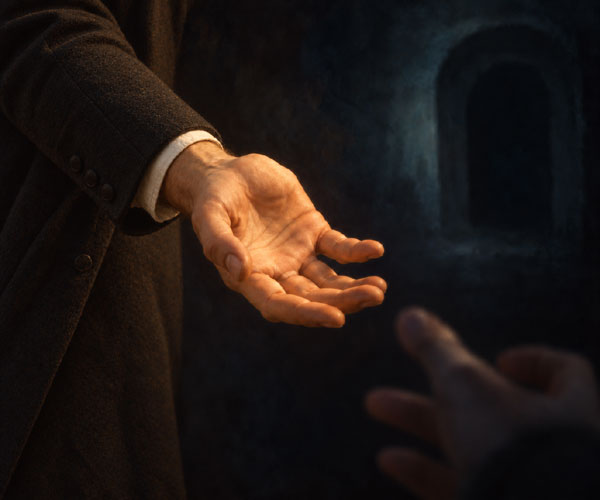
This living hand, now warm and capable
Of earnest grasping, would, if it were cold
And in the icy silence of the tomb,
So haunt thy days and chill thy dreaming nights
That thou would wish thine own heart dry of blood
So in my veins red life might stream again,
And thou be conscience-calm’d—see here it is—
I hold it toward you.
The power of the poem that editors and critics call “This Living Hand”
has never been in question. Because it is untitled and exists only in
manuscript form many critics and editors argue that it is not a
complete poem, but a “fragment”—something Keats started but never
finished.
Whatever his reason for not trying to publish it, I believe that this
poem feels perfectly realized as is and that it is almost impossible to
imagine Keats’ adding anything to it that wouldn’t diminish its power
and ruin the poem.
Kim G. Blank, in Mapping Keats’s Progress, says the short final line
makes the poem “look like a fragment” but admits that it provides a
complete emotional and dramatic ending. It is the muscular
abruptness of the short line, the way its comes at us like a boxing glove
that gives the ending its power.
I wonder whether a preference for prose rather than poetry leads some
readers to find Keats’s poem fragmentary. I’ve noted before in this
column that while it is the mission of prose to give us the world in its
fullest detail, poetry often goes in the opposite direction, eschewing
detail in the interest of making poetry generic and consequently more
universal and applicable to the reader.
For those hankering for prose the poem raises unanswerable questions.
Whose hand is this? To whom is he presenting it? Why the biblical
pronouns? Why, after imagining the hand, entombed, will someone
never be at peace?
In a short story, there wouldn’t be any thous, thys, or thines; readers
would know exactly who was speaking to whom. There’s obviously a
history that has caused a rift between the speaker and the person
spoken to. A short story writer would make it clear as to what was
going on between the parties. We would feel that we were in what we
call the real world.
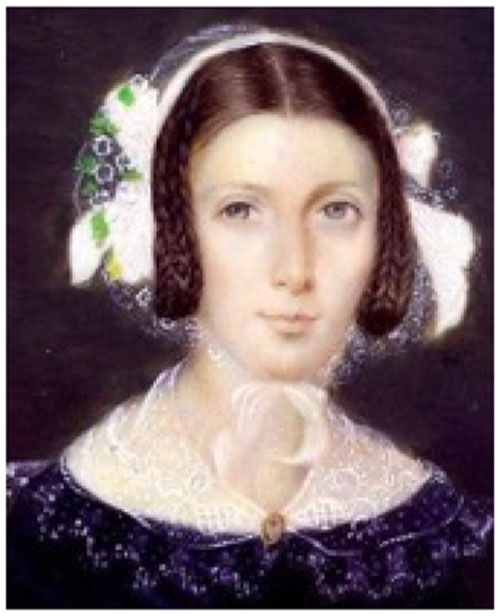
Fanny Brawne
At the time of his death, John Keats was secretly engaged to a beautiful
young woman named Fanny Brawne, whom he hoped to marry.
Suffering from tuberculosis, Keats sailed for Italy in late 1820 in hopes
that its milder climate would cure him; but his health worsened, and
he died in Rome six months later on February 23, 1821.
Readers more interested in the poet’s life than his work may find it
tempting to leap out of the poem and speculate on the possibility that it
was about his relationship with Fanny and his bitterness at knowing it
was unlikely they would get to share a lifetime together. If the
approximate 1819 date editors assign to the poem is correct, however,
that reading is implausible. Keats and Fanny became engaged about
the same time. Keats was not then seriously ill, and the newly
betrothed couple was presumably blissfully happy.
If we are reading the poem qua poem we realize that its originality, its
music, its power depend on keeping all expository details off stage.
Whatever may have been occurring in Keats’s life, he was not a
confessional poet, and he took care to keep any hints of his biography
out of his poem.
Indeed, Keats pushes the generic register higher by substituting the
elevated, biblical pronouns “thou,” “thy,” and “thine,” a total of five
times in addressing the beloved. They are the sort of archaic pronouns
we might expect to find in pastoral poetry. Indeed, one way of looking
at Keats poem is to take it as a riff on pastoral, where a shepherd, more
often than not, upbraids his shepherdess for not requiting his love.
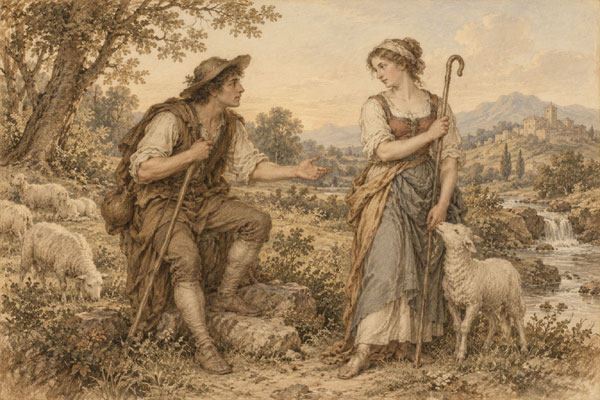
But Keats, of course, is not your typical shepherd. There is none of the
quaint, almost comic pastoral pleading going on here. He who extends
his hand is deadly serious; fully alive, his fingers “warm” and “capable”
of “earnest grasping”; of longing for a robust, rather than fancy
embrace. His carpe diem calls for “red life” to “stream” in his “veins”
again after “the icy silence of the tomb.” His Marvellian coy mistress
will be so stricken by refusing him after he is gone that she will wish
her “own heart dry of blood” to restore him to life and love and thereby
escape having her days haunted and her dreaming chilled.
She is ready, as we are, for the final gesture, the last chance to be
“calmed.” The speaker presents his living hand to her for the last time
(–see here it is–) followed by the devastating challenge of the
abbreviated final line:
I hold it toward you.
No longer those distancing thous or thys, but that sudden intimate
you
, that asks the poem’s also fully alive other to reconsider and reach
across the gulf.
That final word is also crucial for us as readers. So far we could take
comfort in feeling that it is not
we
who are being addressed by the fact
that no one would use those implausible pronouns on
us
. But if we
have ever refused to love or help someone who deserved it, that
you
suddenly reaches out of the poem and that now metaphorical hand
challenges us
as well.
NOTE
Keats always goes for the gold. Could it be a coincidence that what is
perhaps the greatest pastoral poem on unrequited love, Shakespeare’s Venus and Adonis, uses the three archaic pronouns that Keats
employs?
Venus
“Vouchsafe,
thou
wonder, to alight thy
steed” (line 13)
to
“What seest
thou
in the ground? Hold up
thy
head” (line 117)
Adonis
Touch but my lips with those fair lips of
thine
.” (line 115)
Billy Collins has argued that poets sometimes embed a few secrets in
their poems, unlikely to be noted by the public; private jokes to be
savored by the author alone. Did Keats actually use the same pronouns
as Shakespeare as a secret tribute to the Bard?
If so, I apologize for divulging it!
|