|
“Boys think girls are like books,
If the cover doesn’t catch their eye
they won’t bother to read what’s inside.”
~ Marilyn Monroe
(June 1, 1926 – August 4, 1962)
Happy 100th Birthday Marilyn Monroe!
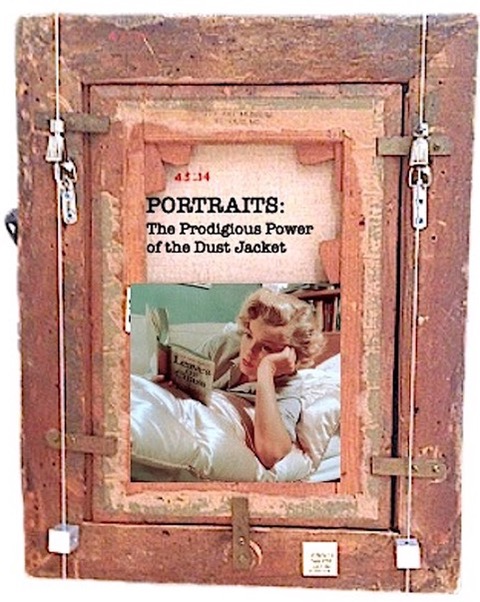
Notwithstanding
her sensual friendship
with diamonds, Marilyn
Monroe was an avid
reader and photos
showing her holding a
book, in this photo the
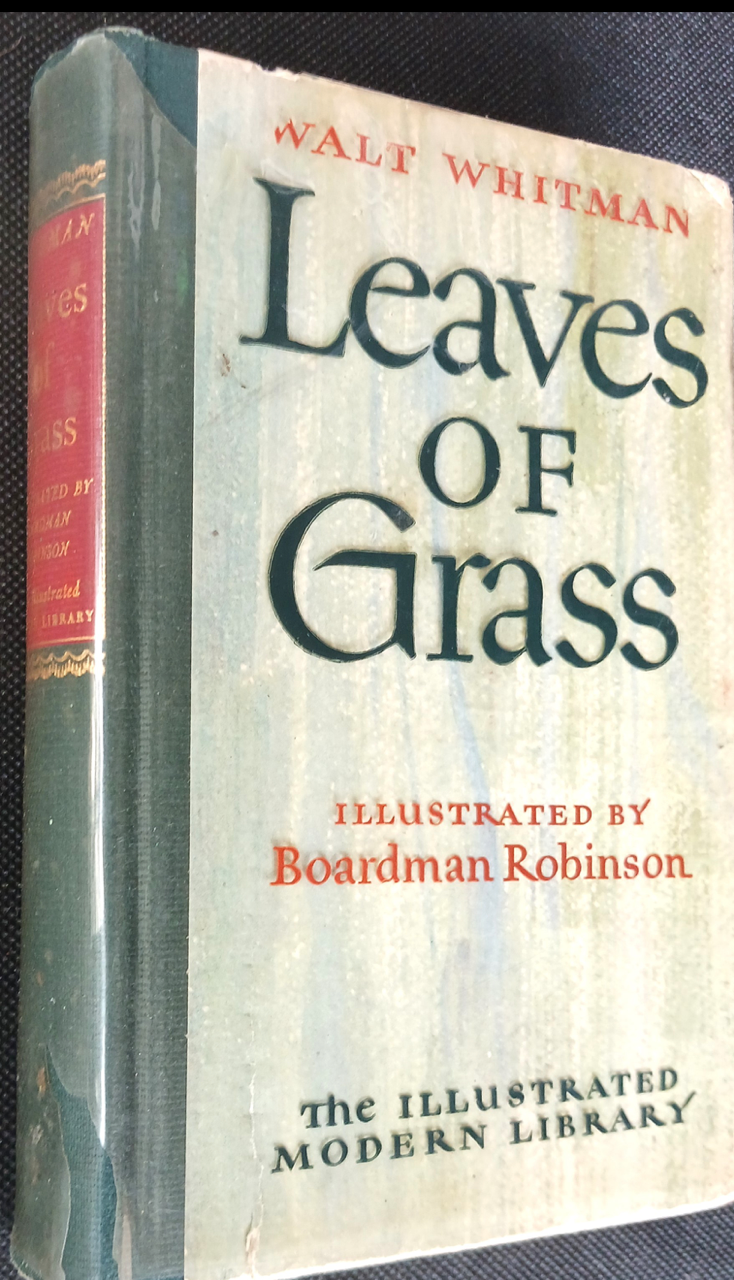
1944 Modern Library
edition of Walt
Whitman’s
masterpiece, may have
been staged but Monroe
was actually an
enthusiastic reader
including between takes
on movie sets. The book
appears to have a dust
jacket in “VG
(Very Good) to
Fine” condition
in antiquarian
bookseller speak.
 |
Her 430-book library contained books ranging from
Common
Sense and Nuclear Warfare
by Bertrand Russell to Dr. Benjamin
Spock’s,
Baby & Child Care,
was auctioned off in 1999 as a part of
her estate and yielded $600,000. (The only book by her husband
playwright Arthur Miller was his little known first novel about
antisemitism,
Focus,
from 1945.) The total auction made $13.4
million. Five of the books were given to Harvard’s Schlesinger library
by an anonymous donor:
My Antonia and
Lucy Gayheart
by Willa Cather,
The Portable Dorothy Parker
,
The Ballad of the
Sad Café
by Carson McCullers and
The Little Disturbances of
Man
by Grace Paley. Monroe had known both Dorothy Parker and
Carson McCullers.
The value of each book in addition to its associative value having
been owned by Monroe may have been determined by the condition
of its dust jacket. 80% to 90% of a rare book’s value is determined
by the condition of its dust jacket.
The dust jacket, which many readers especially young ones, discard
particularly once the edges have become chipped or ripped, is, for
any book dealer and collector almost sacrosanct. It is so hallowed
because of the value it adds to any hardcover book. How did this
come about?
The on again, off again history of the dust jacket aka dust cover or
dust wrapper dates back about 200 years. Two books vie for the title
of first dust jacket: a German book from 1819, Neues Taschenbuch
Von Nürnberg (German Pocketbook of Nürnberg), and an 1829
published English annual, Friendship’s Offering of 1830 .
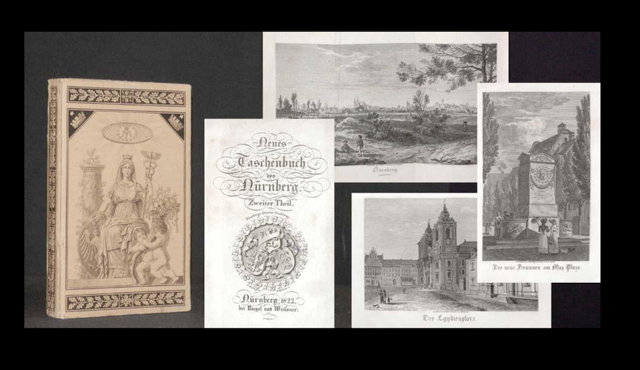
Early dust jackets were often sealed wrappers, known as "sheaths,"
designed to cover delicate silk or paper bindings during transport
and were often discarded after the books were sold. By the mid 19th
century, they became plain brown paper book covers used to protect
the front boards of the books which were now decorated with
embossed designs and gold lettering. These too were discarded once
a book was sold. Not until early in the 20th century did colorful dust
jackets begin to become popular.
These noteworthy covers became a marketing tool enticing book
buyers in bookstores and in window displays. The front and back
flaps and back of the dust jacket offered places for text about the
book, it’s author’s biography or “blurbs” from reviewers. Artists were
often hired to design dust jackets adding another dimension to their
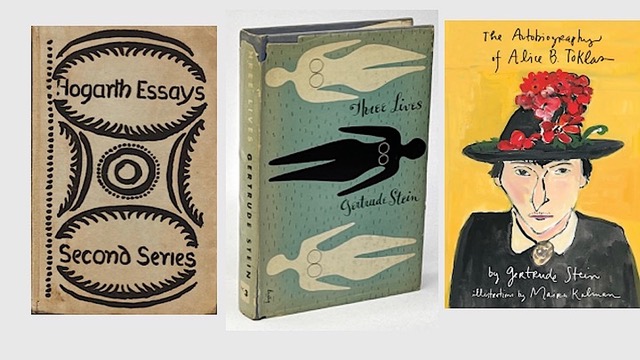
desirability and value. Three books by Gertrude Stein show how
artists showcased their work. One is directly on the book’s front and
back boards (no dust jacket) while the other featured a design very
representative of the artist’s style. The cover design of
Composition
as Explanation
(1926) is by Vanessa Bell published by Virgina
Woolf’s Hogarth Press. The Modern Library edition of
Three Lives
with the dust jacket design by Alvin Lustig reflects the period’s
design flare. Most recently artist and writer Mira Kalman illustrated
The Autobiography of Alice. B. Toklas
with her recognizable
style and humor.
 |
Now to the book value phenomenon. Since many dust jackets have
been discarded or heavily damaged by either age or abuse, books
with them intact and in good condition especially ones with a
relatively small print runs, have attained value. Then too the
increased interest in rare book collecting facilitated by the internet
has caused prices to increase. Lastly, there is the unexplainable
behavior of obsessed collectors whether books, baseball cards, Pez
containers and on and on, that cause prices to rise.
In 1925 Charles Scribner's Sons printed 20,870 copies of F. Scott
Fitzgerald’s
The Great Gatsby.
At first the book was not a great
success, and it took several years before an additional 3,000 were
printed primarily to correct a number of typos. The original dust
jacket was designed by a young artist named Francis Cugat and
became known as the “Celestial Eyes” cover, ultimately becoming his
most famous work.
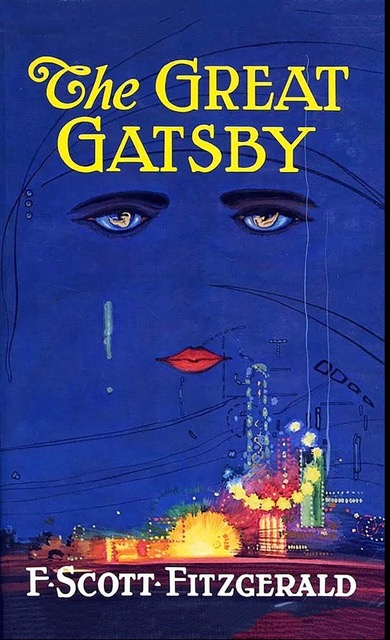
The dust jacket has also been called “the most expensive piece of
paper in literary history” since first editions in “fine” condition with
its dust jacket have sold between $140,000 to over $400,000.
Authentic first editions can be identified by the typos in the text and
a typo on the back flap of the dust jacket where the “J” in “Jay
Gatsby” is lower case. Without a dust jacket? First editions sell
between $1,500 to $5,000.
A few other books and their values with and without dust jackets:
The Maltese Falcon,
Dashiell Hammett (1930)
:
with $36,000+,
without $4000-$6000.
Casino Royal,
Ian Fleming (1953) with $50,000+, without $4,000
or less.
The Hobbit,
T. L. Tolkien (1937): with $250,000, without $10,000
- $40,000.
The list can go on and on with prices changing daily as antiquarian
booksellers and auctioneers acquire and sell more and more rare
finds.
Of course, those precious dust jackets need protection but it was not
until 1939 that Arthur Brody came up with the now ubiquitous
plastic that has been used on millions of books. While he was an
engineering student at Columbia University, he removed an
emulsion from some film and created a plastic covering from it. The
soon to be announced Brodart cover is now available precut in
various sizes or on rolls that can be cut to size. Brody died in 2012,
but the company’s headquarters in Williamsport, PA continue to sell
the book covers and a variety of other products and services.
The future of dust jackets may be uncertain as more and more
hardcover books, both fiction and non-fiction, are published with
laminated covers. Some children’s books are often still published
with dust jackets with the same design laminated on the book’s front
boards. More and more laminated hardcover children’s books are
becoming common with books for adults slowly following. The
reasons are undoubtedly economic and ecological.
So, where did you put those dust-jacketed books that are now
classics that you had in your dorm room in the 1960s, 1970’s or
1980s or those you donated to the library book sale (these of course
will not be covered with a Bodart cover before the sale)? And as for
Marilyn Monroe at 100? Just ask ChatGPT…
* * *
PORTRAITS Book of the Month

A surreal tribute to it.
“Eva called to say she had lost it.” page 1
UK and American editions (2026) with different dust jackets.
|