|
For
Father’s Day, the
Steiny Road Poet offers
a discussion of
“He and They,
Hemingway,”
a portrait of Ernest
Hemingway written by
Gertrude Stein in 1923.
It was her goodbye gift
as he and his first
wife Hadley Richardson
were leaving Paris for
Toronto, Canada, where
they would give birth
to John Hadley Nicanor
Hemingway. The baby,
who Hadley nicknamed
Bumby, would know
Gertrude Stein as his
godmother.
He and They, Hemingway
Among and then young.
Not ninety-three.
Not Lucretia Borgia.
Not in or on a building.
Not a crime not in the time.
Not by this time.
Not in the way.
On their way and to
head away. A head any
way. What is a head. A
head is what every one
not in the north of
Australia returns for
that. In English we
know. And is it to
their credit that they
have nearly finished
and claimed, is there
any memorial of the
failure of civilization
to cope with extreme
and extremely well
begun, to cope with
extreme savagedom.
There and we know.
Hemingway.
How do you
do and good-bye.
Good-bye and how do
you do.
Well and how do you do.
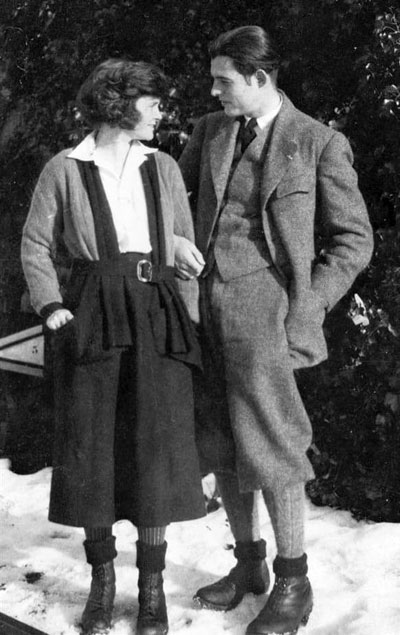
Juxtaposed with the name “Hemingway,” two nouns stand out: Lucretia Borgia and savagedom. The reference to
Borgia, the
purported femme fatale
at the end of the
1400s, might be a
backhanded compliment
about Hemingway’s
masculinity, i.e., a
nod to
Hemingway’s
prowess with women. The
lines that precede the
mention of Lucretia
Borgia might indicate
something
like—among
[women] and then [he
is] young /Not [unlike
that 13 year-old-girl
who in] ninety-three
[—1493—married
her first husband who
was 14 years older than
she was]. Meanwhile,
Hadley Richardson was
eight years older than
Ernest Hemingway.
Allegedly, he picked
her because she was a
nurturing, maybe
motherly, woman who was
independently wealthy.
She was a practical
choice since Hemingway
had no financial
resources and was
trying to establish
himself as a writer.
Savagedom appears in the largest stanza of this prose poem. In
1923, the reference to “the north of Australia” points to a
climatically extreme land (very hot and subject to monsoon rains)
populated mainly by indigenous people who evaded subjugation
by colonial rulers. By the definition of colonial officials,
indigenous people are not civilized and are therefore savage. The
word extreme appears three times in the last sentence of this
stanza. Additionally, there is an undercurrent of sex as suggested
by the words head (think give head), know (think know in the
Biblical sense), and begun (think birth of a baby). So, what is
Stein saying about Hemingway? Maybe that he is a virile, wild
man, a rule breaker, pursuing his own path, and courting danger
and violence. What we readers know about Hemingway over the
course of his life is that he loved bull fighting, boxing, deep sea
fishing, alpine sports, wilderness hiking, and engaging in war.
Stein’s poetic structure in this cubist portrait of Hemingway often
indicates what she wants to emphasize. Start with the title “He
and They, Hemingway” contains the rhyme they/Hemingway. A
reader might question what they has to do with this portrait?
Perhaps Stein is indicating Hemingway is an exceptional man
among men. Moreover, the first line— Among and then
young—poetically underscores Hem (a nickname) at this
time—then—Hem/then is among [men a] young [one].
Hemingway was 24 years old at the time of Stein’s portrait. By
1918 (he was 19 years old), he had already been severely wounded
in World War I as a volunteer in the American Red Cross Motor
Corps in Italy.
In the fifth line—Not a crime not in the time—could indicate that
Hem might be pushing the limits of what is legal. Or maybe that
crime/time rhyme is suggesting that his leaving Paris was not a
good idea for his career path—Not by this time/Not in the way.
Maybe that the family way would get in his way and decapitate
the writerly/intellectual goals he might set for himself. Stein
drums four times on the word head. It is as if Stein is asking does
Hemingway have a good head on his shoulders and is he making
a good decision? Is he blinded by sex? Interestingly, Stein offers
the rhyme between begun and savagedom and this rhyme pairing
comes with the repetition of the word extreme.
The conclusion of the portrait repeats how do you do three times
which emphasizes that Stein was concerned about Hemingway’s
welfare.
The follow-up to the story of Hemingway leaving Paris is that he
became a father when Hadley gave birth to their son October 10,
1923, in Toronto. They returned to Paris in January 1924. In 1925,
they became friends with Pauline Pfeiffer. Pauline and Hem
became lovers in the spring/summer of 1926, and Hadley asked
for a divorce in the fall of 1926 which was finalized in January
1927.
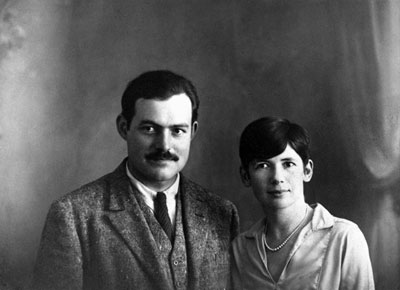
Pauline and Hem married in May 1927. Eventually, Hemingway
would have three sons—two with Pauline Pfeiffer. His youngest
son, Gregory, transitioned to a woman and took the name Gloria.
The Steiny Road Poet tips her hat to Gertrude Stein for her
prescient portrait of Ernest Hemingway who would marry four
times to Lucretia Borgia’s three. Even as a young man, Hem was
the rugged wild man that Stein suggests and that persisted in a
detrimental way until his suicide by shotgun in 1961. Stein’s
concern for Hemingway’s welfare was also intuitively visionary.
|




 Writings