|
For
a first impression
of the show I turned
to YouTube. The
trailer and brief
excerpts gave the
impression of a work
full of ideas and
brilliant
stagecraft, with the
usual excellence of
the Joffrey dancers
on display. But
trailers can trick
you. The performance
I saw was not what I
expected.
Swedish choreographer Alexander Ekman’s Midsummer
Night’s Dream has no relation to Shakespeare’s play, Mendelsohn’s
opera, or Ingmar
Bergman’s
summer movies. The
one association I
found was Woody
Allen’s romp, A
Midsummer
Night’s Sex
Comedy -- albeit
without the central
chase after sex.
Ekman, who is
not attached to any
company, devised the
ballet for the
Swedish National
Ballet in 2015,
adapted it for the
Joffrey Ballet in
Chicago, in 2018,
and revised it again.
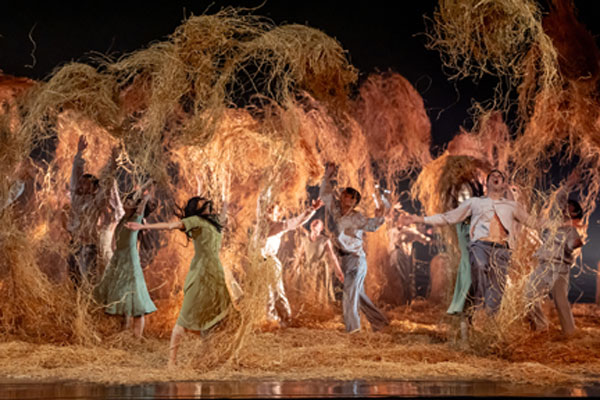
The night begins with a sleeper lying in an iron-framed bed in
front of the curtain. A digital clock above says June 19, 2039 and
at times clicks forward to the next day and back again. The
sleeper of the future is raised by a young woman who hands him a
sheaf of hay. They cross through the curtain and, with a bang, are
in a crowd of 40 dancers in a field of hay. The light is murky
-golden like a midsummer night in the high north where the sun--
a cluster of halogen lights -- never goes down. Or is it an artificial
sun on an outer-space planet? The crowd is throwing sheafs of
hay in the air in wild arcs, catching it and thrashing it up again.
It’s a stunning scene accompanied by a (hardly visible) backstage
band. The six musicians play an attractive, inventive score by
Mikael Karlson -- a mix of classical, contemporary, folklore and
pop.
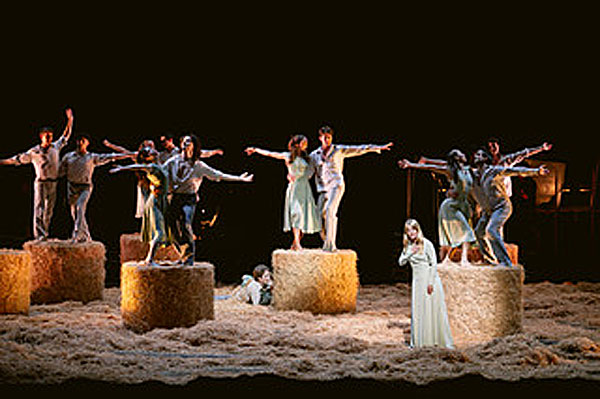
But after this promising start, something odd happens: the
repetition just goes on and on and does not seem to lead
anywhere. The frenzy turns stale as there is no development or
crescendo or new idea. It just stops and everyone lies down while
indie rock vocalist Anna von Hausswolf wanders between the
bodies in a long white dress. There is no connection between her
and the dancers. She stays detached, singing in a birdlike voice
with plaintive, Asian-style high notes. Singing about Swedish
trolls and unicorns? Who knows?
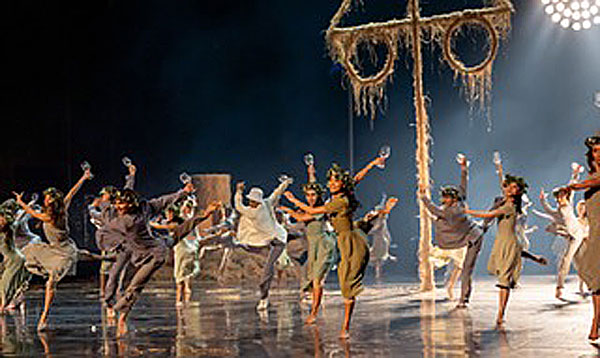
Another scene starts: the group, in simple cotton summer garb,
cleans up the mess and rolls bales of hay around in a jubilant
mood. Some unexciting flirtations happen on top of the bales. A
May pole is set up, they circle it, put flower crowns on their
heads, and are having a jolly good time running and drinking and
kicking up their limbs. One group runs back and forth with a
shaky party tent, then suddenly all are running with umbrellas
while one man crosses on a bicycle. All of it is accompanied by
loud hollers and scrams of laughter, which spells trouble if the
audience sits there staring blankly, not getting the vibe.
The problem is that in all the noise and commotion -- executed
with amazing verve and precision -- nothing arresting is
happening. Certainly nothing futuristic --rather the opposite: a
repetition of the well-known, banal and conventional. The eye
doesn’t know where to look or what to follow as the activities are
spread across the stage like a zillion little pieces of a puzzle that
never comes together to form a picture or a story or convey a
purpose.
I was, to say it frankly, surprised to be rather bored. My interest
picked up at the end of the first half when the dancers settled
around a very long table, banging their glasses and heads down in
unison, in a stomping beat. Now, I thought, something is coming
together to be revealed. But again, nothing emerges. The
stunning violence just peters out, ending with everyone half
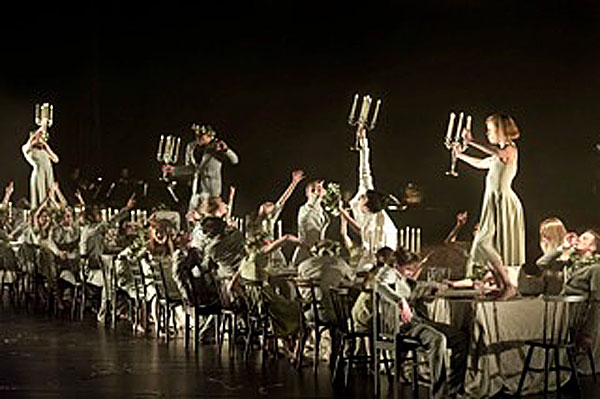
-drunk hanging over their chairs. Candelabras are brought in, a
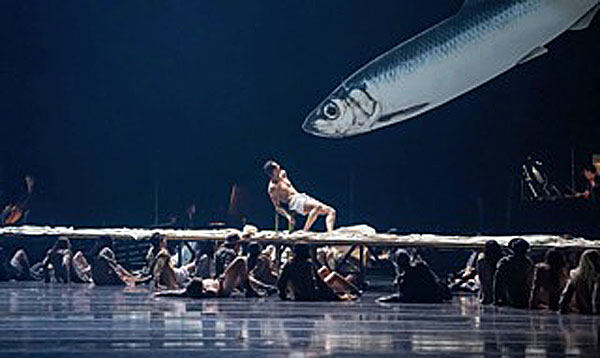
male dancer with a chef’s hat stalks on pointe across the table. He
sets down a chair for another man, this one in underwear, and a
giant cardboard fish floats down toward him. Something fishy
aboard?
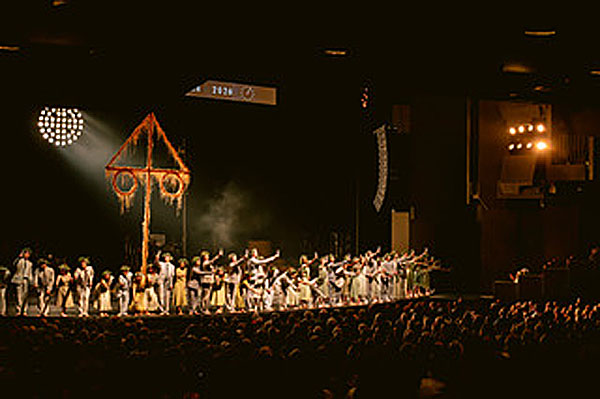
The romp finally stops and all the dancers with their wine glasses
line up at the edge of the stage. When they stand there, toasting
and preening with self-satisfied smiles, the audience finds it
funny. Perhaps because this obvious citation of Pina Bausch’s
iconic lineups has a personal charm even though it’s purely
vanilla, missing Bausch’s provocation.
The second part starts with the same sleeper, now waking up to a
nightmare. The stage is black, a bed hangs Chagall-like in the air,
and all kinds of clownish and grotesque figures twist and twirl
and run around -- men on pointe and surrealist men in suits
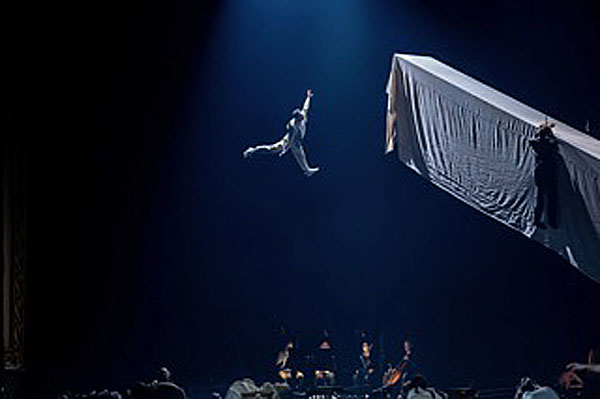
without heads. Now the long banquet table is lifted up on one end
in a perilous angle. Candelabras are everywhere, the fish
descends again and threatens a dancer who falls off the table as if
from a cliff. In the merry chaos below, several male dancers race
across the dark stage with their female partners tossed around
and thrown over their shoulders with violence -- a moment of
excitement and disbelief until you notice the women are cloth
dolls. Suddenly three women appear in men’s shirts with sexy legs
in pointe shoes, hair flowing. To a strong percussion beat, their
strutting and turning brings a marvelous cohesion to the stage.
The rhythm and unity of their movements is more than a relief
from the chaos--it’s pure dance, beautifully executed--the high
point of the evening.
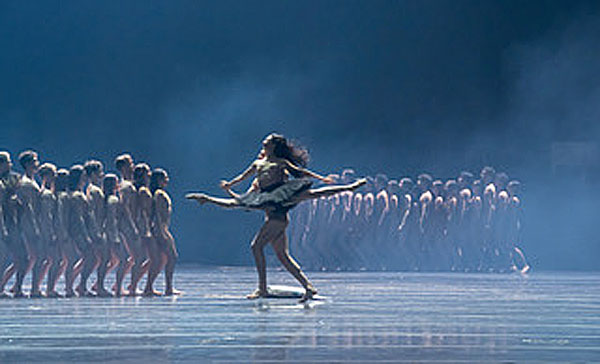
The men, all in underwear, now also move in formation: two
troops in the nude stomp in flat-footed lock-step like human
centipedes and bump into each other to comical effect
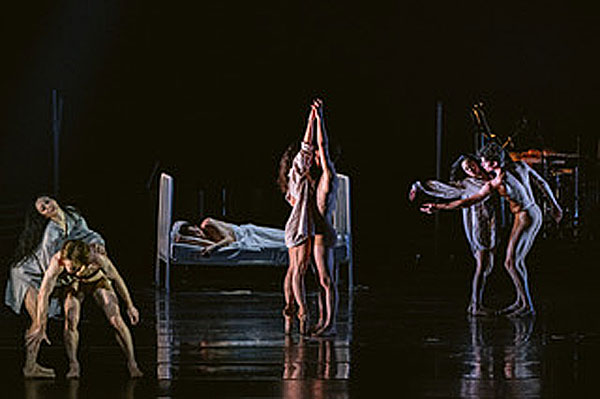
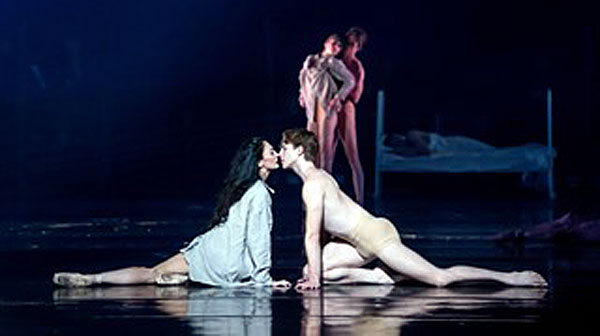
How could a Swedish midsummer nightmare--whether in the
past of in the future-- not finish with a sex scene? The three
women couple with three males and engage in some tantric
exercises and surely entice some spectators when they grind on
the floor in missionary position. Then the singer reappears for the
long overdue lullaby of the end.
Photos: Cheryl Mann
|