|
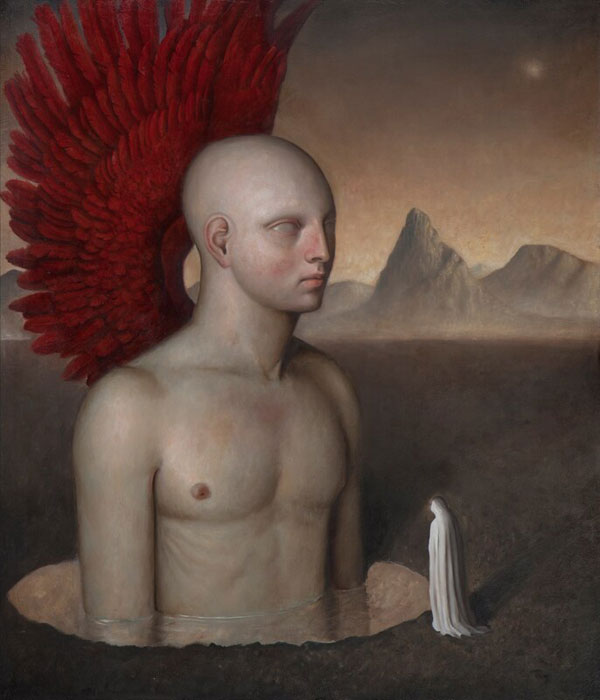
Alessandro Sicioldr, The Genius of the Abyss, 2017
If we are a storehouse for the “seeds of every form and the
sprouts of every sort of life,” as Pico della Mirandola argues, who
knows but that we might not scare ourselves? We are once more
in the “interregnum” that Antonio Gramsci described in his
Prison Notebooks in the early 1930s, a “crisis that consists
precisely in the fact that the old is dying and the new cannot be
born,” in which “morbid phenomena of the most varied kind
come to pass.” A more colorful mistranslation of this last clause
reads, “Now is the time of monsters.”
Mathematician Vernor predicts, "Within thirty years, we will have
the technological means to create superhuman intelligence.
Shortly after, the human era will be ended. Whether that means
extinction or some post-human physical form is secondary to the
fact that the old rules of being human will no longer apply." To
this glowing scenario, CEO of Open AI Sam Altman adds, "AI will
probably lead to the end of the world, but in the meantime,
there'll be great companies.”
Once, we were not so easily impressed. We had not yet
volunteered to be eaten by the gods, they to whom we had
recklessly given birth. We were not afraid of giants, who burned
as brightly as atomic bombs, nor of tiny beings with large eyes,
who were skilled at creating simulacra. Our craniums were large,
and open at the top, but we did not necessarily need large bodies
to go with them. One size fit all. The great assembly hall of the
heart was almost endlessly interactive. Mercury had attached its
power to our ankles. We did not need wings. Few realize that the
oceans fill the footprints that we left, that megaliths mark the vast
multitude of our navels, or that the sky is filled to overflowing
with our tears.
Much stupider than they think, Earth’s top one percent are
nonetheless quite adept at playing games. Let us posit: that they
rule by reactivating some antediluvian trauma, the fear of which
has been bred into our bones, the records about which have been
hidden in the coils of junk DNA, which they, and they alone, have
somehow learned to read. Such feats of micromanagement! All
data is then made to correspond. Not being actual prophets, of
course, their reading of these records is hit or miss at best. “As
you are figuring out the world,” they say, “we will have
manufactured a new one, and then another one after that!” This
does not mean that they are actually in charge. Like us, they are
subject to whatever spells they cast, and, as the apparatus of the
Great Year turns, they are swept along with the other 99 percent.
No part can ever be taken from the whole, nor does the One
increase when added to itself. We move as One, unconsciously,
and pushed forward from behind. At one scale: ideologies at war,
the clash of genomes in the dark; at another scale: a dance of
resonant geometry, the living library of space, of which we can
become at least partially aware.
As we free ourselves from the common wisdom, paranoia may be
the most immediate of temptations. All conspiracy theories may
be true, or none of them, or a fact from this one and an archetype
from that one, but in the end such labyrinthine explorations may
not lead to greater freedom. The trap is this: that we are always
the good guys, and someone else is always to blame for every evil
in the world.
As citizens of the greater city of the cosmos, who have now been
grounded, our job—should we choose to accept it—may be to cut
through the layers of obfuscation that divide each person from
the core of his/her power, so that each may once more serve as a
kind of movable Omphalos. We have only to discover the most
efficient means. We have only to determine the best moment to
move forward, when also it might be better to hold back.
In 333 B.C.—a most symbolic date!—Alexander the Great
marched his army into Gordium, the capital of Phrygia. There, he
encountered an ancient wagon, its yoke tied with several knots all
so tightly entangled that there was no way to see how they were
joined. Phrygian tradition held that the wagon had once belonged
to Gordius, the father of King Midas, and an oracle had declared
that any man who could unravel the knots was destined to rule all
of Asia. According to the chronicler Arrian, Alexander was
instantly overwhelmed with a desire to untie the knot. After
wrestling unsuccessfully with the ropes, he suddenly stepped
back and exclaimed, “What difference should it make how one
manages to undo it?” He then drew his sword and cut the knot in
half. That same night, Gordium was rocked by thunder and
lightning, which Alexander and his men took as a sign that he had
pleased the gods. He did to on to conquer much of Asia, before
dying unexpectedly at the age of 32.
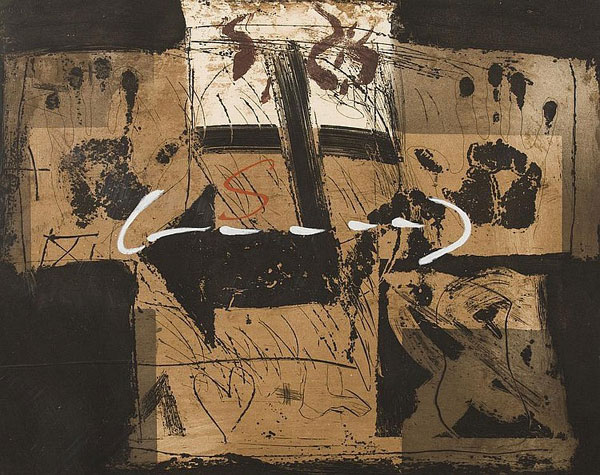 |
Antoni Tapies, Composition with Cross, 1975
Appearances to the contrary, it is possible that the things that
matter most are actually very simple. To see fully may be to know
what to subtract, to know what debts come attached to the very
fact of our breathing. To act clearly may to act from more than
one location, to liberate the subtle genius of the Zero. Each thing
having happened a great many times before, we should have long
ago grown bored with making new mistakes. How is it we have
not? Why do we take so much pleasure in judging ourselves
harshly? We may want to pose such questions to all the Buddhas
we have killed.
***
Gently but persistently, we must bring our attention back to what
I will call the “Boy Scout (or Girl Scout) Code of Conduct,” as this
was understood by the Ancients. The 21 “Anamnesian Maxims”
that correspond to the seven “Anamnesian Virtues” are below.
These are formatted as injunctions. To the extent that they can be
interpreted at all, there are some that must be followed to the
letter. There are others that might put the practitioner into
conflict with the Authorities. In your cultivation of virtue—or
“virtu,” if you go with the classical understanding of the
word—you must read not only with your own eyes but also
through the eyes of your opponent. You must read between the
lines, as well as what is on them. Obey at your own risk. These 21
“Anamnesian Maxims” are as follows:
1) We must love to act well for the sake of acting well; all action is
circular, and no Uroboros can remove the tail from its mouth.
2) We must work hard and stick to our projects through any and
all obstacles, until, as if by magic, we one day finish what we
started. Looking back, we must thank all of those forces that
conspired to destroy us. We will have died more than a dozen
times since we set forth from our blackened port. We must not be
so naïve again.
3) We must learn how to accept the full responsibility for our
actions, and be the first to gladly admit it when we are wrong. If
we discover, as in a dream, that we have caused harm to the
innocent, we must accuse those who have dared to point their
fingers at us, for it is they who have tainted our otherwise spotless
minds.
4) We must cultivate a smile, and be able to transmit warmth
from the solar plexus. It is in this way that our energy will tempt
space to self-organize. As much as does the Sun, we will then be
able to micromanage each event.
5) We must be willing to meet each person on his or her own
terms, however self-deluded or sociopathic they might be. We
will know that we have succeeded when their flaws become an
almost exact mirror-image of our own. We must then kiss the
horror that confronts us in the mirror.
6) We must be generous with our friends, but more generous with
our enemies. We must hold them as close as Teddy bears. For
they MUST be kept off balance. We must trust that our sense of
style will make up for the catastrophic damage that we cause.
7) Putting fears aside, we must do our best to act with some
appropriate degree of courage, which may mean standing still.
We must practice death, as though our lives depended on it, and
be willing, at any moment, to shrug off what we love.
8) We must speak honestly, to the extent that we can hide behind
a mask.
9) We must keep to the Mean. We must do nothing in excess,
except when we choose to violate this rule. This is part of the
natural equilibrium of the Mean. Lacking excess, it would not
know what it is, or how to tell its butt from its elbow.
10) We must act justly. We must treat others in the way that we
would want them to treat us, especially when they deserve a good
slap across the face, which, at the appropriate moment, we must
know how to apply.
11) We must kill first and ask questions later, like the gods, so long
as we have the best interests of our sacrifice at heart.
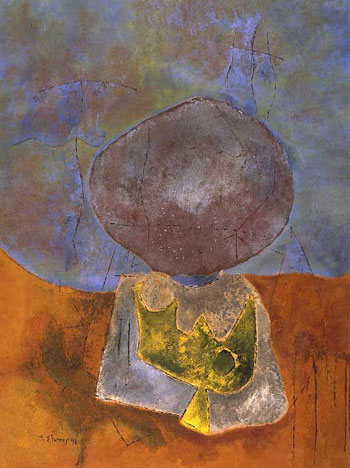
Theodoros Stamos, The Sacrifice of Kronos, 1948
12) We must care for the orphan, and marry our brother’s widow.
If needed, we must be willing to make love to our neighbor’s wife.
Grave indeed are the responsibilities of the caretakers of the
cosmos!
13) The house of the sky has many windows. A window is open,
and we must thank it. As was done “In Illo Tempore,” we must be
able to zip from one place to another with no need to cross
through the intervening distance, for this will reduce our
dependence upon gas.
14) As blunt as need be, we must perfect what Hemingway called
our “built-in bullshit detectors.” We must, if and when we choose,
speak truth to power, or else operate beyond the edges of the
stage. We must cultivate a sense of the innate law of the
omniverse. It is utterly obscure. It is as soft as a breath.
15) We must boldly go where no man has gone before, at first
together, then more and more alone. No other will survive the
wreck. Once having washed ashore, you will there find Argos,
your aged dog, who has been waiting with bated breath for your
return. He is a good dog. He wants only to lick your hand before
he dies. A loyal companion, he will even then share the deep
intelligence of his nose. He will be waiting with his cold head
resting on his paws, on the last dock, as the ocean swells.
16) To the one side Birds and to the other Snakes: Keep eyes wide
open, but do not enter any contest where you would have to stare
them down. Do not offend them with such words as “high” and
“low,” for, already, they tend to regard you as a snack.
17) We must cultivate curiosity, for there would be no world
without it.
18) We must stay alert, and have no fear of boredom. A wait of 12
,000 years is not other than the blinking of an eye. We are not, in
fact, obligated to bring new worlds into existence, however much
we might like to pretend that this is so. No, for we are on a wheel.
On this wheel, each of the spokes functions like the gallery of a
museum, and, from where we stand, we are free to wander into
and out of any period that we choose.
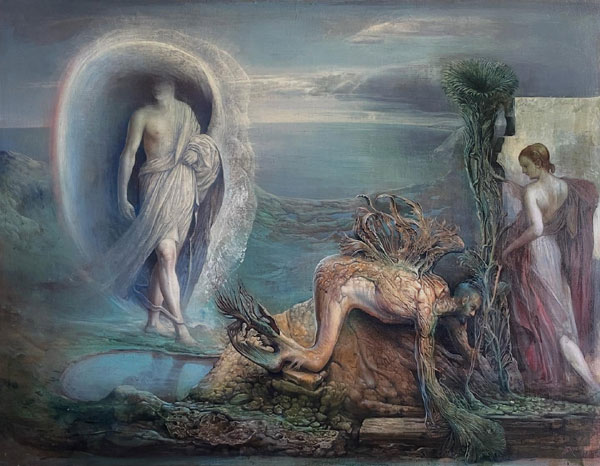
Agostino Arrivabene, Il Botanico, 2025
19) We must be able to bring objects across a threshold with us,
whether gargoyle breastplates or stringed philosophical
instruments, and then fully translate them into this world from
our dreams. Do it well, and these objects will blend seamlessly
with other props in the environment, although some few may
note their faint radioactive glow.
20) We must be good little boys and girls—or else! But no, we are
free to be as difficult and subversive as we want, so long as we
keep the Bindu always before our eyes and the apparatus of our
primal energy intact.
21) We must cultivate the ability to break through any mirror,
leaving, as we go, little evidence of our passing. Moving in and out
from behind the surface of projection, we must snatch the
archaeological relics that we need.
These seven virtues and 21 maxims will allow us to stay grounded
as we venture to reconstruct the non-dual architecture of the city,
which exists in no one place. As we knew, my wide-eyed
shipmates, there is no such thing as time, and the lightning bolt
that directs us falls crazily where it will. Let us pause once more
to note that this is so. The emptiness that is space shows no sign
of disturbance. We cannot leave, for we never did depart.
|