|
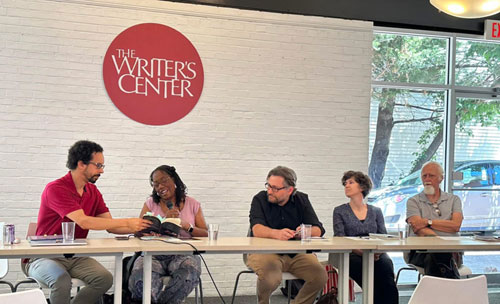
L-R: Poets Hayes Davis, Teri Cross Davis, Roman Kostovski,
Ena Selimović, and Gregory Luce
Towards a poetry of the Demos
I was recently honored to participate in an event created
by Writers for Democratic Action entitled Reimagining America:
Towards a Poetry of the Demos, held at The Writer’s Center in
Bethesda, MD, a suburb of Washington, DC. The purpose of the
gathering was to explore how poets can and should respond to
the threat that fascism poses to our nation. The answers were as
diverse as the poets themselves. My statement follows.
“I say that democracy can never prove itself beyond cavil, until it
founds and luxuriantly grows its own forms of art, poems,
schools, theology, displacing all that exists, or that has been
produced anywhere in the past, under opposite influences.”
—Walt Whitman
I could stop there since no one could add to or improve upon
Walt’s assertion. However, I want to connect this idea to my own
poetic practice. I concur with William Wordsworth who defined
poetry as “a man speaking to men,” though today I would of
course speak of humans speaking to humans. I tend to use
relatively ordinary language with any artistry inherent in the
emotional tone or arrangement of words or the careful choice of
line breaks. This allows me, for example, to give voice to
characters who, while they typify certain types of people, have
individual voices of their own. An example is the title poem of my
most recent collection:
Smells like rain
he says and she
barely able to reach
his hand looks out
across the clear
sky at the thin
line along the far horizon.
Smells like rain
he says and she
taller now thinks
of rain slanting through
the wheat field ahead
of the Oklahoma wind
hearing him whisper please
Lord don’t let it be hail.
Smells like rain
he says and she
taller still and with
a child of her own
looks at him shrunken
on the bed eyes half
open below his sweating
forehead his sister saying
open the window child
and the slightest breeze
ruffling his hair.
Smells like rain
he says and she
whispers smells like rain.
This man and his daughter are not based on any specific
individuals. Rather they represent many people I knew or
encountered as I was growing up in the Great Plains. Poetry
should be able to give voice to those who may not have the gift for
expression that we poets have, but nevertheless deserve to be
heard.
One of my major topics is music, especially jazz. Music is not only
arguably the most democratic of art forms, but jazz in particular
itself creates a miniature democracy on stage on a nightly basis.
Not to mention its role in expressing the joy and pain and struggle
of Black Americans—artists most prominently among them. Two
poems, one about John Coltrane and one about Miles Davis,
exemplify this theme.
Return to A Love Supreme
(after Chasing Trane)
The stairs to heaven
are uneven some broken
you go sideways sometimes
take a step down for
every two up but you climb
and stumble always
grasping the pure beam
of light that he sends back
from somewhere he is
always up ahead.
I try to work my pen
for Trane the way
he played his sax
for God.
All on the Floor
Leaving it all on the floor
they say when a performer
has given everything, the sweat,
the blood, the very breath.
I look at the image
of Miles Davis beaten bloody
by white cops while taking
a smoke break between sets,
beaten for breathing while Black,
leaving some of it on the street.
While confronting racial and social injustice is implicit in my jazz
poems, occasionally I am moved to a more direct confrontation.
Gun violence is a particular concern of mine as a father of sons
and friend of persons of color whose communities are most under
threat from both criminals and law enforcement.
251*
for El Paso and Dayton
It’s Sunday morning in America.
The sun shines on gun barrels
and spent shells. How many shells
scatter on the ground when
eighty-two people are shot?
Could you build a house with them
or just another gun?
If all that smoke collected
into one single cloud, how long
would it blot out the sun?
If all the shots were fired
at the same time would the noise
drown out the sound of bodies
hitting the ground?
It’s Sunday morning in America,
a once-shiny apple rotting in the sun.
*The number of mass shootings in the U.S. as of August 4, 2019.
Among School Children
I walk my dog through the usual
morning crowd of children and parents
gathered as usual along the sidewalk
waiting for the bus. Bella moves among
them, stopping to accept petting and
head scratches. We watch when the bus
pulls up and the kids run to get on.
Another morning in America,
land of the free to shoot at will,
home of the brave schoolchildren
who put their lives on the line
every day in support of the
right to bear arms.
I’d like to close on a slightly more hopeful note. Poetry, as
Wallace Stevens said, must give pleasure, whether through
language, sound, imagery, or some combination of those elements
. The quotidian can be as inspiring as the exotic. Stevens again:
“The imperfect is our paradise.”
End of November
“I found myself more truly and more strange.”
—Wallace Stevens
After work crossword finished,
taste of coffee still lingering,
I flip through the paper.
Brad Pitt is having
an existential crisis
(though his hair is perfect).
I toss the paper
in the bin and step outside.
Even after dark it’s not
too cold for the last day
of November and I don’t
feel like going home
this early on Friday night
so I make my way
down Irving Street breaching
the flow of legs and bodies
in each direction, lights dazzling
all around as I consider where
to have dinner, and I round
the corner onto 14th
and unexpectedly there I am
looking back at me
from a shop window,
headlights sliding along
the glass. I stop and regard
myself perhaps as passing
strangers see me, wide-eyed
and white-haired, then turn
away into a light gust
of wind that brings a sudden
slight chill.
Poetry is a house with many mansions. Part of our work is to keep all the doors open.
|