|
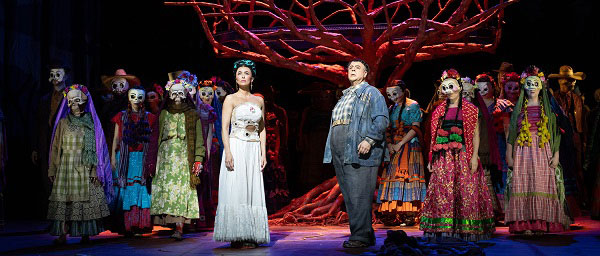
El Ultimo Sueño de Frida y Diego, written in 2022 by composer
Gabriela Lena Frank and librettist Nila Cruz is a surreal opera
that deals with the love story of Mexican artists Frida Kahlo and
Diego Rivera. The Steiny Road Poet saw this two hour and 48
-minute broadcast (including one 25-minute intermission) from
the Metropolitan Opera on June 3, 2026, in a Maryland IMAX
auditorium. Like Gertrude Stein’s and Virgil Thomson’s opera Four Saints in Three Acts, El Ultimo Sueño de Frida y Diego is
more about spectacle than story.
On the Mexican holiday known as the Day of the Dead, Diego
Rivera visits a cemetery and calls for his deceased wife Frida
Kahlo to appear before him. He is severely overweight and dying.
Moreover, he is afraid and wants her comfort. La Catrina, the
Keeper of the Dead, is in the cemetery disguised as an old
woman. She returns to the underworld and urges Frida to visit
Diego, but Frida adamantly says no. In life, she suffered
unrelenting pain, both physical and emotional, caused by Diego’s
cheating on her. However, a young, cross-dressing actor named
Leonardo who impersonates Greta Garbo wants to entertain a
living fan. Leonardo convinces Frida that she has the opportunity
to be a new, stronger self.
In the world of the living, Frida finds Diego despondent and
unable to paint. As a visitor from the underworld, Frida is not
allowed to touch or be touched by any living person. Diego wants
her embrace and she refuses him until he takes her to her
beautiful Casa Azul (Blue House). There her will breaks down.
She embraces Diego and the pains of her life manifest. However,
dawn and return to the underworld beckon. Diego pleads for the
gods to let him join Frida. Catrina petitions Mictlantecutli, god of
the underworld, to allow Diego to depart with Frida. The
underworld god consents and the two are united in death.
The actual love story of Frida and Diego was complex and
colorful. As in the opera, Frida died before Diego. He left
instructions for his family to mix his ashes with hers, but they did
not carry out his wishes.
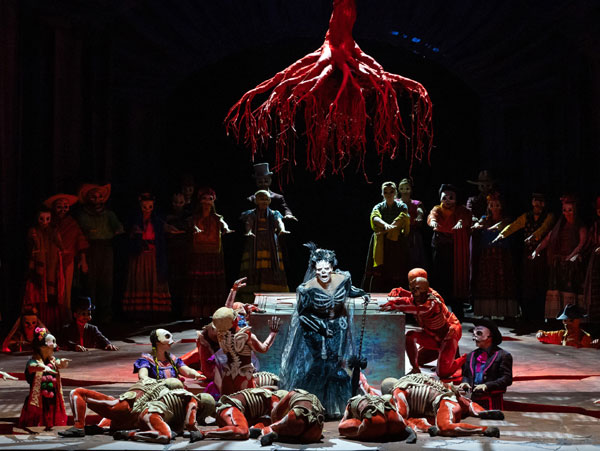
Nila Cruz and Gabriela Lena Frank, along with director and
choreographer Deborah Colker, have created a work of art
worthy of these two tempestuous artists. Like Frida’s and Diego’s
artworks, El Ultimo Sueño provides a landscape of vibrant colors.
The underworld denizens come across like a network of Cirque
de Soleil performers who specialize in contortions and dance
moves akin to those of Michael Jackson. The stage is a zigzag of
cracks where these dancers emerge.
The music similarly is rich and colorful. It uses an often
dissonant, yet accessible idiom to suggest an aura of magic
realism, where the unexpected happens. The orchestra included
such instruments as celesta, marimba, and xylophone. One effect,
explained in the interval between the two acts, is when two
piccolos play the same melody a half step apart to create for an
eerie soundscape.
Costume designers Jon Bausor and Wilberth Gonzalez present a
cornucopia of lush color and fabrics. A favorite scene occurs
when Frida stands before a large wardrobe cabinet deciding what
she will wear for her visit to the world of the living. Some of the
costumes come floating down from above. The way the cabinet
appears from a trapdoor and first looks like a tomb and then is
righted to be a double-door closet adds to set designer Jon
Bausor’s scenic wonder.
Mezzo Isabel Leonard was a spectacular Frida, made up to look
like a more beautiful than life Frida. Her singing was richly
satisfying. Baritone Carlos Alvarez as Diego was presented as a
blimp of a big man with a giant pot belly accentuated by a wide
belt. He made a solidly convincing artist in crisis with his singing
and gestures. Gabriella Reyes as Catrina was a make-up artist’s
piece de resistance. Her skeletal costume and face required hours
of work according to her interview between the two acts. Her
soprano voice rose to the emotional occasion of her role. Nils
Wanderer as Leonardo, the Greta Garbo impersonator, completed
the surreality of this opera with his sonorous countertenor.
The Steiny Road Poet was also pleased to say that her recent
study of the Spanish language was well rewarded by this opera
that was sung in easy-to-understand Spanish with surtitles that
were scripted at the bottom of the screen for comfortable viewing.
|





 Writings