|
Perhaps
America since the
depression will never be
so young again. I suppose
it has to happen it does
to any dog that he can
never be so young again.
But then after they get
old they do get young
again and so this can
happen. It is almost
happening in Europe but
then America is not old
enough yet to get young
again.
— Gertrude Stein
For
someone who spent more
than half of her life in
France, there are an
unusually large number of
references by Gertrude
Stein to America in her
writings. Four of her
books’ titles
include a reference to
America: The Making of
Americans (1925), Lectures in America (1935), The
Geographical History of
America (1937 and Four in America (1947). Though not particularly astute politically, she was an astute observer of people, places and things including observations of the United States.
In 1965, a compilation of excerpts from her books was published as Gertrude Stein’s America edited
by Gilbert A. Harrison.
The 100-page book provides
her perspectives about
America as she said,
“It has always
seemed to me a rare
privilege, this, of being
an American.”
Harrison was the long-time editor of The New Republic magazine
and began writing to Stein
in 1933 while he was a
student at UCLA. He met
her two years later when
she lectured in Pasadena
as part of her U.S. book
tour. Then in 1937, he
visited Gertrude and Alice
in Bilignin at their
French countryside
retreat.
With Stein’s
recurring mentions of
America, what better way
to celebrate our
country’s 250th
birthday, than to have her
visit the White House
along with Alice on July
4th, 1934, at the
invitation of Mrs. Eleanor
Roosevelt? In fact,
they did have tea with
Mrs. Roosevelt but on
December 30th, 1934. Until
now, I have been unable to
find the visit included on
Eleanor’s
appointment calendar.
(Just found out that the
White House Chief Ushers
Diaries for the FDR
administration are at the
FDR Library in Hyde Park,
NY. More research.)
* * *
My story that follows is pure fiction,
as are the AI-generated
photographs. I am
not aware of any
photographs taken of their
White House tea.
Putting it in my Steinese: “Fiction
is fiction is fiction is
fiction. And what is
fiction is not nonfiction
and is fiction and that is
very interesting.”
One guest at the tea party
was definitely not there
(as far as I know.) I felt
it was fitting to have
Lorena Hickok with whom
Eleanor Roosevelt had a
romantic, long-term
relationship present.
Hickok was the most
well-known Associated
Press woman journalist
when she met Eleanor in
1928 to conduct an
interview. In 1932
she was assigned to cover
her during FDR’s
presidential campaign and
a deep, significant
thirty-year friendship
began.
There had been thousands
of distinguished guests at
the White House since John
and Abigail Adams moved in
in 1800 and now it was
time on Independence Day
1934 for four brilliantly
independent women to meet,
have tea and share views
on life and these United
States.

* * *
The Story
GS: We were in Washington on the Fourth of July and it is very strange to
be in Washington on the Fourth of July because Washington is already
Washington and therefore it is already celebrating itself and when it
celebrates itself there is more of it but it is not different.
Alice and I had been invited to tea at the White House by Mrs. Roosevelt.
Everybody called her Eleanor Roosevelt but in Washington they called her
Mrs. Roosevelt because there was also Roosevelt and when there is a
Roosevelt there is always another Roosevelt. This was the Roosevelt who
was president and he was very much president. There are some people who
are presidents and there are some people who are president. Roosevelt was
president.
It was a July Wednesday so it’s very hot. Washington is always hot in the
summer Wednesday or not and the heat in Washington is governmental
heat. Paris can be hot on a Wednesday but Paris is hot for itself.
Washington is hot for everybody.
Alice was pleased because she enjoys invitations and she enjoys houses and
she enjoys seeing how people live in houses and the White House is a house
that belongs to everybody and therefore belongs to nobody and that is
interesting.
Mrs. Roosevelt was waiting for us when we arrived at the White House.
Photographers were waiting to do what photographers do do with their
cameras and flash equipment.
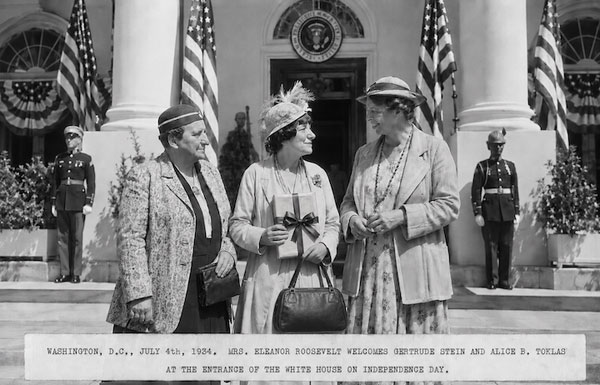
Mrs. Roosevelt then introduced us to the Chief Usher Raymond Muir. I do
not know what to say to a chief usher. We did find out he met his wife in
France. Which was very, very interesting. It will be in our next letters.
He escorted us to a blue room in the white White House. It was blue and
being blue it was called the Blue Room. This is one of the things I like
about America. Sometimes America says exactly what something is and
then everybody is satisfied.
Lorena Hickok was there. I already knew about Hickok because everybody
knew about Hickok. Many people called her “Hick.” So I called her Hick.
Not knowing about Hickok was a way of knowing about Hickok or Hick.
She had the look of a woman who would rather be somewhere else and
therefore was exactly where she wished to be.
Mrs. Roosevelt liked her very much. It is easy to see when somebody likes
somebody very much. They do not look at each other all the time. But they
do look at each other some of the time. And they did look at each other
some of the time at tea. Looking all the time is not necessary when there is
no necessity.
It was time to ask so I did ask, “Mrs. Roosevelt where is the president?”
She said Roosevelt was in the White House talking to governors about
droughts and farms and relief and all the things that were America in 1934.
After the talking Roosevelt and the governors would celebrate
Independence Day. Presidents and governors are like that.
Then we could hear the president laughing somewhere down the corridor.
A presidential laugh is different from an ordinary laugh because it belongs
to many people at once.
I said that he understood performance.
Mrs. Roosevelt laughed and said the presidency required it.
I thought that marriage probably required it too but Alice said that before I
did.
Alice is often quicker than people think.
We drank tea and talked and did look at each other necessarily.
People always think that conversations at the White House must be about
politics but they are often about people and people are much more political
than politics are political.
Mrs. Roosevelt asked me if I missed America. Then Mrs. Roosevelt became
Eleanor to me.
I said that one misses one's language. Everybody thinks they miss a country
but mostly they miss the way they say things. A country is often a language
remembering itself.
Alice said that home is where one is understood without explanation. And
home can be a country or a country home which is understood.
Alice always says things very quietly and then they remain in the room after
everybody else has stopped talking.
Alice had also quietly brought a package with her.
Alice likes packages. She likes wrapping paper and ribbon and boxes and all
the ceremonies by which one thing becomes another thing. A gift is not a
gift until it is wrapped and then unwrapped and then admired.
The package had been resting beside her chair throughout the afternoon.
Eleanor saw it but being a Roosevelt knew it was not time for the package
or its gifting.
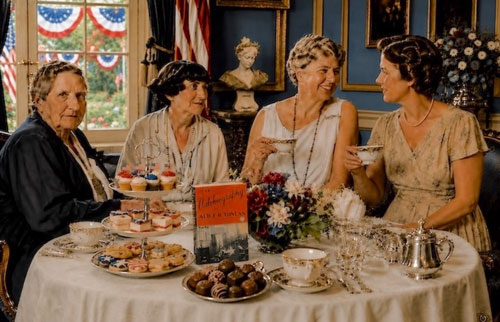
At a certain moment Alice decided it was time.
There is always a certain moment for these things and Alice generally
knows when it has arrived. It is the cook in her and I find it very
interesting.
She lifted the package and handed it to Eleanor.
"Eleanor," she said, "we brought you something."
She seemed genuinely surprised even though the package had been sitting
next to Alice’s chair and she knew why.
People who receive many gifts are often difficult to surprise but Eleanor
had a talent for being pleased. It is one of the reasons so many people liked
her. Hick liked her very much too.
She untied the ribbon carefully.
Alice approved of this.
People who tear wrapping paper make Alice nervous.
Inside was a copy of The Autobiography of Alice B. Toklas
.
The book was newly published and the dust jacket was still bright orange
and black and crisp with Man Ray’s photograph of me at my table stopping
writing and Alice in the doorway stopping cooking.
I had signed it.
Alice had signed it.
This amused me because the book was called The Autobiography of
Alice B. Toklas and yet I had written it and now both of us had signed it and
this seemed exactly correct.
Eleanor looked at the title and laughed.
"Gertrude," she said, "I think this may be the only autobiography signed by
two people."
"That depends," I said. "Perhaps every autobiography is signed by more
than one person. Nobody becomes themselves alone."
"That's a very convenient theory for biographers," Hick said and laughed.
Eleanor opened the cover and read the inscription.
To Eleanor Roosevelt, who understands that public life and private life are
often neighbors and occasionally friends.
With affection,
Gertrude Stein, Alice B. Toklas
For a moment she was silent.
Then she looked at Alice and then at me.
"I shall treasure it," she said.
She did not say it politely. She said it sincerely.
There is a difference.
Many people know how to thank you. Fewer people know how to receive a
gift which is a real thank you and a real thank you is a real gift.
Eleanor knew how to receive one.
She turned a few pages and smiled again.
"I've already been told I must read this."
"You must," said Hick.
"Everybody must," I said.
Alice nodded and said, “I have typed it and I have read it and many think I
wrote it.”
Alice was proud of the book although she pretended not to be. The book
had made her famous in a way that was different from being known. Before
the book she was Alice. After the book she was Alice B. and also Alice.
This is one of the things books do.
They create another version of a person and then both versions continue
living together.
Eleanor placed the book carefully beside her teacup.
"I think," she said, "that books are among the nicest gifts because they allow
the giver to visit again later."
I liked that and remembered that.
It was a very good thing to say about a book.
The afternoon continued.
Our book which was now her book continued to rest beside Eleanor's
teacup. And it seemed pleasant to think that long after the tea was over and
long after the fireworks had disappeared she would open it again and hear
our voices returning from its pages.
Outside there were crowds and flags and music and preparations for
fireworks. Inside there were tea and conversation and the feeling that all of
us had somehow arrived from different directions and were resting for a
moment in the same place.
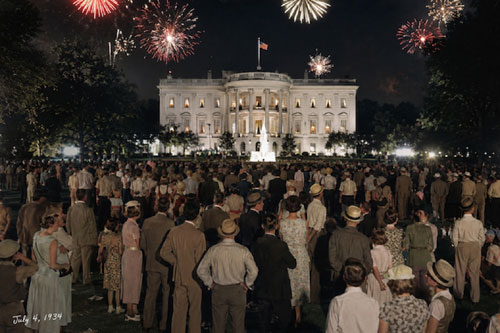
That is what a country is sometimes.
Not a government and not a parade and not fireworks.
A room where each thing is a nice thing.
A hot afternoon. The sun is hot. No one is sticky or perspiring.
Four women talking while a president laughs somewhere in the distance.
The first fireworks of the evening had begun to bloom above Washington,
faint flashes of red and gold appearing beyond the White House windows.
I looked at them and I thought about time because fireworks are very much
like time. They arrive and they disappear and then everybody remembers
them differently.
People were speaking about America and when people speak about
America they are usually speaking about now and when they are speaking
about now they are also speaking about later because America is always
later while it is being now.
I began wondering what America would be in ninety-two years when it
celebrated its two hundred and fiftieth birthday in 2026 which is not 1934.
My wondering was also speaking so Alice was listening and Eleanor was
listening and Hick looking at Eleanor was listening and sometimes when
they were not listening they were speaking.
So I began wondering and speaking and speaking and wondering which
was very interesting.
Ninety-two years is a long time and it is not a long time. Ninety-two years is
only many todays placed one after another until nobody remembers the
first today and everybody is talking about the last one.
I thought there would be more America because there would be more
Americans. There would be more cities and more roads and more houses
and more people moving from one place to another and then discovering
that they had brought themselves along with them.
There would be talking without speaking and listening without hearing and
writing without paper and traveling without traveling. There would be
driving without drivers. Everybody would be somewhere else while being
where they were.
This sounds impossible only until it happens. Most impossible things
become ordinary very quickly. Once something has happened often enough
it begins to look as though it could never have been otherwise.
I imagined little machines. Everybody would carry them. They would ask
questions of the machines and the machines would answer. Some answers
would be correct and some answers would not be correct answers and
many people would not notice the difference.
Alice looked at me. She was thinking about her big machine Smith-Premier
typewriter and thinking about a little machine.
People in 2026 would still worry. People in 2026 would still hurry. People
in 2026 would still announce that everything was changing and then
continue doing many of the same things they had always done. That is 2026
and not 1934.
And they would eat too much.
I felt certain of that.
But there would still be tea. Eleanor and Hick and Alice lifted their
teacups. They did not reach for a small cake.
And there would still be books.
People would say nobody reads anymore. People would always say that.
Then somebody somewhere would open a book and begin reading and
another person would write a book and somebody else would worry about
books disappearing. This also would continue.
I thought of Sappho.
Everybody knows Sappho and nobody knows Sappho. She lived a very long
time ago and yet she is always arriving. Most of her words are gone and still
she remains. That is a very literary thing to do.
I said this aloud.
Alice nodded.
Alice always liked people who could make much from little.
"Perhaps what is missing makes people pay more attention," Alice said.
Alice liked recipes and manuscripts for the same reason. She understood
that an omission can be an ingredient.
Eleanor smiled.
"I think people admire courage," she said. "A woman whose voice can still
be heard after so many centuries must have possessed a great deal of it."
Eleanor often looked for character in history. She liked brave people
because she spent much of her life encouraging bravery in other people.
Hick laughed. "Or perhaps she was simply a very good writer."
Journalists are suspicious of grand explanations. They prefer explanations
that fit in a newspaper column.
I liked Hick's answer.
A writer survives because she is a writer. There is something satisfactory
about that.
"But it is strange," Eleanor said, "that fragments can last longer than
complete things."
"Not strange," I said. "People remember pieces. Whole things are difficult.
Pieces travel."
Alice laughed. “Gertrude likes pieces because she writes them."
"I write wholes," I said.
"You write pieces that insist they are wholes," said Alice.
This amused Hick very much.
Outside another firework burst against the darkening sky.
People in 2026 would still be trying to discover what America is. They
would write books about it and make speeches about it and argue about it
and celebrate it and criticize it and vote about it and sing about it.
And they would not know.
Not because America would be impossible to understand but because
America is the answer to a question that changes while it is being asked.
That is why America continues.
A country is young when it remembers being born. A country becomes old
when it remembers becoming itself. America in 2026 would still be
becoming itself and therefore it would still be young.
Alice was sitting beside me and I could tell she was already remembering
the afternoon while it was still happening. Alice has always been able to do
that.
Eleanor was looking toward the window. Eleanor was a woman who liked
motion. Even when she was sitting still she seemed to be moving toward
the next thing.
Hick was leaning back in her chair watching Eleanor and not watching
Eleanor. There are people who understand things by looking away from
them.
For a little while none of us spoke.
The room was quiet except for the distant sounds of celebration outside
and the occasional rattle of cups and saucers being collected by the staff
who had entered the blue Blue Room quietly.
Then Alice reached for the last small cake before the serving plate was
taken away.
This seemed important.
Alice always pays attention to important things.
Hick laughed.
Eleanor laughed.
Alice smiled in the way she smiles when she knows she has been observed
and does not mind being observed.
The afternoon was ending.
Tea parties always end even when conversation does not. Conversation
goes on and tea stops and then everybody stands up and discovers that time
has passed.
Eleanor rose first. She had many duties because everybody wanted
something from Eleanor Roosevelt. A president wanted something from
her. The country wanted something from her. The newspapers wanted
something from her. Very often the people who wanted the most from her
were ordinary people she had never met.
She thanked us for coming.
Alice thanked her for receiving us.
Hick said something witty and everybody laughed.
Then we moved toward the windows where the fireworks were brighter
now and the crowds outside sounded larger.
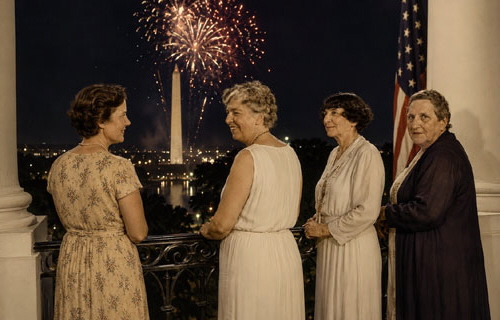
For a moment the four of us stood together looking out over Washington
and America and the Washington Monument which is in Washington which
is in America and Washington was the Father of Our Country which is very
interesting on the Fourth of July 1934 or the Fourth of July 2026 in ninety
-two years.
Lorena Hickok
Eleanor Roosevelt
Alice B. Toklas
and Gertrude Stein.
Four women who had arrived there by very different roads. And roads are
the important thing and what is on them.
Above us the fireworks continued blooming and disappearing.
The city glowed.
The country celebrated itself.
And it seemed possible that the evening of July 4th, 1934, and the evening
of July 4th, 2026, were looking at one another across time each one
imagining the other and each one being imagined in return.
That is what time does when it is being time.
* * *
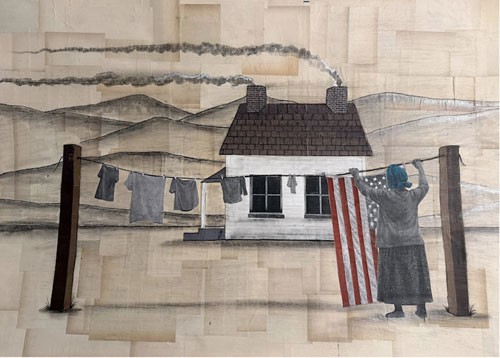
Art of the Month
“Worn Thin by Weather and Time,”
Meikel Church (mixed media collage)
Courtesy of the artist: meikelchurchcollage.com
|