|
Edwin S. Curtis–Anthropology Through A Romantic Lens
When photographer
Edward S. Curtis
finally completed his
opus magnum, The North American Indian in 1926, it was a collection of twenty volumes and some 2200 photogravures that had taken him two decades to complete. The project commissioned by financier J. P. Morgan, became Curtis’ defining achievement and one of the seminal works in that late 19th century-early 20th century American movement of Romantic Pictorialism in art and a similarly romanticized brand of anthropology and ethnology whose underlying misconceptions nonetheless proved ironically valuable to preserving an interest in—if not a completely accurate documentation—of native peoples.

Edward Sherrill Curtis was born into a farming family in
Whitewater, WI in 1868, soon after moved to Minnesota, and
then left school in the sixth grade due to the family’s straightened
circumstances. Always interested in photography, he built his
own camera at an early age and when he was seventeen,
apprenticed to a St. Paul photographer. He went on to co-own
two photography studios in Seattle and garnered recognition for
several photographs he had entered into the National
Photographic Society’s 1895 exhibition, one of which – an image
of Mt. Ranier - won the grand prize. Another of his entries was a
portrait of Native American Princess Angeline, the first of such
images which would spur Curtis on to to his life’s work. The
Native American expert George Bird Grinnell took notice of
Curtis and arranged to have Curtis appointed Official
Photographer for the 1899 Alaska Expedition and later to join
Grinnell on a mission to photograph the Blackfoot Confederacy
people in Montana in 1900.
All this work drew the attention of J. P. Morgan who gave Curtis
$75,000 to produce a twenty volume, 1500 photograph series on
Native Americans over a five year period. Clearly, Morgan knew
how to drive a shrewd bargain, because he stipulated that the
money was to fund the costs of the expedition and writing,
editing, and printing the books - not to pay Curtis any salary –
and that Morgan would received twenty-five sets of books and
five hundred original prints. Curtis, nonetheless, accepted the
opportunity, though the actual endeavor took the photographer
almost twenty years and some 40,000 photographs to complete.
With Morgan’s funding, Curtis was able to hire help with the
project, including that of journalist William E. Myers, logistic
advice from Bill Phillips, and anthropological and editorial
expertise from Frederick Webb Hodge.
Curtis plunged into the task with a passion, not only producing
twenty-five times the number of prints he wad been
commissioned to do, but recording over 10,000 wax cylinders of
Native American language and music, keeping extensive written
records of native culture, customs, and tribal leaders, and even
producing a feature-length silent film entitled In the Land of the
Head Hunters with a cast comprised entirely of Native
Americans, that premiered in 1914.
Regretfully, in addition to being plagued by an acrimonious
divorce and alimony, Curtis was a poor businessman. Despite
some of his ground-breaking work, he made very little money,
selling rights to his work to men like Morgan or to the Museum of
Natural History for fractions of their worth. He died
impoverished in 1952 at the age of eighty-four. It was only some
twenty years after his death that artistic attention was focused on
Curtis, and he has gradually enjoyed a renascence as a
photographer whose singular aesthetic and perspective were
deeply imbedded in America’s late 19th and early 20th century
racialist thinking.
Curtis’ interest in Native American culture must be seen in the
context of the historical period in which he came of age as an
artist. The late 19th and early 20th centuries spawned a number
of artistic endeavors designed to understand and “preserve” non
-Caucasian cultures in America. In music, for example, composer
Charles Wakefield Cadman (1881-1946) was involved with the so
-called “Indianist” movement in which he studied and
incorporated elements of American Indian music into his own
compositions. He is perhaps best remembered for beautiful
songs like “From the Land of the Sky Blue Waters,” which
soprano Lilian Nordica made famous. Or there were the
folklorists John Lomax (1867-1948) and his son Alan Lomax (1915
-2002) made it their life’s work to travel the country collecting,
transcribing, and eventually recording American tunes for the
Smithsonian. In the literary world heiress Mabel Dodge Luhan
(1879-1962) fell in love with Taos, New Mexico (and with a Native
American Tony Luhan, whom she eventually married), and she
founded her art and literary colony there. And the list goes on. It
was a period of ironies expressed not only in art, music, and
culture, but in national policies. Teddy Roosevelt’s Presidency,
for example, espoused its own version of colonialism both abroad
and in his tribal relations at the same time that it made great
efforts in conservation and preservation of the “wildness” of the
West.

Curtis’ photography reflects many of the same ironies, and it is
now fashionable to question his “unscientific” research, his staged
images “passed off” as real life photographs, and his
romanticizing of the Native American tribes as “noble
savages.” Yet, as a small but insightful exhibition at the Portland
(Maine) Museum of Art demonstrated, perhaps these hindsight
judgments do not do Curtis’ work justice. The twenty-two
photographs on display there, taken between 1903-1930 for The
North American Indian, speak to Curtis’ skill not only as a
technician but also as an artist, who, like Alfred Stieglitz, believed
a photograph had intrinsic value as a work of art rather than a
mere means of documentation. Moreover, they evidence an
empathy and a genuine respect for his subjects. These are
interpretations with an agenda – Curtis’ belief he was preserving
tribal heritages facing extinction – but at the same time, they are
some of the finest compositions and studies produced by the
early camera lens.
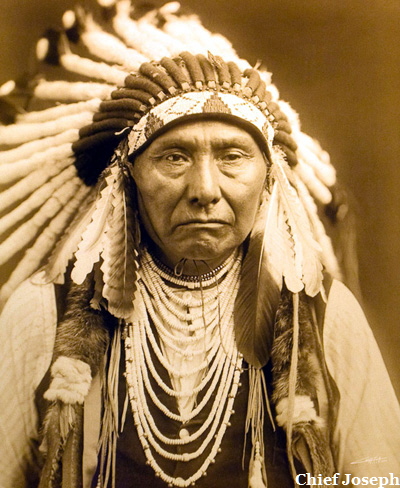
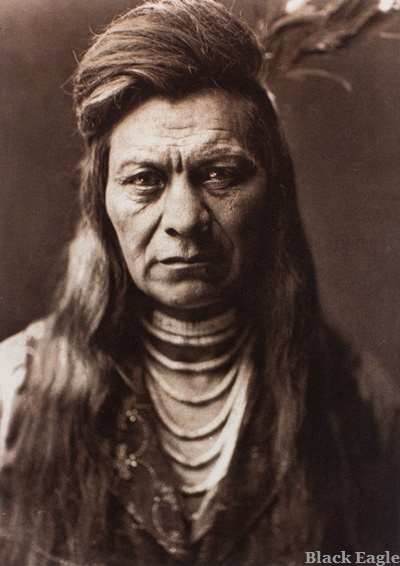
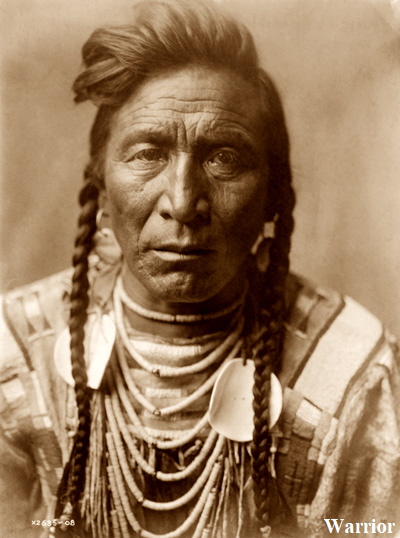
Curtis’ prints reveal his fondness for sepia- toned, soft focus,
dramatic lighting, and carefully balanced composition. He proves
himself to be equally adept at still life, landscape, and portraiture,
though it is in his human images that he achieves his finest work.
Take, for example, the first image of “Grizzly Bear Ferocious,” the
Nez Percé chieftain whose wizened face and penetrating eyes
make him appear exotic and dangerous. Or the famous portrait of
“Chief Joseph,” who radiates dignity and sadness – a silent
witness to the horrors his people have experienced. Or there is
the captivating image of the young chief “White Bull Umatella”
with a shawl drawn mysteriously across half his burnished face so
that only the riveting eyes peer out. And there is the portrait of
“Kyetani,” a Wisham warrior wearing an elaborate headdress and
rows of beaded necklaces that suggests both quiet, patient stasis
and pent-up feline energy.
Then, too, there are the non-specific human images – figures
posed in landscapes to evoke what Curtis believed were their
native settings. Highly theatrical, they could be motion picture
stills, and they vibrate again with the combination of stillness and
kineticism. A warrior astride his pinto horse is a combination of
meditativeness and dynamism. A group of braves on horseback
(“On the Move Spokan”) poses several men against a dramatic
sky to suggest the hardy nomadic life style.
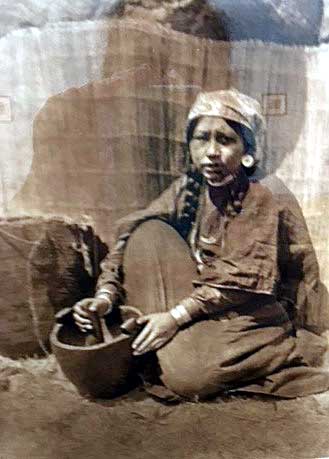
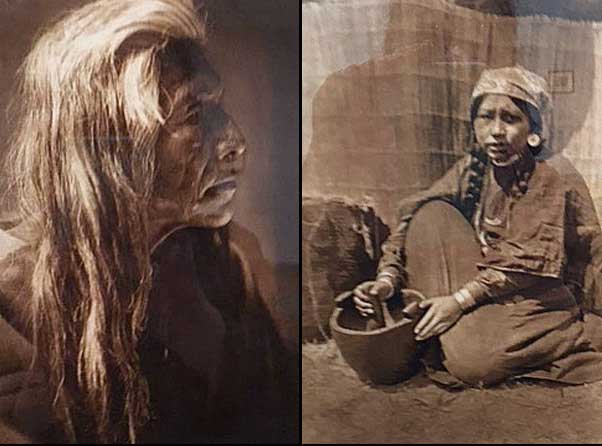
Curtis’ female portraits are genre studies, depicting women in
their traditional domestic roles as wives, mothers, and gatherers .
Most have an hieratic quality such as the commanding profile of a
“Wisham Woman” whose aquiline nose, wrinkled parchment
skin, and intense stare compel the viewer. Or the “Cayuse Mother
and Child” which takes its cue from iconic Christian images of
this theme, and the endearing capture of a little boy on a horse
(“Learning to Ride”) that invites white Americans to identify with
these universal themes. And sometimes the female sitter is
adorned and posed, so that she, too, becomes a work of art, such
as the hieratic woman in geometrically patterned garments with
her similarly patterned baskets.

Among the few other photographs in the exhibition, there are
several pure landscapes and still lives, which demonstrate the
formalism of which Curtis was also capable. An image of “Tents”
reminds of Cezanne’s haystacks or a view of “Wind Mountain on
the Columbia River” is born from the same American tradition
that birthed the Hudson River School early in the 19th century.
Edward S. Curtis’ photography may represent a spurious chapter
in American ethnology and anthropology, but there is no question
that the purely artistic values of his photographs are remarkable.
Curtis’s use of light and shade, his handling of the lens to evoke
atmosphere, his skill at composition, and his sense of drama
secure a place for these images in the history of photography.
Moreover, besides the pioneering technical attributes of his work,
Curtis demonstrates that he is an artist in a deeper sense: he
believes his lens should reveal more than just the surface of his
subjects, but rather, should evoke their spirit and soul.
Editor’s Note: This article was published 10 years ago in Scene4. It is as
relevant today as it was then, not only because of the life and artistic
accomplishments of Curtis but also the sensitivity, and depth he captured in
the people and culture he photographed.
|