|
This reviewer saw Simon Godwin’s production of Othello by Washington, DC’s Shakespeare Theatre Company (STC) on
June 7, 2026, at Harmon
Hall. Godwin, who is the
Artistic Director of STC,
updated the story to a
“modern capital”
in the current time.
Godwin’s interpretation
evoked a strong emotional
response in this reviewer,
reminding her of the current
war in Iran and the reality
that the American public is
not getting a truthful
picture of what is happening
there.
Set in five acts, the story
of Othello involves an
officer, Iago, who was passed
over for promotion by the
general, Othello, a Moor.
Instead, Cassio, an outsider
with less experience, was
awarded the military rank
that Iago thought should be
his. Iago vows to get revenge.
Iago enlists Roderigo, a
young, rejected suitor of
Desdemona, the daughter of
Senator Brabantio. She has
eloped with Othello. The two
aggrieved men bang on the
senator’s door late at
night to alert him to
Desdemona’s secret. The
senator becomes upset.
However, his reaction
is interrupted by news that
the Turks are invading
Cypress, and the Duke of
Venice has ordered Othello to
lead the defense against the
invaders. An uneasy peace is
made between the father and
newly married couple.
Desdemona insists on going to
Cypress with her husband.
Influenced by Iago’s
and Rodrigo’s poisonous
visit, Brabantio admonishes
Othello to look after her
because she has deceived her
father and may do the same to
him.
While the invading Turks are
quelled by a violent storm,
things get worse for the
married couple. Iago, who is
known as an honest man,
insinuates that Desdemona is
deceiving Othello by having
an affair with Cassio. Iago
gets Cassio drunk and
manipulates him into starting
a brawl. Othello strips him
of his new commission. Iago
then urges Cassio to enlist
Desdemona’s help to
persuade Othello to restore
Cassio’s commission.

Meanwhile, Desdemona loses the handkerchief with the
embroidered strawberry given to her by Othello. Emilia,
Desdemona’s maid and Iago’s wife, finds the handkerchief and
gives it to Iago. Iago plants the handkerchief in Cassio’s room.
Cassio gives the pretty “napkin” to his girlfriend Bianca and asks
her to copy it.
Iago then provokes Othello’s jealousy. He claims he saw Cassio
with the strawberry handkerchief and urges Othello to ask his
wife to show him his gift to her. Othello agrees with Iago that
Cassio must die. Iago urges Rodrigo to ambush Cassio but Cassio
fights back and Rodrigo is killed. Othello confronts Desdemona.
She proclaims her innocence, but he doesn’t believe her and
smothers her. Emilia enters and sees what Othello has done.
Enraged, she tells Othello about Iago’s treachery. Iago arrives and
kills Emilia, for which he is arrested. Othello is also arrested and
stripped of his command. He immediately kills himself. Cassio is
put in charge of Iago’s punishment.
The play opens with an environment immediately recognizable to
a contemporary audience: backyard grills, lawn chairs, beer cases,
rock music, and modern military and political imagery. The
audience perceives a contemporary world with people they might
meet today on the street in any big city like Washington, DC or
London.
This telling of Othello’s tragic story involves no swords, no lush
Elizabethan costumes, and no pristine Desdemona embodying the
quintessence of innocence. Instead, there are guns and knives,
military fatigues, women in pants, and a sassy Desdemona who
seems out of character when she follows her husband’s command
to go to bed, expressed as if he was sending a child to bed without
supper. Her attendant Emilia sports a tattoo on her arm and plays
a sexual game with her husband when she teases him to come and
get Desdemona’s handkerchief. Emilia partially stuffs it in her bra
and then she hides it in her underwear.
These characters brought into a modern timeframe seem to be
less complex than their Elizabethan counterparts. Othello never
presents as the exceptional warrior hero. Iago is more of a weasel
with his sometimes high pitched voice than the clever confidant
fox. Cassio and Rodrigo behave like fraternity boys who get into
trouble through bad influences. Desdemona, Emilia, and Bianca
seem like know-it-alls with big mouths.

Moreover, the role of Othello, the Moor, is played by the African
American Wendell Pierce and the role of Desdemona by the
Caucasian Olivia Cygan, it does not seem to matter that they are
an interracial couple. Godwin achieves this by changing the
audience focus to contemporary political, social, and
psychological trappings. In today’s reality, an interracial couple is
not an exotic pairing. The problems of race blend in with other
modern issues that include class tensions, political polarization,
misinformation, toxic masculinity, misogyny, and the struggle for
power.
This reviewer has no bones to pick with the actors. She believes
that they were true to Godwin’s vision for this production of Othello, which is too uncomfortably matched to the political
situation in today’s United States of America.
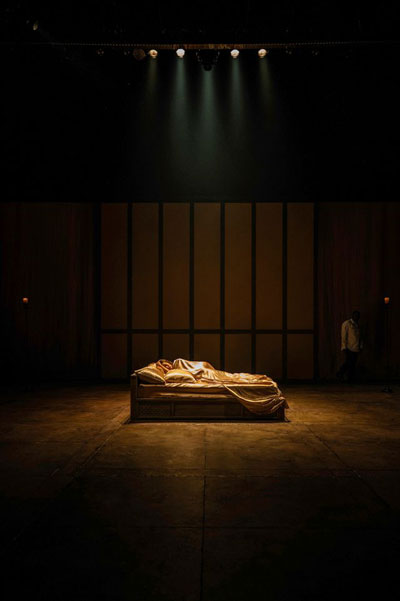
A favorite image from this production was the marriage bed
which came out of a trapdoor in the floor and was eventually
elevated to a heavenly height. It stands as metaphor for the life
that Othello could not attain.
This two hour and 45 minute production with one 15 minute
intermission began May 19 and was extended to June 28, 2026.
Shows are selling out. The audience this reviewer was part of rose
to their feet for a standing ovation. This reviewer dashed out the
door.
Photos: Teresa Castracane
|





 Writings