|
There
are countless short
stories, novels, and
plays about
protagonists whose
lives are outwardly
unremarkable but
inwardly
earth-shattering. Death of a Salesman, with
its famous rallying
cry, “Attention
must be paid,”
may be the most famous
example.
Hollywood films,
led by studios catering
to the worldwide demand
for Fall Down Go Boom,
are less reliable
vectors for stories
about quiet
lives. (Foreign
films, independent
films, and
documentaries are
another story.)
2025 saw the release of Mike Flanagan’s The Life of Chuck, based
on a novella by Stephen
King, and Clint
Bentley’s Train Dreams, adapted
by Bentley and Greg
Kwedar from the novella
by Denis Johnson. The Life of Chuck and Train Dreams have
protagonists who are
even less noteworthy
than Willy Loman.
Chuck Krantz is a
modern-day accountant
in an unnamed town in
the Midwest, played as
a boy by Benjamin
Pajak, as a teenager by
Jacob Tremblay, and as
a man by Tom
Hiddleston.
Robert Grainier, played
by Joel Edgerton, is a
logger, railroad
worker, and wagon
driver in Bonners
Ferry, Idaho, in the
early and middle years
of the 20th Century.
What to say about these
movies? Both
follow their
protagonists’
lives so closely that
it is difficult to
discuss them without
plot spoilers. I
can tell you the
following: both films
have
narrators—Nick
Offerman in two of the
three sections of The
Life of Chuck, and Will Patton throughout Train Dreams. (Both
narrators add
considerably to the
films, which
isn’t always true
with movie
narration.) Train Dreams is
linear in its
storytelling, whereas The Life of Chuck is told backwards, a’ la The
Curious Case of
Benjamin Button, in three segments.
One of the protagonists
lives to old age, the
other
doesn’t.
One has a passion for
dancing, the other is
never seen anywhere
near a dance
floor. Both have
lives marred by
heartbreaking
tragedy. And
both, ultimately,
demonstrate the
interconnectedness of
people and the
universe, although one
nurses serious doubts
about that.
The first section of The Life of Chuck—presented as “Act Three”-
-is titled, “Thanks, Chuck.” The lead characters here are high
school English teacher Marty Anderson (Chiwetel Ejiofor) and his
ex-wife, nurse Felicia Gordon (Karen Gillan), desperately trying
to reunite in what appears to be the end of the world. California
has fallen into the sea, wildfires and floods are rampant
everywhere, the Internet and cell phones have stopped working,
stars and planets disappear from the night sky. The only constant
is the message, “Charles Krantz: 39 Great Years. Thanks,
Chuck!” The message appears on TV and billboards, featuring a
picture of a smiling, bespectacled Chuck at his desk, and also in
radio ads, graffiti, and skywriting.
In this segment, we meet funeral director Sam Yarborough (Carl
Lumbly), whom we will see again. We also encounter three things
that will serve as motifs throughout the film: Whitman’s Song of
Myself, with its line, “I am large. I contain multitudes;” Steve
Winwood’s song, “Gimme Some Lovin’:” and Carl Sagan’s Cosmic
Calendar, which states that if you visualize the history of the
universe as a calendar, all of earth’s recorded history occurred in
the last ten seconds of December 31.
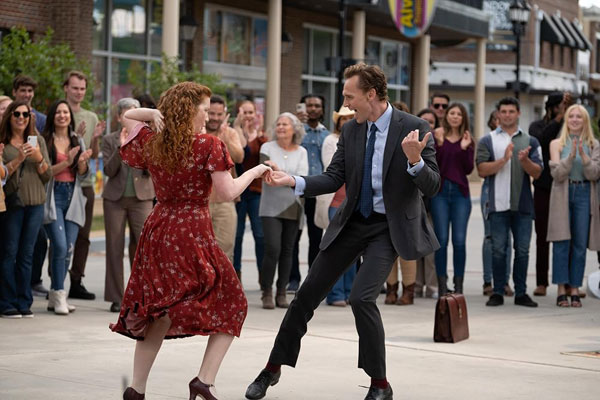
Act Two, “Buskers Forever,” is a vignette set nine months before
Act Three, in which Chuck, on break from an accountancy
conference at a resort town, suddenly starts dancing to the beat
provided by a drum busker (Taylor Gordon), and invites a young
woman (Annalise Basso) to dance with him.
Act Two provides the introduction to Act One, “I Contain
Multitudes,” the longest of the segments. It tells the story of
Chuck the orphan, raised by his adoring Zayde Albie (Mark
Hamill) and Bubbe Sarah (Mia Sara) in their vast Victorian
house. Sarah instills a love of musicals and dancing in Chuck, a
love that allows him to become the hit of his school’s Fall Fling
with his dancing partner Cat McCoy (Trinity Bliss). But Albie
advises Chuck to forget dancing as a career and study
mathematics instead. “When you look at the night sky, you see
the greatest equation in the universe!” he exclaims. Albie has
only one edict for Chuck: he must never enter the cupola room at
the top of the house, which Albie keeps under lock and key.
Act One is also where Chuck’s teacher Miss Richards (Kate Siegel)
tells him about Song of Myself. She makes him put his hands to
the sides of his head and says that between his hands are
“everyone you will ever know, and everyone you will just
imagine.”
By now you know there is a great deal of the metaphysical, and
even the mystical, inThe Life of Chuck. These elements are less
evident in Train Dreams, but not absent. The film begins with
the view from a train emerging from a tunnel into a dazzlingly
green forest. Although the wilderness is gone, the narrator tells
us, we can still hear its echoes. Robert Grainier—no one ever calls
him Bob—is haunted by those echoes all his life. That and his
circumstances set him apart.
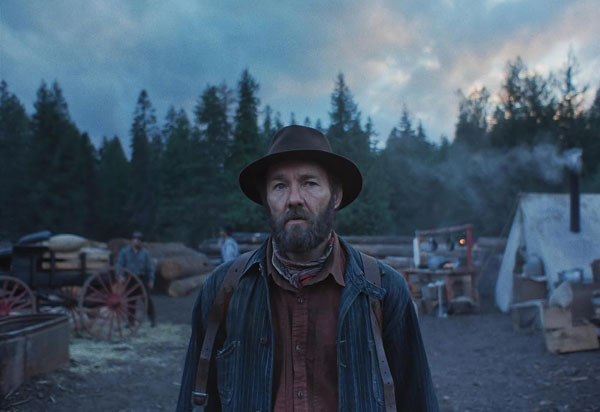
Robert was born sometime in the 1880s. He was six or seven
when he was put on a train to Idaho. He never knew his parents,
or even who they were; he never knew the day or year of his
birth. He saw some horrible things in his boyhood—a badly
wounded man in a ditch, the forced relocation of more than a
hundred Chinese families—but learned to put them out of his
mind.
Robert drifts through the first thirty or so years of his life until he
meets Gladys Olding (Felicity Jones) at a church picnic. Gladys is
cheerful and straightforward, a foil to his taciturnity, and she
answers a deep need in his soul. They marry, build a cabin on an
acre of land, and have a baby girl named Kate. Their life together
is blissful, but Robert must spend months at a time away from
home, on logging or railroad jobs, to make ends meet. Gladys
suggests she and Kate come along with him, but Robert insists it is
too dangerous.
We see exactly what Robert means. Loggers are killed by falling
trees or branches, with only their boots nailed onto trees to mark
their passing. One man is killed by a gunman seeking vengeance
for the murder of his brother. A Chinese worker (Alfred Hsing) is
thrown off a railroad bridge for no apparent reason except his
race; Robert, who made an ineffectual attempt to save him, is
haunted by his image (his ghost?) ever after. Nevertheless, his
words to Gladys will haunt him even more.
How to compare the two films? Both are well-made and
entertaining, but Train Dreams has a delicate poetry that The Life
of Chuck lacks. With the candy-colored photography by Eben
Bolter and production design by Steve Arnold, The Life of Chuck has a glossy Hollywood sheen reminiscent of the work of Ron
Howard or Robert Zemeckis. That doesn’t mean it isn’t heartfelt;
all the actors perform beautifully, and Matthew Lillard as Marty’s
neighbor Gus has an especially moving monologue in Act
Three. But The Life of Chuck is not free of a certain glibness.
There are also a couple of plot inconsistencies which, though
minor, detract from the film.

If The Life of Chuck reminded me of Howard and Zemeckis, only
one director came to my mind when I watched Train Dreams: Terrence Malick. Justin Chang of The New Yorker calls Train
Dreams “a compacted, simplified version” of Malick’s work, and
that sounds fair to me, although I don’t have Chang’s reservations
about the film. Malick is famous for the dreamlike flow of his
movies, and Clint Bentley gives Train Dreams its own riverlike
flow—similar to Malick’s, but more deliberate, more focused on a
single character. Enhanced by the atmospheric music by Bryce
Dessner and the exquisite cinematography by Adolpho Veloso, Train Dreams can reasonably be described as a stream-of
-consciousness movie, the consciousness being that of Robert
Grainier.
Train Dreams is even more finely acted than The Life of Chuck, starting with Joel Edgerton’s performance as Robert. Edgerton is
a marvelously internal actor, one who suggests worlds of emotion
without even changing expression. He puts that ability to good
use in Train Dreams, playing a man forced by circumstance and
tragedy to spend his life in isolation. His scenes with Gladys are
almost unbearably moving, especially in retrospect, and there is
also deep feeling in his encounters with his friends: explosives
expert Arn Peoples (William H. Macy), storekeeper Augustus
Jack (Nathaniel Arcand), and forest ranger Claire Thompson
(Kerry Condon). He also has a mysterious encounter with an
injured girl in the woods, which is better left undescribed to
ensure that it has its intended impact on viewers. All these
connections are important, but transitory; only in the end, via an
impulsive act on Robert’s part, does he finally come to feel that he
is part of the world.
E.M. Forster said A Passage to India was a story about the
difficulty of living in the Universe. The same can be said about The Life of Chuck and Train Dreams. Both films show lives filled
with turmoil and revelation, and although those lives are difficult,
they are anything but desperate.
|