|
In
the past, the famous
Canadian circus has
impressed me with
the daring
acrobatics and the
dazzling artistry of
the stage design,
but I always wished
that more
meaningful, poetic
ideas would replace
some of the
elaborate, but
standard, variété numbers (muscle-men whirling women in glittery tricots around, building human pyramids, etc.) accompanied by predictable circus music.
The latest show, Auana,
went a good step in
this direction. It
is one of the few
resident shows of
the Cirque, like O or Mystère in Las Vegas, conceived for one unique location. In this case, a rather intimate venue of some 700 seats at the Outrigger Waikiki Beachcomber Hotel in Honolulu , a block from the famous beach. Auana, meaning “wandering or setting out on a journey,” is a celebration of Hawaiian culture and history, conceived by a team that included local artists, musicians, Hawaiian dancers and even language experts.
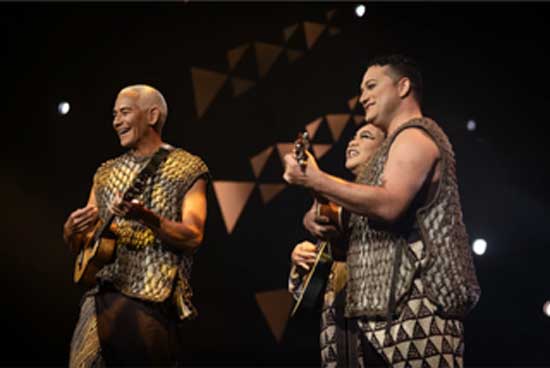
One entered a semi-dark space with a stage framed by arcs and
rays of Hawaiian patterns, showing a backdrop of a calm ocean at
sunrise. While people got to their seats, gentle Hawaiian guitar
music filled the cave-like auditorium. The sun slowly rose to
reveal a postcard beach from the Golden Age of the thirties, when
Hawaiian music and culture first reached beyond the islands.
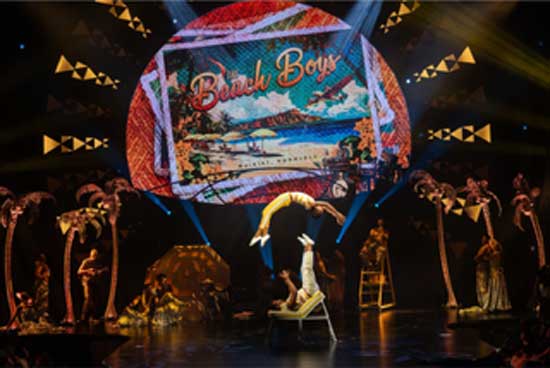
The show began with Hawaiian “beach boys” and girls. A foot
juggler kicked his partner into the air like a ball with shocking
precision and alacrity, and a rope jumper performed her tricks
with such impossible speed that the audience broke into laughter.
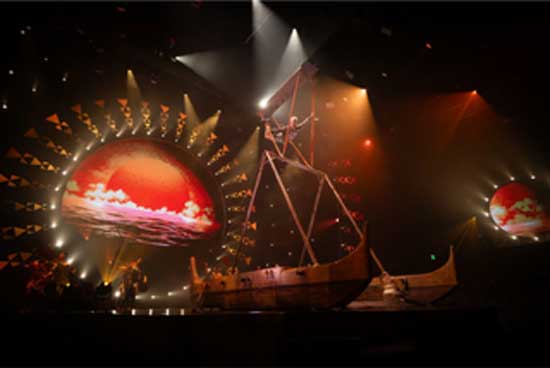
Three acrobats on a swing-board between two ancient canoes
propelled each other into high flights toward the audience,
smoothly landing in a hanging net that had appeared out of
nowhere. The utter simplicity of this “Holo Moana Voyaging
Swing” gave one the sensation of being flung through the air like a
child, making it easy to imagine surfers flung fearlessly from their
boards into the waves.
Different ocean and jungle sets followed, stylistically unified by
the seductive “Auana-pattern” in the “traditional Hawaiian art of
´ohe kāpala, a method of printing patterns using carved bamboo
stamps.” (Program notes) The scenes were further unified by
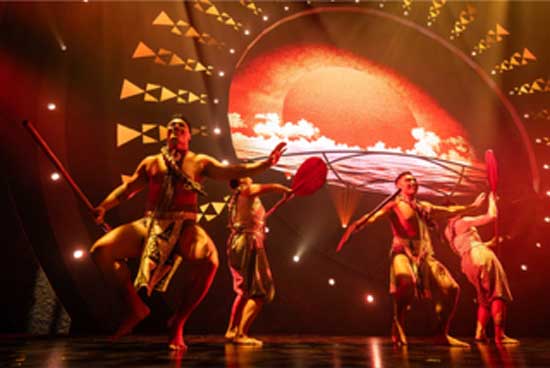
traditional dances during and between the acrobatic acts. There
was a paddle dance, a stick dance, moon and rainbow dances, and
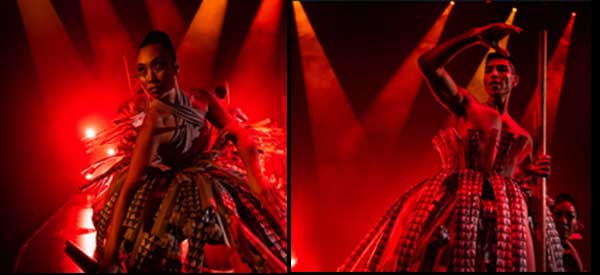
a culminating volcano-fire dance. Dancers and athletes alike wore
sumptuous costumes of natural fibers and fabrics (with no trace
of the straw skirts and coconut bras of tourist hula shows). There
was an immersive quality to the show, with dancers rushing up
and down the aisles at an enthusiastic pace, colored by beautiful
light projections.
Daring acrobatics, tasteful Hawaiian music, songs in native
language, and authentic dances -- but a particularly impressive
element to me was once again the stage craft, the seamless
transition of scenes and sets that usually encumbers and
interrupts theater, opera and ballet performances. Cirque du
Soleil showplaces are magic boxes that apparently operate under
their own technological laws.
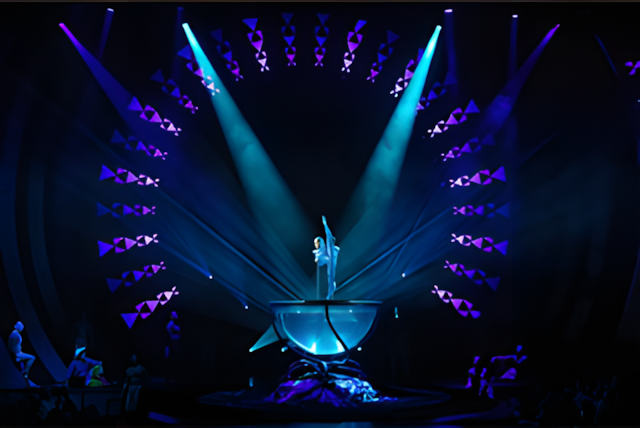
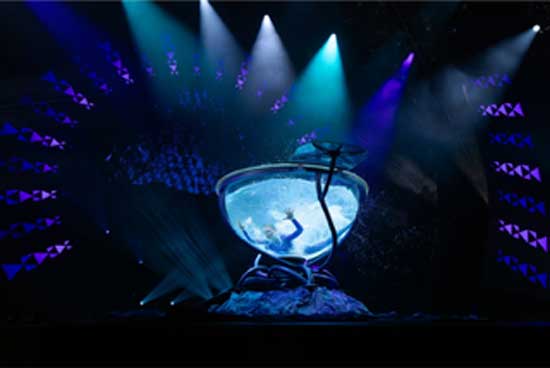
A main element of the magic is of course the clever lighting, for
example, when the stage suddenly plunged into night-blue, and a
huge glass bowl appeared (out of nowhere) to illustrate a
mythical theme: Mãmala, a woman shape-shifter, half surf-rider
and half water creature. From handstand twists and torques
above the rim, the young Hawaiian mermaid dove repeatedly into
the spectacularly lit bowl, each time happily splashing and
twisting the water out of her ponytail.
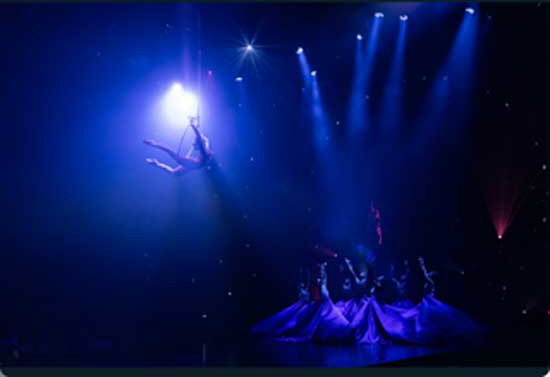
Another mythical element of the Pacific isles came with the aerial
lyra, calling up the moon goddess Hina with her hoop while the
swaying skirts of the Hula dancers below evoke the swell of ocean
waves. Her supple contortions and air pirouettes transcended the
predictable athletic feats when she swung herself high across the
night sky, sailed toward the audience and suddenly disappeared
in the rafters like the moon in a cloud.
Sand painting provided a long breath of poetry: a mature-looking
artist sat in front of the stage with a simple box, gently swaying
her hands through the box. On a huge screen (another unnoticed
apparition), her nimble hands painted the legends of how the
islands were created by the union of Mother Earth and Father
Sky. In hardly perceptible stroke of her fingers, a naked goddess
gave birth to ocean waves, tropical landscapes, birds and flowers,
all shifting and changing as fleetingly as the touch of wind. A song
in Hawaiian language was the only accompaniment to this
exquisite artistry.
Of course, there was also the comic relief any good circus must
provide, embodied by the Hawaiian figure of the Trickster, the
jester who also acted as Emcee. He blew a balloon into a huge
beach ball, managed to trick his way inside the ball and merrily
bounced about. In another scene, Without using any words, he
enlisted four young men from the audience to mime the
musicians of a band. He mimicked the instrument for each one
and invited them to copy his tricky stomping and clapping
rhythms -- an effort crowned by great comical failure. But he still
got them all to clown along irresistibly to the circus music of the
orchestra.
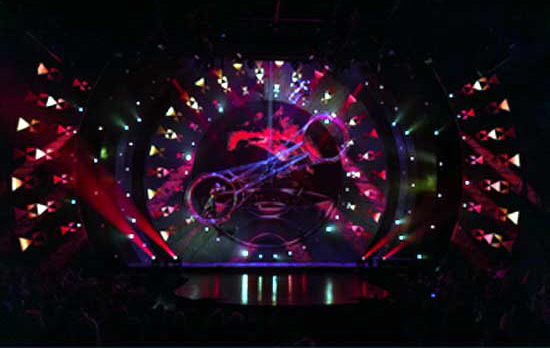
The last number was “Lua Pele,” a dramatic scene of volcanic fire.
Again out of nowhere, a gigantic apparatus of two connected
wheels appeared center-stage. This Wheel of Life symbolized the
volcano goddess Pele and her protective brother, the double
power of destruction and renewal. It was set in motion by two
acrobats using pure kinetic shift of weight to set the double-wheel
spinning and sometimes stopping in midair. At full speed, they
climbed outside their wheel and ran and leapt atop the spinning
wheels without a net. This feat, accompanied by fiery dances
below, brought the house down.
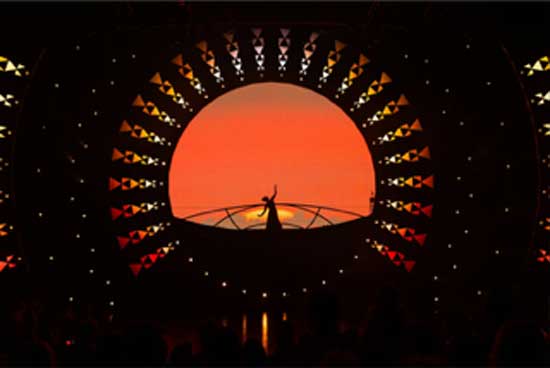
Water, air, sand, and fire – all the natural elements of the
Hawaiian islands were celebrated. In the final tableau, another
unexpected stage dimension opened up when the orchestra
appeared “in the clouds” above the stage and the whole company
appeared for a rainbow dance. Then a single dancer moved into
the center of the backdrop circle and performed in slow, graceful
Hula movements the ritual worship of the setting sun.
Photos: Cirque du Soleil Auana
The Creators
· Neil Dorward – Show Director
· Dr. Aaron J. Salā – Cultural Creative Producer
· Manaola Yap – Costumer Designer
· Kumu Hula Hiwa Vaughan – Hula Choreographer
· Keao NeSmith – Hawaiian Linguist
· Richard Peakman - Associate Stage Director
· Susanna Macaulay - Associate Creation Director
· John S. Barnett - Director of Production
· Ravi Chandwani and Ryan Dilley - Production Design
· Simon Guilbault - Set Designer
· Hugo Mercier-Bosseny - Lighting Designer
· Evan Duffy – Composer
· Tamlyn Wright – Props Designer
· Yianni Epivatinos - Sound Designer and Head of Audio
· Philippe Aubertin - Acrobatic Performance Designer
· Ewen Seagel - Acrobatic Equipment Designer
· Heidi Doucet - Makeup Designer
· Vanessa Ashley – Makeup Designer Assistant
|