|
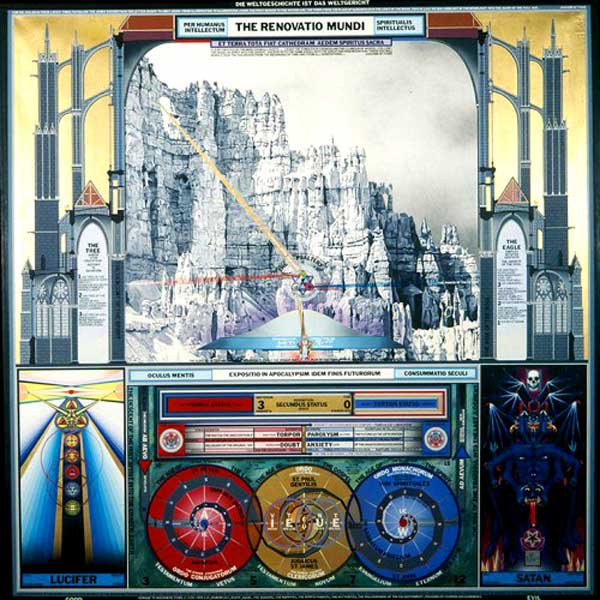
Paul Lafolley, The Renovatio Mundi, 1977
The
Hebrew calendar began
on October 6th, 3761
B.C. The Mayan calendar
began on August 11th,
3114 B.C. The current
age in the Vedic
calendar began on
February 18th, 3102
B.C. All of these
calendars would seem to
point to an even more
archaic system, now
lost, to some larger
complex of cycles in
which these start-dates
are embedded. Just as
there are larger
cycles, so too, there
should be smaller
cycles, like days
within a week or weeks
within a month, during
which archetypal forces
move in and out of
dominance. If we do
grant that such models
may be valid, we may
also find that the
Ancients were less
literal than we are.
Even now, perhaps, they
tempt us to conflate
the “when”
with the
“how,” the
archetype with the
means of its projection.February
8th, 3102 B.C. was the
date on which the
Dvapara Yuga ended.
3102 B.C. was the year
of the Kurukshetra War,
during which, it is
said, 3.94 million
warriors lost their
lives. Such a date is
clearly anything but
trivial, but on what
plane were these
battles fought? Were
the current laws of
physics in effect?
Where are all of the
shattered cities and
scorched bones? Were
the weapons
described—the
Brahmashiras and the
Nagastras and the
Pramohana
Astras—no more
than metaphorical, or
are we missing some key
aspect of the story?
December 21st, 2012,
was a date that left
many prophets
disappointed, yet it
was on this date that
Warner Bros. released a
movie called The Impossible.
Based on actual events,
it tells the story of
an English family on
vacation at a resort in
Khao Lak, Thailand, who
were separated when the
Indian Ocean tsunami of
2004 struck. After a
movie-length ordeal,
they are once again
reunited. This was the
tsunami that killed
230,000 people and
displaced 1.7 million
more. Many critics gave
it positive reviews.
Eric Koln, of Indie Wire,
on the other hand, gave
it only a B-minus
grade. He argued that
it suffered from a
“feel-good”
plot within the context
of mass-destruction.
Already anxious, I had
no desire to see or
judge the movie for
myself. Waves haunt me,
as they have for the
past 12,000 or so
years, and this one
seemed just a local
instance of far greater
things to come. For me,
the Paleolithic
glaciers are still just
about to melt, and a
rise in sea-level will
destroy the cities on
most coasts.
But why, you may ask,
do so many of our
predictions turn out to
be wrong? Now that 2012
has come and gone, and
the visions of its
cultic devotees have
proven far less than
accurate, we may want
to free ourselves from
any obsessive focus
upon dates. The
Time-Snake is far
slipperier than our
theories. It is not
that we do not know,
perhaps, but rather
that there is no way to
determine what we know,
or to differentiate a
corporate logo from a
hieroglyph. We see, but
we have forgotten how
to read. We believe
that our minds
penetrate beyond the
ends of our own noses,
when, in fact, they
rarely penetrate that
far.
If we humans cannot
travel from one side of
the omniverse to the
other, it is perhaps
because, at this point
in the Kali Yuga, we
have gotten much too
big. In the Satya Yuga,
when the Sun still had
a face, we knew enough
to avoid getting
tripped by our own
feet. We could enter
through the keyhole of
the pineal gland to
then exit onto the pyre
that the Birds had
built to burn us,
where, as we watched
with bland amusement,
our bones would turn to
ash. Our 10,000-year
life-spans allowed for
much experimentation.
We inhabited our bodies
from the outside in,
like the visitors to a
museum—the Smithsonian Institution,
let’s
say—and not, as
in the present, from
the inside out.
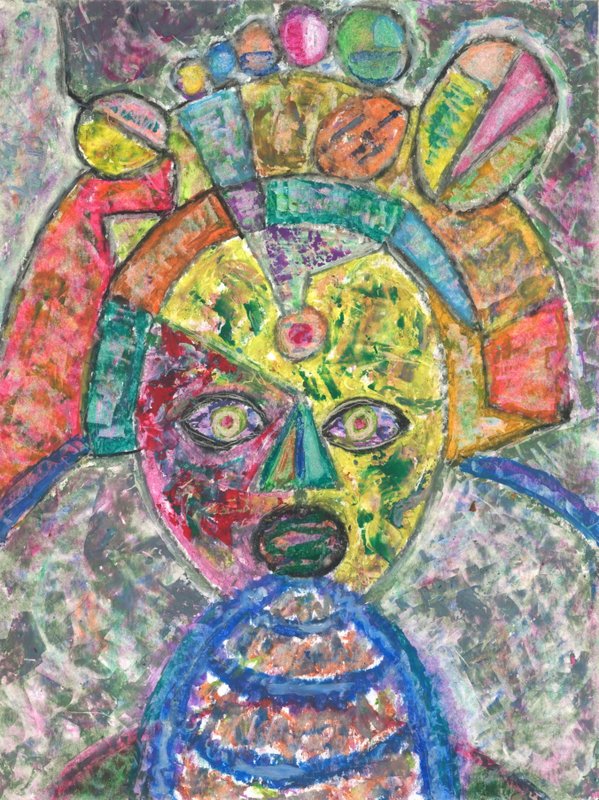
Brian George, Homage to Dhyanyogi Madhusudandas # 6
There is an aperture, an eye that opens in an atom, a point around
which the figure eight is twisted. There is a zero that gave birth to
the Big Bang, which even now contains it. How strange it is that
this zero is no bigger than it was. There is a passage that leads to
the edge of the known world. There is a tunnel that we remember,
which also remembers us, which waits for our return. We must
only dare to enter. Such a small requirement this is—to go where
we have been, to slip into a passage, to step out the other side.
There is a luminous tunnel that opens out of Life and onto Death,
which can turn like a frightening kaleidoscope, which
contemporary custom tells us we would do well to avoid.
Ignoring the instruction manuals that were left to us by the
Ancients, we may, quite foolishly, decline to enter through this
exit, to exit through this entrance. We may wait for 60 to 70 years
to see what can be seen. We may prefer the safety of the known to
the recognition that such safety is a hoax.
We do, of course, have cause for some degree of hesitation. There
are forces that oppose the reclamation of our birthright, who stole
and occupied the depths that we had earlier possessed. On the
other side of the aperture, we may draw to ourselves beings who
are adept at playing games, who may be quick to realize that our
skill-set has grown rusty. They may trap us in light’s bargain
basement, if not worse, with no capacity to come and go as we see
fit. We may inadvertently have travelled with big targets on our
backs.
Do the Ancients still have our interests at heart? Are the Snakes
our friends, and will the Birds be curious enough to even turn
their heads when we speak? Should we dare to enter, what relics
will we leave, what evidence of our scorched earth war against our
shadows, what trace of our Promethean technology? Will the
Snakes set us up for the kill, or will they dazzle us with their feats
of encyclopedic recall? Will we know which words are teachings,
which are snares? How black is the ocean that will swallow up our
cities? How much will it hurt to stare into the Sun? Once the Birds
have burnt us, if they do, how much of what we are will drift free
of the ash? Will we once more hear the hum that preceded the Big
Bang?
There is a passage that leads to the edge of the known world. We
are there, at the point around which the figure eight is twisted, in
the moment just before the start of the Great Year, nor have we
ever left. To the one side: desolation; to the other side: a waste.
We pause to wonder what has happened to our breathing, which,
after deepening, has somehow fled into the distance. Was the
rhythm of that heartbeat ever really ours? As the zero opens, a
voice presents us with an ultimatum, which some may hear as a
choice. “You may live,” it says, “or you may die.” We must choose
the third alternative.
|