|
I
gotta tell ya, that
you’d sort of listen
to Jeff along the way and
you’d go “wow,
he’s gettin’
really, really good,
Jeff” and
you’d hear him a few
years later and he’d
keep gettin’ better
and better and better. And
he still has, all the way
through. You know, he
leaves us mere mortals,
believe me, you know, just
wondering and having so
much respect for him.—Jimmy
Page inducting Jeff Beck
into the Rock & Roll
Hall of Fame, 2009
I
always keep a guitar in
nearly every place in the
house to remind me that I
should be doing that. And
ah, the guitar is always a
constant challenge. Every
time I pick it up I
pretend that I’ve
just started
playing—and it seems
to work.—Jeff
Beck, Still on the Run:
The Jeff Beck Story
There’s a Zen
parable about two
carpenters who ply their
trade over the same 20
years. One carpenter
continues to learn new
skills, honing his craft
year after year. The
other learns enough in a
year to get by then never
progresses. One man is a
carpenter of 20
years—a master,
the other a carpenter for
one year twenty times in a
row.
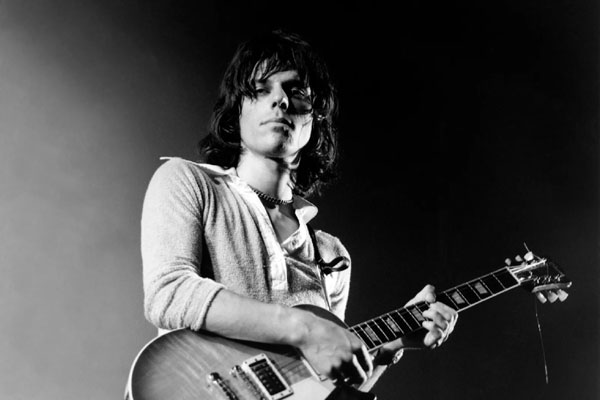
Jeff Beck was that rarest man, a master and a maverick, an artist
relentless in his desire to improve, push, innovate, and attain
greater fluency in order to express his art ever more fully.
I “discovered” Jeff Beck in 8th grade when I heard “Star Cycle”
and “El Becko” on the radio. It was 1980 and Jeff had a new
album: There and Back. I made it my mission to get that LP (I’m
on my second copy.) I didn’t realize that I’d already heard and
loved Jeff Beck as a member of The Yardbirds; “Heart Full of
Soul,” “Shapes of Things,” and “Over, Under, Sideways, Down” all
owe their chart-topping chops to Jeff’s groundbreaking guitar
genius.
If guitar is a language, then every guitarist plays in his or her
dialect. My precocious epiphany was that I understood every
nuance of Jeff’s dialect, every phrase of his patois. Soon I was
absorbed in what he had to tell me on Flash, Wired, and Blow by
Blow. In 1995 I saw Jeff Beck at the Garden State Arts Center
where I got to hear him play “Star Cycle” along with his canonical
mainstays “Freeway Jam,” “Cause We’ve Ended as Lovers,”
“Goodbye Pork Pie Hat,” and “People Get Ready.”
The hands of Jeff Beck
As well as hearing how his technique improved, you can literally see how Jeff Beck’s approach evolved. Compare the way he
manipulates his guitar in 1974 when he plays “She’s a Woman” on
a BBCFOUR session (it’s the 1954 “oxblood” Gibson Les Paul, the
same ax he wields on the cover of Blow by Blow) to where he’s at
on March 22, 1999 performing “What Mama Said” on Late Night
with David Letterman.
In a YouTube video called “Why JEFF BECK is UNCOPYABLE,”
Rick Beato, the amiable musician, producer, and music educator,
says: “When you talk about the sound of the guitar being in the
hands, his sound is completely in his hands.”
Fellow Yardbirds and longtime friends Eric Clapton and Jimmy
Page concur, both linking the hands to the dialect. Clapton said in
an interview: “I don’t even know how he’s doing it half the
time—he’s combining the tremolo arm with bending and with
volume. There’s so much going on between his left hand and his
right hand and what the right hand is doing—all the independence
it has. It’s all about making that voice.” Page put it this way: “He’s
developed a technique which is so complex—it’s just a beauty to behold and to hear and to feel his playing. He’s having a
conversation with you when he’s playing, it’s just that he’s not
singing.”
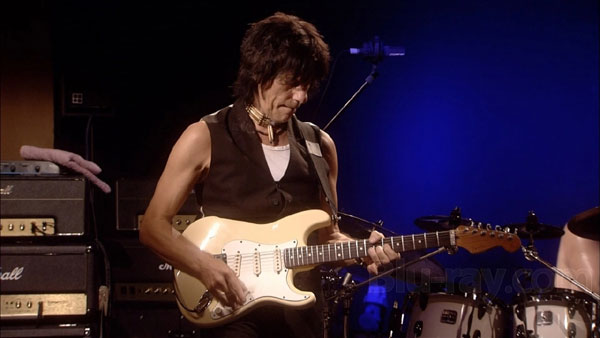
For the apotheosis performance where you can both hear and see
the evolution of his technique, you must watch Performing This
Week: Live at Ronnie Scott’s (there’s a film as well as an album).
Jeff played five nights in 2007 at London’s legendary Ronnie
Scott’s Jazz Club, an intimate venue that seats 250 lucky souls. I
bought the DVD a few months ago; whoever decided to film and
lovingly record the show deserves a Nobel Prize.
For these gigs, Beck’s band of ringers consisted of Vinnie Colaiuta
on drums; Jason Rebello on keyboards and synthesizers; and a 22
year-old phenom on bass named Tal Wilkenfeld. To listen to this
album is to have one’s ears ravished, but to watch this
performance is to behold a master. Jeff is 63: he’s been playing
guitar—and getting better and better at it—for roughly 50 years.
And there’s a real sense of occasion. No doubt deliberately seated
at a table out of the spotlight are Robert Plant and Jimmy Page.
Appearing later on stage to accompany Jeff is Eric Clapton. Think
of those three guitarists in one cozy club, the Holy Trinity sprung
from “the Surrey Delta” and nurtured in that six-string incubator
known as The Yardbirds. Brian May of Queen, who grew up in the
same area of England, can be also seen enjoying the show.
Every song constitutes a highlight. Hardly a day goes by that I
don’t watch or at least listen to these live versions of “Beck’s
Bolero,” “Angel (Footsteps),” or “Nadia.” Four songs into the set,
“Cause We’ve Ended as Lovers” provides the first showstopper.
Stevie Wonder’s achingly mournful song always allowed Jeff to
use his entire sonic palette, but this performance crackles with an
additional dynamic: Jeff gives the first solo to the kid. He even
slings his Stratocaster behind his back and clasps his hands
together, as much to say “the stage is yours” as to admire Tal’s
skills. She plays like the second coming of Jaco Pastorius and as
she lays down phrase after astonishing phrase, Beck throws his
arms in the air and looks to the heavens in a delightfully paternal
effusion of joy and esteem.
A second showstopper, Jeff’s rendition of “A Day in the Life”
earned him a Grammy for Best Instrumental Rock performance.
But before the Grammy came Jimmy Page’s ecstatic applause and
beatific smile as the camera briefly shows him overcome with
admiration. And then there’s the encore with Clapton who joins
Jeff and the band for a Chess Records A and B-side of Muddy
Waters: “Little Brown Bird” and “You Need Love,” the latter the
basis for Led Zeppelin’s “Whole Lotta Love” (wish Jimmy had
stepped up to help out on that one!)
When Jeff and his bandmates take their bows, the audience rises
in thunderous, heartfelt ovation. What an outpouring of love for
this man! You can tell that everyone there realized that they’d
experienced something rare and exquisite and beautiful.
One of one
For my money, Jeff Beck is the greatest Rock guitarist of them all.
His toolbox held everything—he could use distortion and
feedback as well as Page or Hendrix; riddle you with hammer-ons
a la Eddie Van Halen; and modulate that whammy bar as if it was
part of his right hand, enabling him to create sounds like a pedal
steel . . . or a crying baby or a menacing howl or an ethereal spirit
singing in deep space.
We never got to see where Jimi Hendrix might have taken his art;
like a butterfly in amber, Jimi’s genius remains preserved at 27.
Like a lot of guitarists at the time, when Jeff heard (and saw) Jimi
he thought of simply packing it in, as in “damn, what’s the point?”
But Jeff kept playing and, more importantly, kept
improving—from the sitar-like riff on “Heart Full of Soul” to his
astonishing replication of Hindi singing on “Nadia,” from “Beck’s
Bolero” to “El Becko,” from “Freeway Jam” to “Roy’s Toy.”
Jeff Beck racked up eight Grammy Awards. He played so nice
they put him in the Rock & Roll Hall of Fame twice—as a Yardbird
in 1992 then as a solo artist in 2009. His collaborations read like a
Who’s Who of Rock, Soul, Pop, and Jazz Fusion: Jimmy Page,
Keith Moon, Rod Stewart, Ron Wood, Nicky Hopkins, Stevie
Wonder, George Martin, Max Middleton, Donovan, Stanley
Clarke, Jon Bon Jovi (that’s Jeff shredding the solo on “Blaze of
Glory”), Jan Hammer, and Sting, as well as many of tomorrow’s
legends, such as singers Imogen Heap and Joss Stone, guitarist
Jennifer Batten, and bassists Rhonda Smith and Tal Wilkenfeld.
He was called “the guitarist’s guitarist.” After his death, a new title
appeared: one of one. As with all great artists, though, Beck’s
technical skills served higher artistic ambitions: Jeff always had
the finest musical ideas. Rick Beato astutely points out: “One
thing is that he plays the most unique phrases of anyone I can
think of.” Precisely!
I have a simple measure for his greatness: if I could be
miraculously given the ability to play guitar like anyone, my first
choice would be Jeff Beck. No question.
Jeff’s death haunts me. We lost this amazing human being on
January 10, 2023. My eyes frequently moisten watching him play
at any point in his career but most poignantly in that bravura in
excelsis at Ronnie Scott’s. It breaks my heart that Jeff died of
bacterial meningitis. The other two “Surrey Delta” prodigies with
whom he grew up—Eric Clapton and Jimmy Page—tempted death
with substance abuse, particularly heroin addiction, while Beck
took pretty good care of himself and had notably steered clear of
the heavy drugs which ravaged the ranks of his peers.
But there’s a deeper reason why I’ve taken his passing much
harder than other Rock titans: for 43 years, Jeff Beck talked to
me. I understood what he was saying so well that I felt I knew
him; it was merely incidental that we’d never actually met.
At Beck’s funeral, Jimmy Page eulogized his longtime friend,
sometime collaborator, and, in the best way, rival guitarist by
calling him “the quiet chief.” Jeff tended to be soft-spoken, though
he had a refreshingly irreverent sense of humor. Jeff Beck did his
real speaking through his guitar. You listen to his music, you
watch him play, and you realize that Jeff Beck was a beautiful
human being, a supreme artist. He was The Master.
|