|
MIRROR . . . . . . . . . . . . . . . . . . . Sylvia Plath
I am silver and exact. I have no preconceptions.
Whatever I see I swallow immediately
Just as it is, unmisted by love or dislike.
I am not cruel, only truthful—
The eye of a little god, four-cornered.
Most of the time I meditate on the opposite wall.
It is pink, with speckles. I have looked at it so long
I think it is part of my heart. But it flickers.
Faces and darkness separate us over and over.
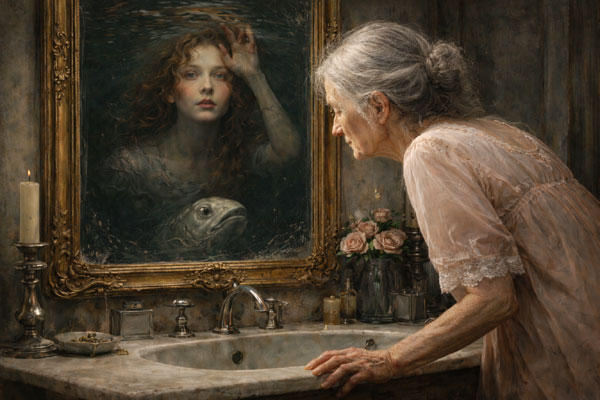
Now I am a lake. A woman bends over me,
Searching my reaches for what she really is.
Then she turns to those liars, the candles or the moon.
I see her back and reflect it faithfully.
She rewards me with tears and an agitation of hands.
I am important to her. She comes and goes.
Each morning it is her face that replaces the darkness.
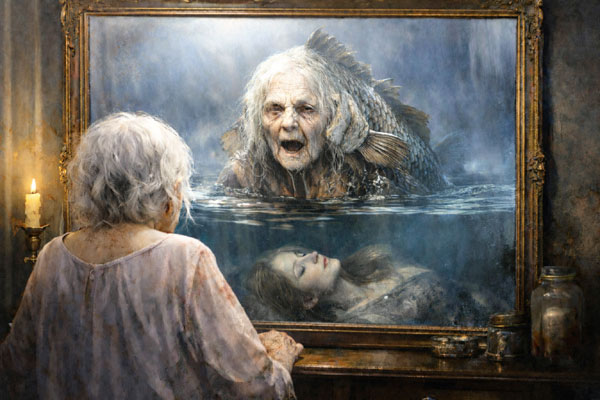
In me she has drowned a young girl, and in me an old
woman
Rises toward her day after day, like a terrible fish.
Sylvia Plath’s “Mirror” was first published in The New Yorker in
1961 and in her famous collection Ariel after her suicide. For me,
it’s one of the most inventive and profound examples of
personification that poetry has to offer.
This two-stanza poem begins with our looking glass explaining
what it’s like to be a mirror on a wall in a particular room:
Most of the time I meditate on the opposite wall.
It is pink, with speckles. I have looked at it so long
I think it is part of my heart.
Like the imaginary tree in the forest, no one is around to be
reflected in its silver
and exact
surface; so most of the time our
Mirror simply reflects the wall on the other side of the room. One
would think it would be bored out of its frame, meditating for
hours on a section of wallpaper,
pink, with speckles
, but
Mirror sees it as the core of its own identity, as
part of my
heart.
Mirror is upset when Zen-like communion with its heart is
interrupted by darkness
at night or faces that occasionally
flicker
upon it during daylight.
I have looked at it so long
suggests that Mirror feels love for the wall and is unhappy at
being separated from its essence by men and women who happen
by to gaze at themselves.
Being a mirror, it is powerless to avoid such reflections and takes
pains to explain its modus operandi when it comes to interacting
with human beings. Ethically it has
no preconceptions
and is unmisted by love or dislike
. Those who look into this Mirror
need not fear that any bias or predisposition will alter its
faithfully produced reflections in any way.
Our Mirror, however, is aware that humans are often unhappy
with what they see in its looking glass. It wants to assure them
that, as the mere eye of a little god,
its infallibility is limited:
I am not cruel, only truthful.
Those words, however, do not imply kindness—only
neutrality—and are sinisterly modified by the fact that
Whatever I see I swallow immediately.
The only being who visits Mirror is someone who has done so
day
after day
from the time she was a beautiful young woman until
she has reached old age. We should not miss the fact that a
personification is personifying a woman. Above all, we should
notice that terrible word
swallow
which suggests that our Mirror
is a predator devouring its prey.
The woman provides the nutrition for Mirror’s existence.
*****
Now I am a lake.
The power of Plath’s personification lies in the poet’s ability to
make us forget that a mirror is just glass locked into a wooden
frame. That’s mostly what our Mirror is in stanza one. Although
stanza two mirrors one in size, our Mirror must now interact with
a woman who, like Narcissus, begins by contemplating the
reflection of her own beauty but, unlike that youth, lives on to
witness beauty ravaged by time.
A woman bends over me.
She is not standing erect and looking into a mirror on a wall. Like
Narcissus she is bent over, possibly seeing her reflection in the
water of her boudoir’s basin. In order to accommodate this
woman our Mirror has abandoned its glass and become a lake.
As water, our Mirror can relax, shimmer, be more natural, feel
more like the human it’s being asked to reflect. It’s as if Mirror is
remembering its famous encounter with the youth who eons ago,
smitten by his beauty, fell into his reflection and drowned.
A literal mirror, of course, could remember nothing at all. But
Plath’s personified Mirror might well remember Narcissus; and
although a literal mirror cannot see or sympathize with the
woman it reflects, the human consciousness Plath gives her
mirror allows for such sympathy, and even a hint of emotion.
Narcissus was so distracted by his beauty that he spurned the
beautiful nymph Echo and lost his chance to perpetuate himself.
Passing through time, Sylvia Plath’s woman is destroyed by what
Narcissus never lived long enough to experience: decrepitude.
Mirror’s woman would love to find her youthful beauty unaltered
each day; but what she finds—whether in glass or shimmering
water—are the increasingly disturbing signs of her mortality.
She turns her back on Mirror, seeking the flattering light of
those
liars, the candles or the moon.
As she turns away, Mirror
presents rejection of the truth by showing her
back
to the reader.
(I can hear T.S. Eliot muttering, “Humankind cannot bear very
much reality.”)
After faithfully reflecting the pathos of the woman’s plight, Mirror
realizes that although she is not a constant companion
I am important to her.
Looking into its glass, deploring what she
sees, the woman rewards Mirror’s faithfulness with
human
anguish, with tears
and agitation of hands.
As she ages, it’s as
if she is imploring her Mirror to whisper cosmetic nothings rather
than truthful
reflections. Mirror, meanwhile, is experiencing
something akin to unrequited love.
Each morning—Let there be Light!—there’s an almost cosmic
sense of quiet joy as the woman’s
face replaces the darkness.
This feels like a long-time marriage in which Mirror has accepted
its partner to have and to hold, for better, for worse, till death do
us part.
The woman, however, never accepts Mirror’s love. There may
have been a honeymoon period when Mirror reflected the
woman’s Narcissus-like beauty. But all too soon, her lover insisted
on revealing blemishes, then wrinkles and lines. The poem
dramatizes an impossible marriage between human desire for
illusion and the uncompromising reality of truth.
In me she has drowned a young girl, and in me an old
woman
Rises toward her day after day, like a terrible fish.
I once had an English Professor who argued that Hamlet,
Macbeth, Othello, and Antony, far from having a “tragic flaw,”
were done in by a tragic virtue. The tragedy arises because Mirror
cannot soften its vision, and the woman cannot endure being
mortal.
Mirror’s tragic virtue is that it is incapable of lying. Plath leaves
Mirror on the wall to grieve for her lover, forced by faithfulness to
truth to innocently drown
beauty and turn it into a
terrible fish.
All images provided in collaboration with ChatGPT’s Artist in
Residence, AI.
|