|
“Clarity
is of no importance
because nobody listens
and nobody knows what
you mean, nor how
clearly you mean what
you mean. But if
you have vitality
enough of knowing
enough of what you
mean, somebody and
sometimes and sometimes
a great many will have
to realize that you
know what you mean and
so they will agree that
you mean what you know,
what you know you mean,
which is as near as
anybody can come to
understanding any
one.” — Gertrude
Stein, FOUR IN AMERICA
(posthumously published
by Yale University 1947
with an introduction by
Thornton Wilder)
With this post, I begin my monthly PORTRAITS in Scene4 after having submitted articles from time to time over the years. As for the name of these musings,
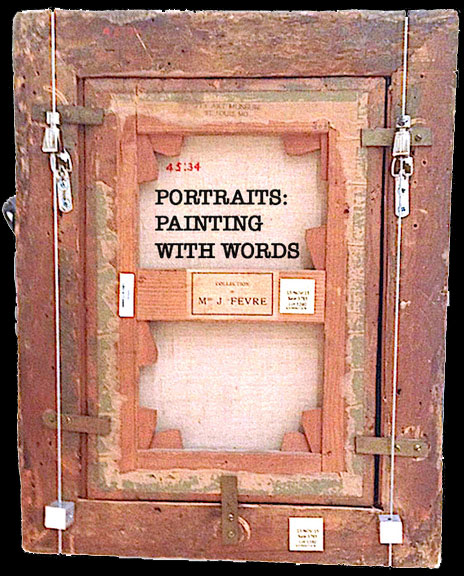
PORTRAITS: Painting with Words
, it’s taken
from part of the title
of a favorite book in
my Gertrude Stein and
Alice B. Toklas
collection. The
book,
Portraits and Prayers
, was published in
1934. It includes
fifty-eight of her
prose portraits or word
paintings which she
began writing in 1908.
One of the first was
“Ada”
written about Alice
whom she had met a few
years earlier. (It
doesn’t appear in
this book but was in
GEOGRAPHY AND PLAYS
published in 1922.)
Alice/Ada:
“..came to be
happier than anybody
else who was living
then. It is easy to
believe this
thing…And
certainly Ada all her
living then was happier
in living than any one
else who ever could ,
who was, who is, who
ever will be
living.”
Other portraits soon
followed of the artists
whose painted portraits
covered the walls floor
to ceiling at rue de
Fleurus: Cezanne,
Matisse and Picasso and
friends Carl Van
Vechten, Virgil
Thomson, Mabel Dodge
and Jean Cocteau.
One of the most
well-known of the word
portraits is
Picasso’s from
1923, “If I Told
Him A Completed
Portrait of
Picasso.”
It begins:
“If I told him would he like it. Would he like it if I told him.
Would he like it would Napolean would Napolean would
would he like it…”
And ends one hundred and two lines later with:
“Miracles play.
Play fairly.
Play fairly well.
A well.
A well.
As or as presently.
Let me recite what history teaches. History teaches.”
Oh, if only!
She would write Picasso’s word portrait sixteen years after he had painted
her
iconic portrait. But it had taken more than eighty sittings for
him to paint her
portrait –
that’s a lot of
sitting on a rickety,
18th or 19th century
chair. And she
had to trudge on the
cobblestones and stairs
of Montmartre to a cold
studio in a long robe
and sandals, no less!
Hence the sixteen year
lag? But what a
portrait it is.
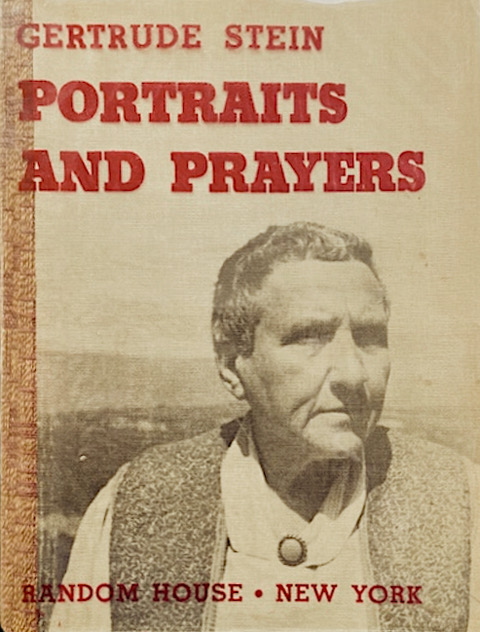
The first edition is itself an amazing example of book design and one-of-a
-kind book art. Directly printed on the front board is one of Carl Van
Vechten’s numerous photographs of Stein. Instead of the traditional paper
dust jacket, the book has a delicate one of clear plastic with the book’s title
printed on it in bold red. To find a copy of the book with an intact
dustjacket is, in bookseller parlance, “very rare!” I have one copy, signed
by Stein. The spine of the book features a brocade-tweedy fabric
reminiscent of Gertrude’s signature vests.
The book was designed by Ernst Reichl, who designed a number of Stein’s
books for Random House as well as Alice’s memoir
What is Remembered
in 1963. He was the father of food writer Ruth Reichl, who
wrote the introduction to the most recent paperback edition of Alice’s
cookbook (Harper Perennial Modern Classics, 2021.)
My PORTRAITS will freely pick and choose aspects of what Stein called
“the continuous present.” I have never purported to be a Stein scholar and
have on occasion butted “roses” with them and was once reprimanded for
seemingly trying to be Alice’s agent!
To fully understand “the continuous present,” is for me a challenge. To
simplify the scholar’s climb up that Steinian summit, the closing statement
of an AI summary gives me comfort and writing milestones.
“Stein's continuous present is often considered a "natural" form of
perception, reflecting the way consciousness works by associating
disconnected events rather than experiencing life as a smooth, linear
progression.”
A common dictum among mentors of creative fiction writing is “Write
about what you know.” Most of what I’ve written, both fiction and non
-fiction, invariably is influenced by my longtime obsession with
GertrudeandAlice. So ‘ “a natural form of perception,” “associating
disconnected events, rather than experiencing life as a smooth, linear
progression” ’ will be one of the elements of my PORTRAITS stylebook.
For example, on page 1 of the stylebook I would have:
“Just as proper pronouns are now considered de rigeur, over the years
“GertrudeandAlice” is my proper collective noun and de rigeur when I
refer to the two Mesdames from Paris. In 1935 Edmund Wilson had after
all called them ‘the most complete example of human symbiosis I have ever
seen.’ “
(The jury is still out as to when I’ll use “Stein” or “Gertrude” or “Toklas” or
“Alice”.)
As I begin to frame my portraits I can only hope “…sometimes a great
many will have to realize that you know what you mean and so they will
agree that you mean what you know, what you know you mean, which is
as near as anybody can come to understanding any one.”
PORTRAITS Pix of the Month
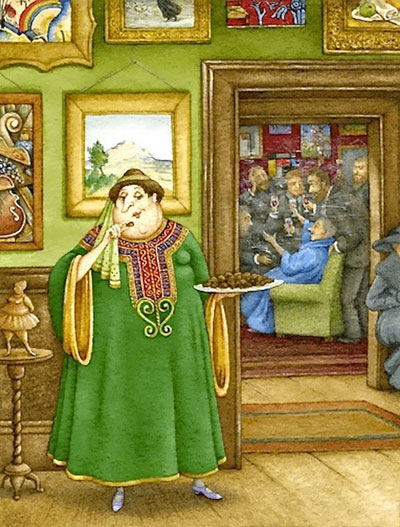
“The Art Critic ”, Michael Sowa, 1996.
The madam in green is a bit stout to be Alice, though she appears to be
ready to serve the hashish fudge. But in the next room does look like Gertie
holding court. Hmmm?
|