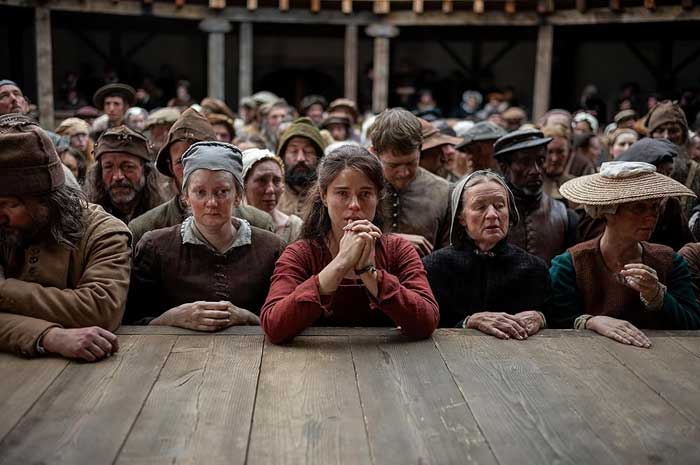
|
That is my home of love; if I have strayed,
Like him that travels, I return again…
William Shakespeare, Sonnet 109
Just as Shakespeare’s life story is virtually a tabula rasa, so
is that of his wife,
Anne Hathaway.
Their marriage has been
the subject of
centuries of
speculation; the usual
assumptions run along
the lines of Ian
McKellen, who noted in
his one-man show Acting Shakespeare that
not once in
thirty-seven plays did
Shakespeare depict a
happy marriage.
Anne Hathaway does not even appear in the multi-Oscar-winning Shakespeare in Love, John
Madden’s 1998
film that portrays
Shakespeare (Joseph
Fiennes) pursuing an
affair with the
fictitious Viola de
Lesseps (Gwyneth
Paltrow), who inspires
him to write Romeo and Juliet. The
portrait of a shrewish
Anne appears in John
McKay’s A Waste of Shame (2005);
in that film, Anne
(Anna Chancellor)
drives William (Rupert
Graves) to escape to
London, where he writes
sonnets to the Dark
Lady (Indira Varma) and
the Fair Youth (Tom
Sturridge). In
Kenneth Branagh’s
2019 film All is True, William
(Branagh) has retired
to Stratford after
twenty years in London,
and he and Anne (Judi
Dench) are virtual
strangers to each
other. William
idealizes his dead son
Hamnet, imagining he
would have been his
father’s
successor as a poet and
playwright; however,
Hamnet’s
surviving twin sister
Judith holds secrets
that threaten to
destroy William’s
illusions.
Chloe Zhao’s Hamnet, with
a screenplay by Zhao
and Maggie
O’Farrell based
on
O’Farrell’s
novel, is a more moving
film than any of the
aforementioned, and
indeed the most moving
film of the past
year. Hamnet depicts
a different period in
the Shakespeares’
marriage from All is True and
paints a different
portrait of the
Shakespeare family. It
begins in happiness and
rapturous love,
progresses to grief and
bitterness, and ends in
catharsis through the
performance of a
tragedy.
 |
At the film’s beginning, there is a title stating that Hamlet and
Hamnet were interchangeable names in Elizabethan
times. Similarly, the will of Anne Hathaway’s father refers to her
as “Agnes,” so we must assume Anne and Agnes were
interchangeable names as well. The lead character in Hamnet is
called Agnes (pronounced ahn-yes). As played by Jessie Buckley,
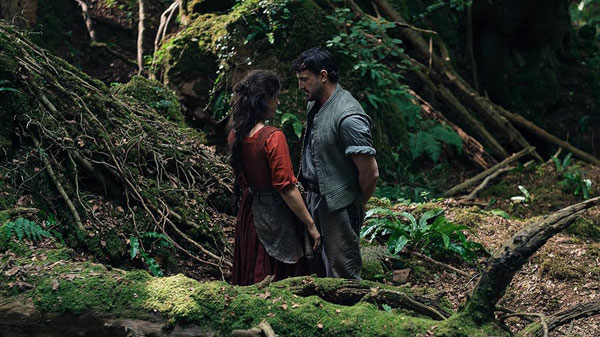
Agnes is a child of the woodlands, called a “forest witch” by her
Stratford neighbors. She collects herbs, trains her hawk, finds
refuge in a hollow under the roots of an ancient tree. Coming
home from her rambles, she encounters William (Paul Mescal),
her younger brothers’ Latin tutor. At first he is more intrigued
with her than she with him, but soon they fall in love. He tells her
the story of Orpheus and Eurydice; she reads his palm and
predicts a successful future for themselves and two children.
Agnes and William have unhappy home lives. Agnes’ rigid
stepmother (Justine Mitchell) has never been a mother to her;
William’s father (David Wilmot) is a choleric brute who mocks his
son’s ambitions, while his mother (Emily Watson) tries to keep the
peace. Agnes and William know their families will disapprove of
their match, so they arrange it that they have to marry.
Zhao is meticulous, as she was in The Rider and Nomadland, in
establishing the visual world her characters inhabit. With the aid
of cinematographer Lukasz Zal and production designer Fiona
Crombie, she creates a green world of unimaginable lushness—a
place Titania and Oberon could inhabit. Perhaps here she was a
bit too meticulous, because during the first half-hour I wondered
when she’d finally begin the story. Then Agnes and William began
their married life, and I was entranced to the end.
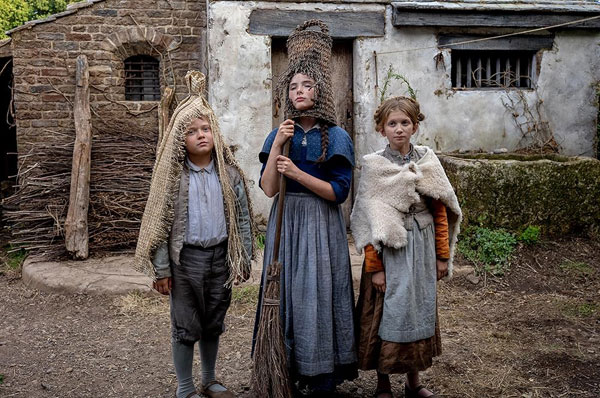
Agnes goes into the woods, her nurturing place, to bear her first
child Susanna (Bodhi Rae Breathnach). She wants to go to the
woods for her next delivery, but there is flooding in the streets,
and William’s mother forbids it. She delivers twins: Hamnet
(Jacobi Jupe) and Judith (Olivia Lynes). Hamnet is robust, but at
first Judith appears stillborn. Her mother’s embrace revives her,
but she remains sickly.
The problems Agnes and William face sound totally familiar and
modern. William has ambitions he cannot fulfill in Stratford, and
leaves for London. He wants to bring his family there, but Agnes
fears for her children’s safety. William comes back to Stratford
when he can, which isn’t often. Agnes stays in the country air of
Stratford, where she takes her children to the woods, teaches
them about herbs, and shares her mystic bond with hawks and
other birds.
Judith and Hamnet become touchingly close. When plague comes
to Stratford, Judith comes down with it. What Hamnet does in
response is a heartbreaking variation on the Biblical quote,
“Greater love hath no man.”
Both parents are overwhelmed with sorrow, and Agnes’ is
compounded by her rage at William over his absence. It is up to
William to expiate this sorrow the only way he can—through his
art.
Future generations will cite Jessie Buckley’s performance in Hamnet, along with Casey Affleck’s in Manchester by the Sea, as
the outstanding cinematic portrayal of grief. Agnes’ emotions are
raw, almost feral, and she reveals successive, ferocious levels of
love, rage, and tenderness. Buckley dominates the film, but
Mescal is also mesmerizing as William, desperately pouring his
grief into his work, commanding the actor playing Hamlet (Noah
Jupe) to repeat his lines ad infinitum until they match William’s
own feelings. (That the Motion Picture Academy ignored Mescal
will be one of its lasting disgraces.)
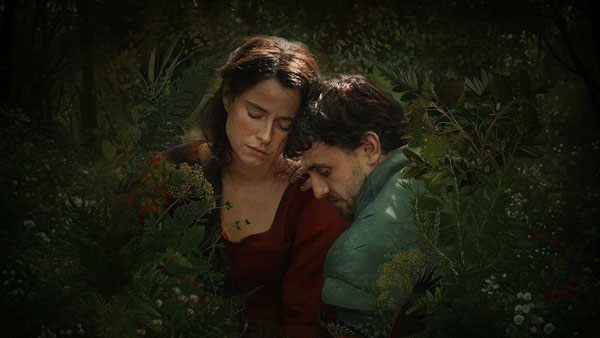
The entire cast—which also includes Joe Alwyn as Agnes’
brother—is noteworthy, but special mention must be made of the
Jupe brothers, Jacobi and Noah. Zhao cleverly uses their facial
resemblance to enhance the power of the ending, but that
cleverness would be for nought if the brothers did not deliver the
goods. Jacobi is deeply moving as Hamnet, and as for Noah, his
performance here makes me want to see him play Hamlet in a full
production. He’s only 21, but he’s obviously up to it.
Some reviewers have accused Zhao and O’Farrell of
sentimentality. After Hamnet’’s death William bitterly recites the
“To Be or Not to Be” soliloquy while staring into the Thames, in
obvious contemplation of violating the canon ‘gainst
self-slaughter. Some critics have condemned this as overkill.
While I am normally not a fan of authors quoting themselves in
movies, this scene packs a punch as filmed by Zhao and played by
Mescal. Others have groaned at composer Max Richter’s use of
his famous piece “On the Nature of Daylight”— a work of
astonishing poignancy, but one that has appeared already on
multiple film soundtracks ranging from The Handmaid’s Tale to Jiro Dreams of Sushi. All I can say is that it works magnificently
in Hamnet.
Hamnet is a transcendent emotional experience, especially in its
final scenes, and a moving tribute to the healing power of art. It
asserts that William and Agnes Shakespeare truly lived in a home
of love; death could shake its foundations, but not bring it down.
Above all, it makes Agnes Shakespeare a real person, and her
emotions real and palpable, in a way no previous film has done. It
is a story that should have been told long ago, but we can be
thankful it has been told now.
|