|
Note:
As SF Ballet was
short on production
photos of the
different casts for
La Sylphide, please
notice that some
photos show Danish
guest Alban Lendorf
(American Ballet
Theater) and Joseph
Walsh instead of Wei
Wang whom I saw in
the role of James.
It
is a puzzle why
American ballet
companies tend to
perform the Danish La Sylphide by Bournonville’s (1836) instead of the much more romantic original version by Taglioni, from 1832. The illustrious ballerina Marie Taglioni, his daughter, had danced the first Sylphide on
pointe, apparently
hardly touching the
ground, reshaping
classical ballet
overnight.
Bournonville had
seen the ballet in
Copenhagen and made
the tale his own by
considerably
shortening it to a
new score and
sweeping off the
romantic and erotic
content with a cool
norhern broom. In
order to see the
romance of La Sylphide you have to go to Paris or Italy-- or to YouTube.
Alban Lendorf (photo: Lindsey Rallo)
SF Ballet’s reprisal of the Danish La Sylphide this April changed
my opinion of it. I saw the ballet less as a weaker version than an
altogether different affair. Ex-Princical dancer Ulrik Birkkjaer, a
former member of the Royal Danish Ballet, who had starred in
the ballet, polished up Helgi Tomassons’s 1987 production (that
had a substantial overhaul already in 2004 and 2012). With the
participation of SF Ballet’s artistic director, Tamara Rojo, the
latest revival brought out the dark, cynical aspects in the story of a
young Scotsman who falls for a sylph on his wedding day. This
time, his chasing after an illusion comes across not as a fatal love
story, but as a tale of greed, egoism and betrayal -- convincing and
illuminating.
Alban Lendorf (photo: Lindsey Rallo)
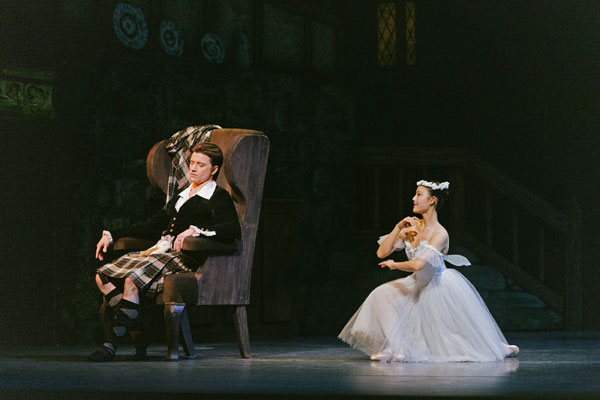
Usually, the “romantic“ hero, James (Wei Wang), is depicted as a
charmer with a mean streak, which doesn’t quite gel. Why
sympathize with a guy who abandons his fiancee Effy (Carmela
Mayo) and acts like a nasty control-freak? Should we feel sorry for
him when he destroys the beautiful sylph (Wona Park) whom he
cannot possess?
In the new revival, James is a negative hero from the get-go.
Principal Wei Wang, who trained in Bejing and at SF Ballet
School, hides his natural charm and plays a surly, arrogant fellow
-- anything but a sensitive soul in love with a dream. As he chases
aftrer the sylph, his sharp, precise footwork and explosive leaps
do more than highlight the essential Bournonville style. The rapid battements, cross-beats of both legs in the air, that have to be
executed with a rather immobile upper body, suddenly seem to
express the obsessive character of James.
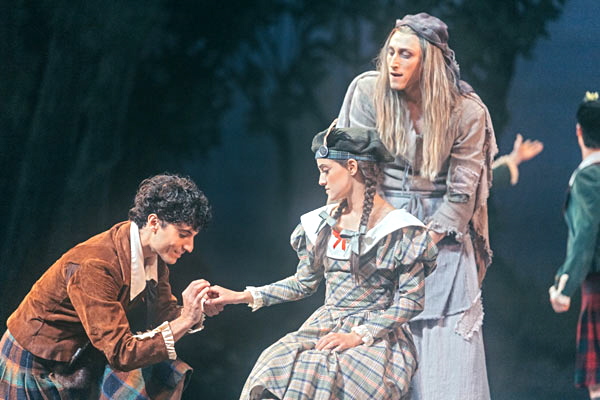 |
The production also highlights aspects of comedy. James is
indifferent to the the wedding reels with Effy and their guests. He
has something else in mind while the men, women and kids in
their Scottish dresses and kilts are having a jolly good time with
the rapid tempi of the score (by Herman Severin Loevenskiold)
and Bournonville’s stomping steps that seem to predict the
staccato footwork of River Dance. He breaks away frantically
whenever the slyph flits by. At the same time, he energetically
defends his possession, Effy, againts his rival Gürn (a comically
understated Fernando Carratala Coloma) who keeps trying to kiss
her hand.
 |
One time, when James almost catches his butterfly she escapes up
the chimney -- a moment of such perfect stage craft that it
brought the house down. A darker comical presence is the old
woman/witch. danced by the stunninly tall spindly Nathaniel
Remez. He has fascinating twisted movements and over-the-top
expressionist pantomimes as he/she reads people’s destiny from
their hands and reacts to James’s meanness by promising him his
just desserts.
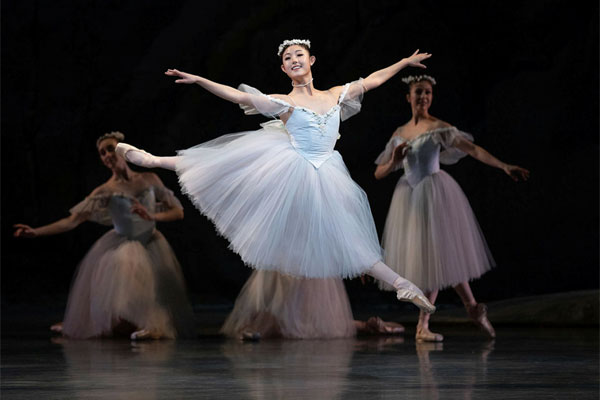
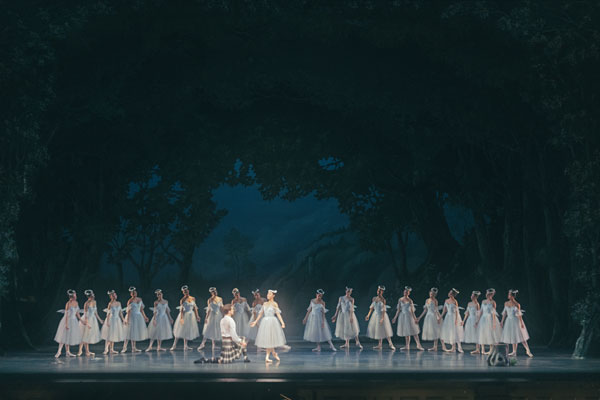
In the second act, the forest, lyrical passages in the score support
the traditional graceful wafting of the group of eighteen sylphs
with their little wings and diaphanous tutus. It’s exciting to see
Wei Way running among them, now with a tiny smile on his face,
searching for his love object much like Prince Siegfried among the
Swan Maidens or Albrecht among the Wilis of Giselle.
Bournonville has his negative hero running all the time, chasing
after the flighty sylph, leaping and running to and fro to get hold
of her. The fact that he never does give us the rarety of a classical
ballet without a pas de deux!
 |
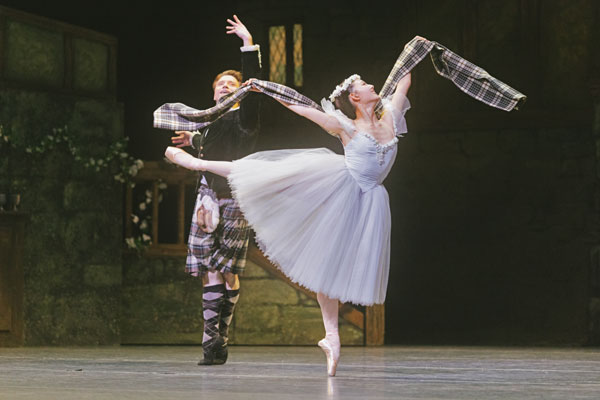
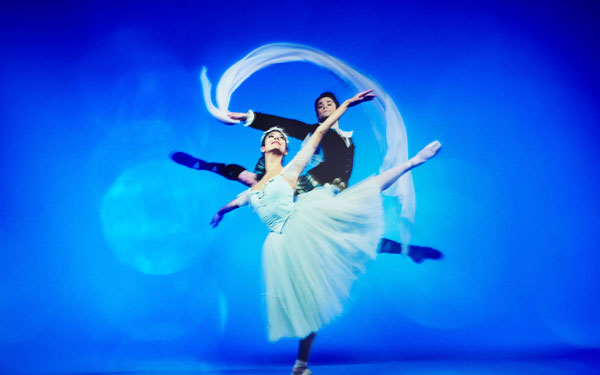
The high point of Wei Wang’s mastery comes when he toys with
the poisoned scarf (supplied by the witch from a steaming
cauldron). He makes the scarf dance in the air with the same
exhilarating precision of his feet, throws it in beautiful arcs and
catches it in his leaps, catches it in his leaps as if a second winged
creature were flying about. Now the sylph has to chase after him
and the alluing scarf. It’s a dramatic role reversal: he has the
control over her desire. He lures her close, makes her kneel
before him, and winds the scarf around her arms. Tied to him by
force, her wings fall off and she dies. The “moral of the tale” plays
out in the background where Effy is on her wedding march with
Gürn.
Joseph Walsh — photo: Erik Tomasson
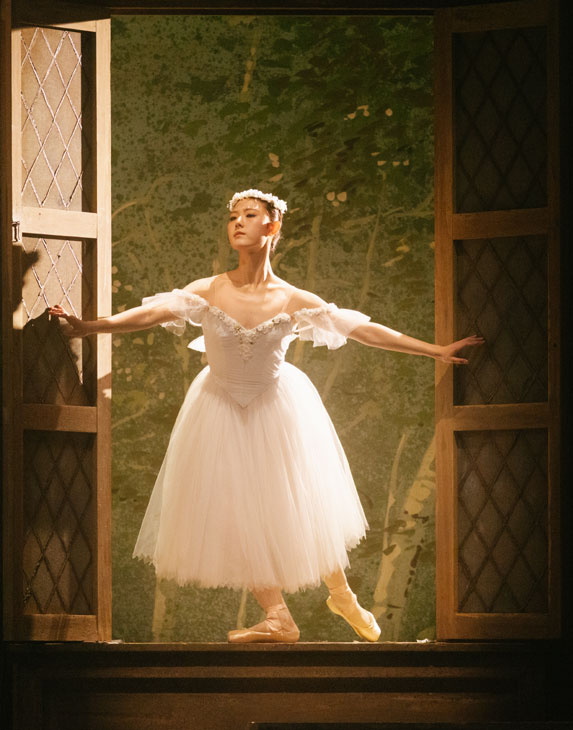
With matching artistic finesse, South-Korean Principal Wona Park
embodies the airy promise of a dream world. A former graduate
from San Francisco Ballet Schoo, she impressed with her fluid
arms, startling balances on pointe, high, soft leaps, and sensitive,
musical phrasing. I found her enchanting and kept wondering
about her artistic guidance by Tamara Rojo who has danced the
role herself and is a superior role model for her company. The
truly great Sylphides add an air of romantic longing and tragedy
to the role. Wona Park, already graceful and light as a feather, can
go even further when she allows herself to abandon her smiles
and express emotion with her face. Like Rojo did, or Yuan Yuan
Tan in 2004, or the great Carla Fracci, to name some of the best.
No matter, it was a memorable achievement for both protagonists
and the whole company. The SF Ballet Orchestra under Martin
West played with particular freshness and verve to bring the old
tale into the present moment.
Coda: a photo of the invisible hero of this review:
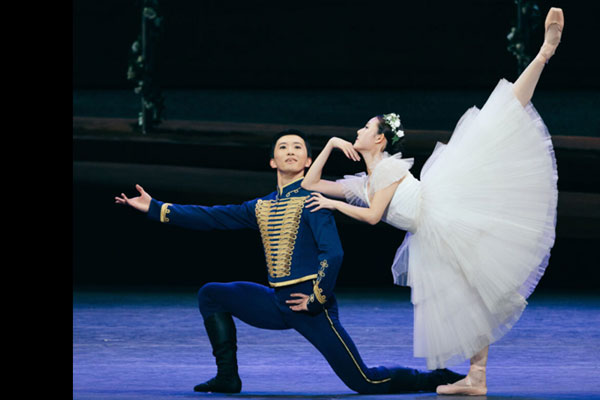
Wei Wang — photo: Erik Tomasson
All other photos: Lindsay Rallo
|