|
The
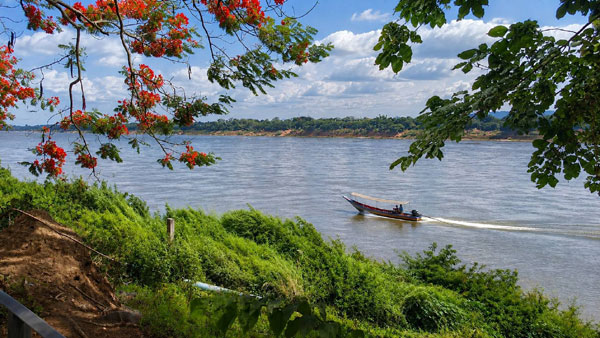
Mekong River, flowing
along the border
between Thailand, Loas
and Cambodia in
photographs taken in
early May 2026, still
moves gently, serving
as a natural water
boundary between the
countries.
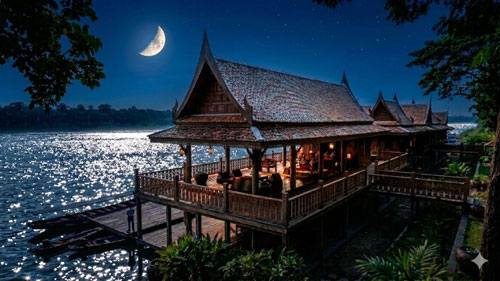
The hundred-year-old
house on the Thai side,
which belonged to my
great-grandparents, no
longer
remains—not even
a trace of it survives
this year. Yet visits
to the place continue
from time to time, and
it has become something
of a family legend.
Twenty years ago, some
of the grandchildren
dreamed of restoring
and developing it, but
those plans remained
only stories passed
down through
conversation.
Now, when another
generation visits, it
is no longer the
grandchildren but the
great-grandchildren.
The only thing left to
bring back are a few
photographs. In the
end, everything returns
to its ordinary state.
The administration of
Battambang, Siem Reap,
and Sisophon once
involved Thai officials
being appointed to
govern Khmer
territories. At that
time, there was not yet
a country on the world
map called Cambodia.
The lands across the
river were still
considered part of
Siam. Even the name
Siem Reap was
associated with
“Siam
Raja.” The
administration of local
territories during the
reign of King
Chulalongkorn (Rama V)
was highly
sophisticated.
I wish to record these
memories as a
descendant of a
governor from Siam who
was sent to govern Siem
Reap. Due to Western
colonial expansion, our
family relocated to
live along the Mekong
River while waiting for
the opportunity to
return.
But nothing could ever truly return to the way it had been.
Being a city governor
in those days was
perhaps comparable to
being a provincial
governor today, though
the title may seem less
significant now.
Many knowledgeable
people have already
written about Siamese
administration in
colonial territories,
and such materials can
be found easily. My
account, however, is
not based on formal
history or politics
from any particular
era. It is based solely
on family stories that
I have never seen
formally documented. I
am a granddaughter who
grew up in Chiang Mai.
I studied there and
lived with my
grandparents, who had
fled Bangkok Noi in
Thonburi during the
Second World War.
My grandfather studied
and worked in Bangkok
before marrying the
daughter of the owner
of Sri Ubon Cinema in
Ubon Ratchathani
Province. My
grandmother was of
Thai-Chinese heritage
and could speak the
Teochew Chinese
dialect. The family
lived in Bangkok and
had eight
children—four
sons and four
daughters. Before the
outbreak of war, they
moved to Chiang Mai,
where my grandfather
became a teacher at Mae
Jo Agricultural
College.
Many of my
grandfather’s
children graduated from
universities in
Bangkok, including
Chulalongkorn
University, Kasetsart
University, and nursing
colleges. Most later
continued their studies
and careers in the
United States. Three
granddaughters came to
live in the Chiang Mai
family home to attend
school, including
myself. At that time,
my grandfather had
retired from government
service and became
principal of Thammaraj
Suksa School, located
within Wat Phra Singh,
a school for monks and
novices. My grandfather
was the only son of Mr.
Mek Wongphuthorn, a
government official
from central Siam who
had once governed Siem
Reap and later fled
back to Siam because of
French colonial
expansion.
I lived in the same
house as my grandfather
in Chiang Mai for
nearly twenty years.
It can therefore be
said that I learned the
stories of our family
directly from those who
inherited the
bloodline. The person
who tried hardest to
explain and preserve
the memories of the
past was my mother.
Fifty years ago, we
still had the remains
of what was called the
“hundred-year-old
house.” We also
had painted portraits
of my great-grandfather
and great-grandmother
displayed in the family
shrine room in Chiang
Mai.
Some of my
grandfather’s
children, who became
architects, later
returned to visit the
homeland and dreamed of
restoring the old
riverside house in
Khemarat. The house had
been built parallel to
the Mekong River. Only
later did I realize
that the opposite bank
was Laos.
My
great-grandfather’s
name was Thai, and our
family surname was a
royal surname granted
by the Thai monarchy.
This confirmed that we
were not Khmer.
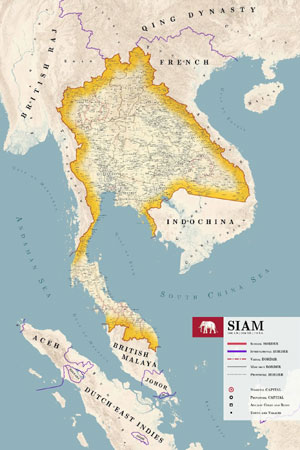
At that time there was not yet a Cambodian nation on the map as
it exists today. There were only territories marked under Siam,
and later maps displayed symbols such as white elephants
associated with Siam.
Toward the end of the reign of King Chulalongkorn (Rama V), the
governor of Siem Reap returned to Siam aboard a warship. He
was deeply dissatisfied with France, whose colonial expansion
had seized territories and relocated populations, including lands
east of the Mekong such as Siem Reap, Battambang, and
Sisophon. Following the turmoil of the era and the suffering
experienced by Siam, while King Chulalongkorn was ill, observing
events became more important than returning to the capital. My
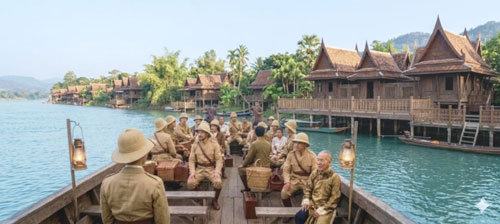
great-grandfather returned to Siam with his retainers. They
settled along the Mekong at a place called Phuthorn (He had
changed the name to Khemarat ) and built a residence there while
waiting for the opportunity to return.
But I was born long after these events.
Many foreigners have since taken pleasure in debating and
criticizing the Kingdom of Siam, which at one time appeared to be
among the largest and most influential states in Asia.
My account may be challenged by scholars, historians,
mapmakers, and even by Khmer interpretations of history. After
recovering territory from France, some Cambodian nationalist
narratives extended maps across the Mekong into parts of
northeastern Thailand. This created controversy because areas
containing ancient temples were often claimed as belonging to a
Khmer empire. The term “Khmer” itself was frequently used
broadly to describe people rather than political boundaries.
Countries that lack a complete understanding of their own history
can construct narratives in many different ways.
As late as 1977, Cambodians were still killing one another during
the era of the Khmer Rouge. It is unfortunate that much of the
modernization that existed before then was lost after French
colonial rule. At that time, the forced relocation of people from
Siem Reap under French orders was viewed by Siam as an
emergency situation and was strongly opposed. Numerous
directives came from the royal court.
Siam lost tribute, authority, and territory to France, which was
one of the most aggressive colonial powers in Indochina. France
demanded concessions from Siam and obtained them with little
room for negotiation. Warfare in that era already involved
firearms and steam-powered warships. Meanwhile, the First
World War was beginning in Europe and spreading among many
nations.
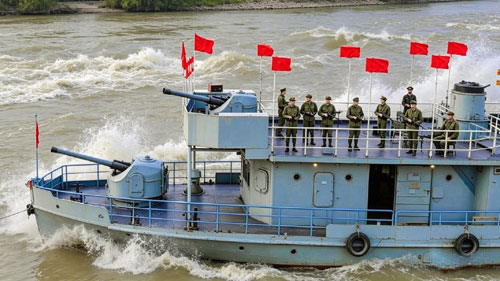
After settling in Khemarat, Mr. Mek Wongphuthorn and his
followers refused to move elsewhere. Together they built
traditional Thai houses along the Mekong River. The house faced
the river, enduring waves, wind, and storms. No one surrendered
to hardship. Mr. Mek sent his only son to Bangkok to study and to
ensure his safety.
I have noticed writings by another author set along the Mekong
featuring a young man named Mek as the central character.
Perhaps one day I will have the opportunity to speak with that
author. The story I tell here is the true story of my family.
My great-grandfather, Mr. Mek Wongphuthorn, was a Thai
official who served as governor of Siem Reap before returning to
Siam. I do not know the precise rank or title he held, so I simply
refer to him as “Mr. Mek.”
The stories written by others about a character named Mek may
be coincidental, but I have not yet had the opportunity to
compare them.
The Mekong River has always possessed a special charm. Many
doctoral dissertations have been written about it by scholars from
various countries, including Thailand. Some foreigners and even
some Thais have criticized Siam as an imperial power.
Nevertheless, I regret that the true stories of Siamese families
who served their country have often gone unrecorded. When my
great-grandfather returned and built the riverside house later
known as the “hundred-year-old house,” he became the governor
of Khemarat on the Thai side of the river.
The area was once associated with the name “Phuthorn,” and he
governed there as city governor. The surname Wongphuthorn
was later granted as a royal surname during the reign of King
Vajiravudh (Rama VI). The descendants who remain today tell
only a few stories: that Mr. Mek Wongphuthorn served as
governor of Khemarat and that he often spoke about events in
Thailand. I am a granddaughter who lived in Chiang Mai with his
only son, my grandfather, Chuea Wongphuthorn.
My grandfather studied French and even shared his French
textbooks with me when I was young. He often said that his father
wished to return to Siem Reap. He wondered whether France had
misunderstood something when it transferred Thai-administered
territories to Cambodia, despite Siam having governed them for
generations. He also observed that many of the newer inhabitants
who later returned to the area were not necessarily ethnic Khmer
but included people of Vietnamese origin.
These are the memories and stories passed down through my
family—stories carried by the waters of the Mekong River,
remembered long after the old house.
|